
Conifers
Prickly juniper, or red
Juniperus oxycedrus
Synonyms: Red juniper, Reddish juniper, Red-fruited juniper, Rusty juniper, Juniperus oxycedrus ssp. rufescens Debat, Louis, Juniperus rufescens Link
Prickly juniper (Juniperus occidentalis Hook.) – a species of plants from the genus Juniper (Juniperus) of the family Cupressaceae. It was first described in 1753 by Carl Linnaeus in his "Species Plantarum 2:1038". The name comes from the Latin "oxycedrus", which means "sharp cedar".
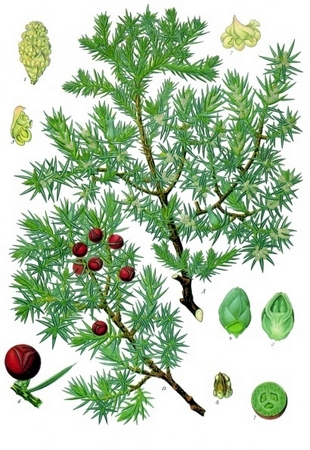
Illustration from the book "Köhler’s Medizinal-Pflanzen", 1887
In nature it grows in the Mediterranean region from Morocco to Portugal, from northern to southern France eastwards to western Iran, and southwards to Lebanon and Israel. In Ukraine it grows in Crimea. It is found on rocks and slopes, in dry open woods, in garrigues and maquis. It rises in mountains up to 1600 (2200) m above sea level. It occurs alongside Pinus, Carpinus betulus, Quercus, Quercus-Lentiscus, Cedrus libani, Pinus nigra, Juniperus foetidissima, Juniperus excelsa.
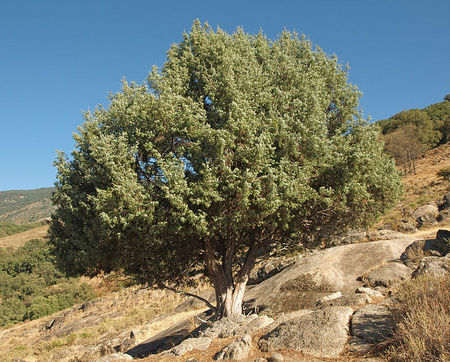
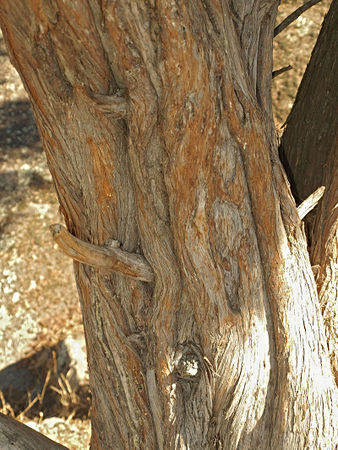
It is an evergreen shrub or tree 5-10 m high and up to 1 m in diameter. It grows slowly. Crown is ovate-conical, later may become umbrella-shaped. Bark smooth, light gray; on young shoots reddish or yellow-brown, later becoming green. Branches directed upwards or spreading, straight, bluntly three-angled.
Leaves needle-like, arranged in whorls of 3, appressed, sharp, spreading, rather dense, linear with a long acute tip. They reach 15-20 mm in length and 1.3-2 mm in width, with two longitudinally arranged strips, glossy green beneath. The keel is longitudinal, prominent, without a gland.
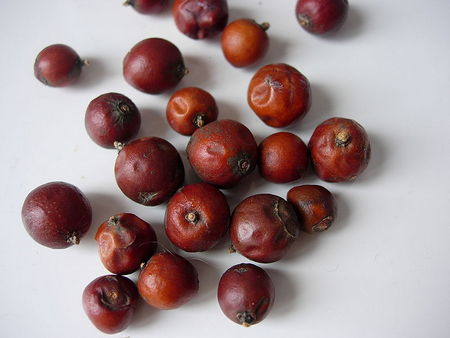
The plant is dioecious. Male cones are yellow, 2-3 mm long; after releasing pollen they fall off in late winter or early spring. Female cones are berry-like, mature over 18 months, green. Fruits are almost sessile, borne singly, 6-7 (11-12) mm in diameter, nearly globose, glossy, reddish-brown, with 2-3 (rarely 1-4) seeds inside. Seeds are broadly ovate, slightly three-sided.
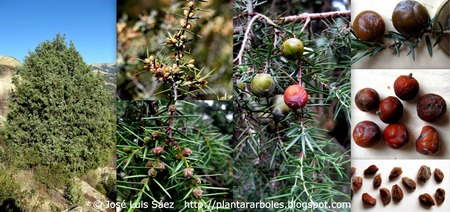
Varieties: some botanists split this species into 3 subspecies -
- Juniperus oxycedrus L. (western prickly juniper)
- Juniperus navicularis Gand. (J. oxycedrus subsp. transtagana or Portuguese prickly juniper)
- Juniperus deltoides R.P.Adams (eastern prickly juniper)
Additionally distinguished are the subspecies Juniperus oxycedrus var. badia H.Gay (syn. J. oxycedrus subsp. badia (H.Gay) Debeaux) and Juniperus oxycedrus subsp. Macrocarpa.
Hardiness: 3-9 (-34°C)

Site: drought-tolerant, heat-loving, practically undemanding regarding soil, tolerant of smoke and air pollution.
Planting: recommended spacing between plants 0.5 or 1.2-2 m. Planting depth – 70 cm. Drainage if necessary: crushed brick or sand, layer 15-20 cm. Soil mix: topsoil, peat and sand in ratio 1:2:1. Transplanting is poorly tolerated even with a clod of earth.
Care: in spring (April-May) apply nitroammofoska 30-40 g/m2. In dry summers it is recommended to water the plant 2-3 times per season and perform evening spraying once a week. Mulch with peat or sawdust in a layer of 5-8 cm.
Pruning: needs only sanitary pruning.
Diseases: rust (Arcerid (50 g per 10 l of water) spray 4 times at 10-day intervals), shutte, biatorellal and nectriaceous canker, alternariosis, root cancer (Oligotrophus betheli).
Pests: aphids (Fitoverm (2 g per 1 l of water) spray 2 times at 10-14 day intervals), leaf-mining moth (Decis (2.5 g per 10 l) spray 2 times at 10-14 day intervals), spider mite (Karate (50 g per 10 l)), scale insects (carbophos (70 g per 10 l of water)), galls, sawfly, shoot moth, pine looper.
Propagation: propagated by seeds.
Uses: highly ornamental in solitary and group plantings. Wood heavy, durable, reddish in color with pale sapwood, resistant to rot. Used in construction and in various crafts. Can be grown in bonsai style.