
Conifers
Common juniper, or Veres
Juniperus communis
Synonyms: Верес, Тетеревиный куст, Juniperus albanica Pénzes, Juniperus argaea Balansa ex Parl., Juniperus borealis Salisb., Juniperus caucasica Fisch. ex Gordon, Juniperus communis var. arborescens Gaudin, Juniperus communis var. brevifolia Sanio, Juniperus communis subsp. brevifolia (Sanio) Pénzes, Juniperus communis f. crispa Browicz & Ziel., Juniperus communis subsp. cupressiformis Vict. & Sennen ex Pénzes, Juniperus communis var. erecta Pursh, Juniperus communis var. fastigiata Parl., Juniperus communis var. hemisphaerica (J.Presl & C.Presl) Parl., Juniperus communis subsp. hemisphaerica (J.Presl & C.Presl) Nyman, Juniperus communis var. hispanica Endl., Juniperus communis var. montana Neilr., Juniperus communis var. oblonga Loudon, Juniperus communis var. oblonga-pendula Loudon, Juniperus communis f. oblonga-pendula (Loudon) Beissn., Juniperus communis subsp. pannonica Pénzes, Juniperus communis var. pendula Carrière, Juniperus communis var. pendula-aurea Sénécl., Juniperus communis f. pendulina Kuphaldt, Juniperus communis f. pungens Velen., Juniperus communis var. stricta Endl., Juniperus communis var. suecica (Mill.) Aiton, Juniperus compressa Carrière, Juniperus cracovia K.Koch, Juniperus dealbata Loudon, Juniperus depressa Stevels, Juniperus difformis Gilib., Juniperus echinoformis Rinz ex Bolse, Juniperus elliptica K.Koch, Juniperus fastigiata Knight, Juniperus hemisphaerica C.Presl, Juniperus hibernica Lodd. ex Loudon, Juniperus hispanica Booth ex Endl., Juniperus interrupta H.L.Wendl. ex Endl., Juniperus kanitzii Csató, Juniperus microphylla Antoine, Juniperus niemannii E.L.Wolf, Juniperus oblongopendula Loudon ex Beissn., Juniperus occidentalis Carrière, Juniperus oxycedrus subsp. hemisphaerica (J.Presl & C.Presl) E.Schmid, Juniperus reflexa Gordon, Juniperus saxatilis Lindl. & Gordon, Juniperus suecica Mill., Juniperus taurica Lindl. & Gordon, Juniperus uralensis Beissn., Juniperus vulgaris Bubani, Juniperus withmanniana Carrière, Sabina dealbata (Loudon) Antoine, Thuiaecarpus juniperinus Trautv.
Common juniper (Juniperus communis L.) – the type species of the genus Juniper (Juniperus) of the family Cupressaceae. It was first described in 1753 by Carl Linnaeus in his «Species Plantarum», Tomus II. Long-lived, it can live up to 2000 years.
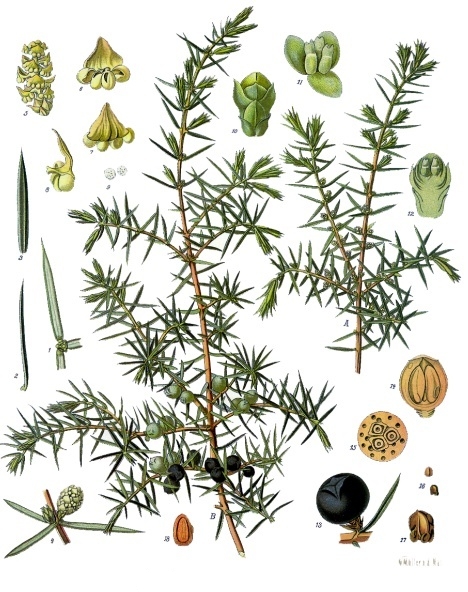
Franz Eugen Köhler, Köhler's Medizinal-Pflanzen
In nature it grows in temperate climates of the Northern Hemisphere – Europe, Asia, and North America. It is also found in North Africa and in parts of Asia with tropical climates (Nepal and Pakistan). It grows on limestone, heaths, dry hills and mountain slopes, in pine undergrowth, and in deciduous and mixed forests. It forms thickets on sites of felled trees and is less often found in mossy bogs. It can grow on various soils but is more often found on sandy or excessively moist, slightly waterlogged soils.
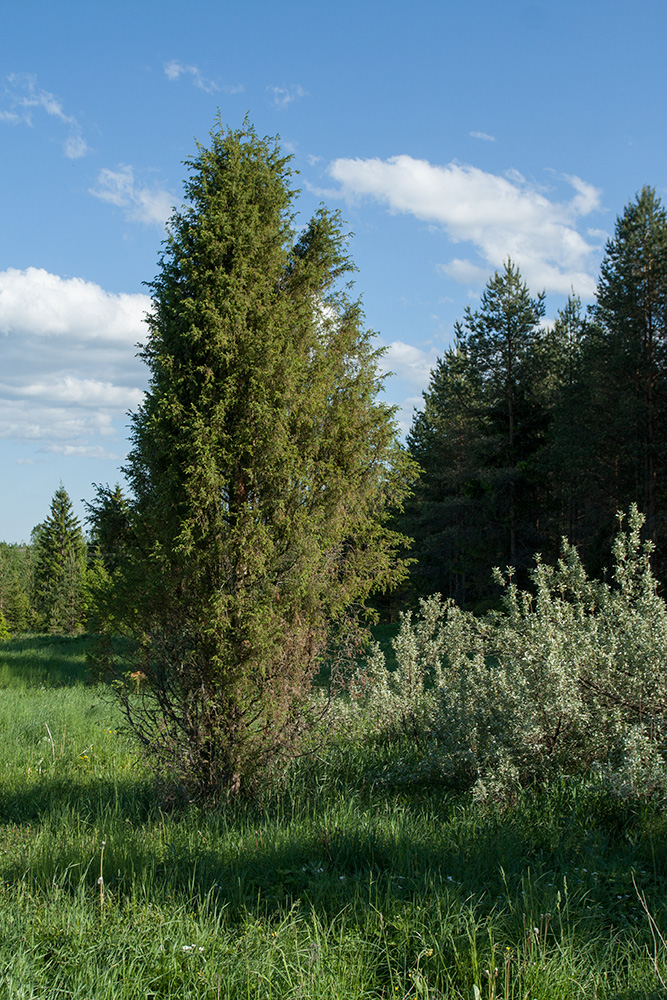
Photo by D. Oreshkin
It is an evergreen coniferous shrub 1-3 m high, less often a tree 8-13 m high. It grows slowly. The crown is conical or ovoid; male plants have a narrower crown, female plants are spreading or ascending, less often with pendulous branch tips. The bark is dark gray or grayish-brown, peeling longitudinally. Shoots are reddish-brown. Buds are small, without scales, covered by scale-like leaves.
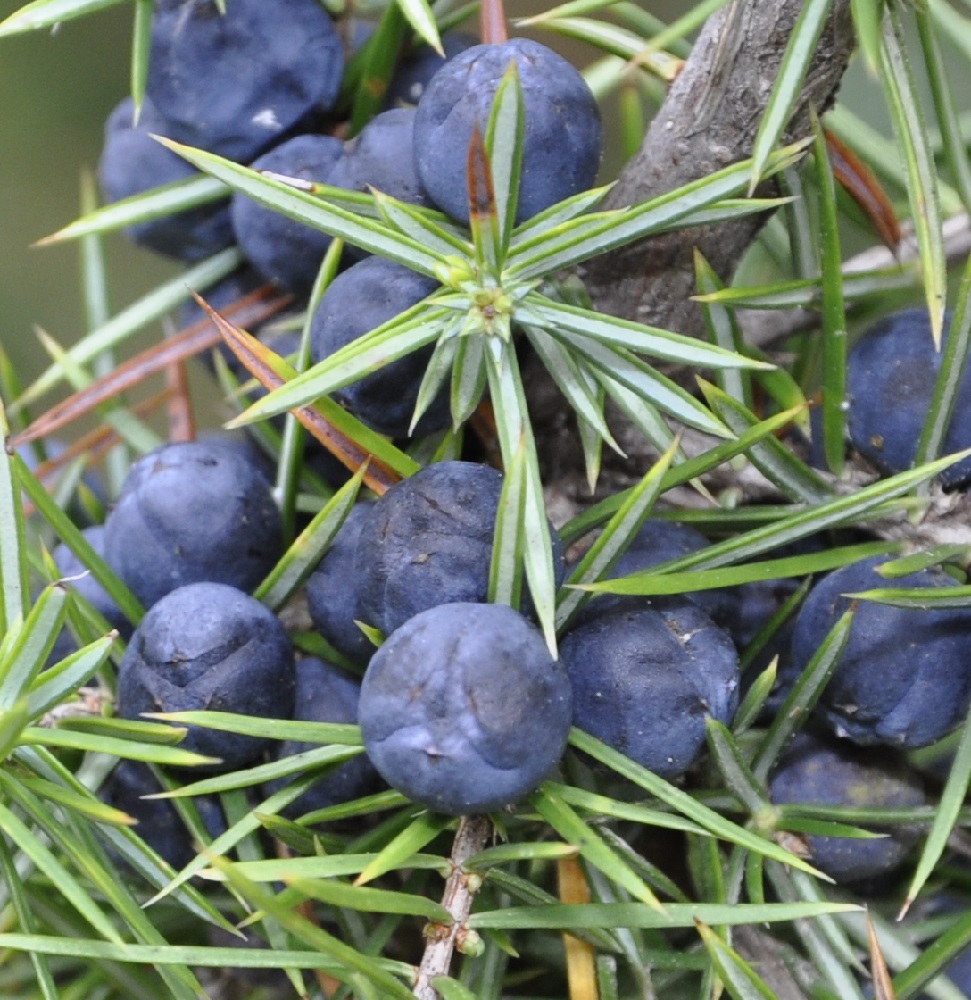
Photo by R. Tsandekidis
The root system is shallow, but due to the plant's small size it is not prone to windthrow.
Leaves are prickly, awl-shaped or awl-pointed, arranged in whorls of three, 1-1.5 cm long and 0.7-7.5 mm wide, rigid, sessile, almost triangular in cross-section, dense, with a shallow groove on the upper side and with a single undivided, less often divided to the middle, whitish stomatal band. On the underside the leaves are glossy green, with a blunt keel. Leaves grow in rings, three in each ring.
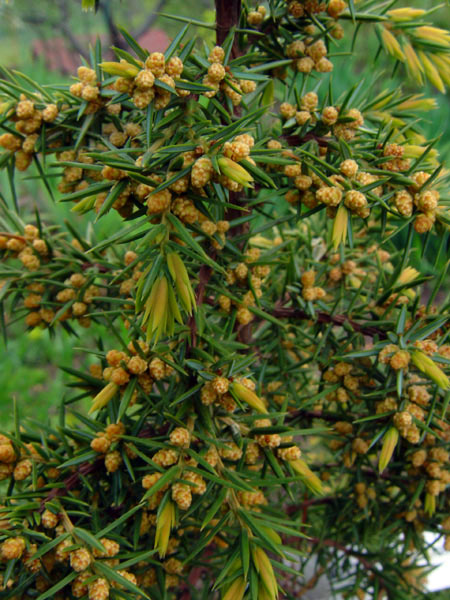
The plant is dioecious, less often monoecious. Microstrobili (male cones) are almost sessile, yellowish, 2-3 mm long, release pollen in March–April and then immediately fall. Macrostrobili (female cones) are numerous berry-like cones, 5-9 mm in diameter, oblong-ovoid or globose, pale green, turning black-blue at maturity with or without a bluish bloom. Fruits mature in the 2nd or 3rd year in autumn, consist of 3 or 6 scales, sessile or on short stalks. There are 3 (rarely 2) seeds per cone; they are elongate-ovoid or ovoid-conical, yellow-brown. Begins to bear fruit at 5-10 years.
Subspecies:
Juniperus communis subsp. Communis
- Juniperus communis subsp. communis var. communis
- Juniperus communis subsp. communis var. depressa Pursh
- Juniperus communis subsp. communis var. Hemisphaerica
- Juniperus communis subsp. communis var. nipponica
Juniperus communis subsp. alpina (Suter) Čelak.
- Juniperus communis subsp. alpina var. alpina
- Juniperus communis subsp. alpina var. megistocarpa Fernald & H.St.John
- Juniperus communis subsp. alpina var. jackii Rehder
Juniperus communis subsp. hemisphaerica (J. et. С. Presl) Nym. (hemispherical)
Juniperus communis var. Montana
Cultivars: Hibernica, Hornibrookii, Repanda, Green Carpet.
Hardiness: 5-9 (-15°C)

Site: drought-tolerant, heat-loving, practically undemanding to soil, but prefers light, calcareous soils; resistant to smoke and gas pollution.
Planting: recommended spacing between plants 0.5 or 1.2-2 m. Planting depth – 70 cm. Drainage if necessary: crushed brick or sand, layer 15-20 cm. Soil mix: topsoil, peat and sand in ratio 1:2:1. Transplanting is poorly tolerated, even with a root ball.
Care: in spring (April–May) apply nitroammophoska 30-40 g/m2. In dry summers it is recommended to water the plant 2-3 times per season and to perform evening spraying once a week. Mulch with peat or sawdust to a layer of 5-8 cm.
Pruning: requires only sanitary pruning.
Diseases: rust (Arcerid (50 g per 10 L of water) — spray 4 times at 10-day intervals), Schütte, Biatorrhella and Nectria canker, alternariosis, root/crown cancer (Oligotrophus betheli).
Pests: aphids (Fitoverm (2 g per 1 L of water) — spray 2 times at 10-14 day intervals), leaf-miner moth (Decis (2.5 g per 10 L) — spray 2 times at 10-14 day intervals), spider mite (Karate (50 g per 10 L)), scale insects (Carbophos (70 g per 10 L of water)), galls, sawfly, shoot moth, pine looper.
Propagation: in nature reproduces by seeds dispersed by thrushes, ants and lemmings. Seedlings have 2 cotyledons.
Uses: ornamental, used as a garden and park plant and as a soil-protective plant. Wood is light, reddish, with a pleasant scent. Used for turnery, for making walking sticks and toys. Juniper oil is produced from the wood. The berry-cones are used for juniper vodka, beer and gin. The fruits are also widely used in cooking and medicine.