
Conifers
Juniper
Juniperus
Synonyms: Arceuthos Antoine & Kotschy (1854), Cedrus Duhamel (1755), Sabina Mill. (1754), archa, yalivec.
Juniper (Juniperus L.) – a genus of plants in the cypress family (Cupressaceae). It was first described by Carl Linnaeus in 1753 in his «Species Plantarum». The Russian name derives from the Old Slavic word «moždževelь», which comes from the Proto-Indo-European «mezg» - to weave or bind. The Ukrainian name «ялівець» originated from «(j)alovьсь», which by one version is related to the word «barren» («яловый») meaning «infertile» or from the Ancient Greek ἐλάτη «fir» and Armenian ełevin «cedar». The Latin name may derive either from » joini-parus« (giving branches suitable for weaving) or from the Celtic «Jeneprus»— thorny. The Latin name was first applied to these plants by Virgil, which allowed Linnaeus to use it for the genus. Lives long, up to 600 years.
Members of the genus grow in the Northern Hemisphere – from the Arctic to subtropical mountainous regions; they are also found in Africa (East African juniper). Most species occur in small ranges located in mountainous countries or systems. Tree-form junipers form open forests in the Mediterranean, central Near East, in southern parts of North America and in the arid regions of Mexico. Other junipers form the third tier and understory of coniferous or light deciduous forests. Dwarf species grow on rocks, stony slopes, at the upper timberline.
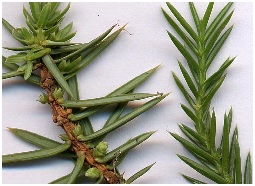
Common juniper
Members of the genus are evergreen coniferous shrubs or trees 10-12, rarely 20-30 m tall. Shrubs are often prostrate. Buds are without scales, naked, less often surrounded by shortened and appressed leaves, more rarely with numerous dense scales (in stone juniper).
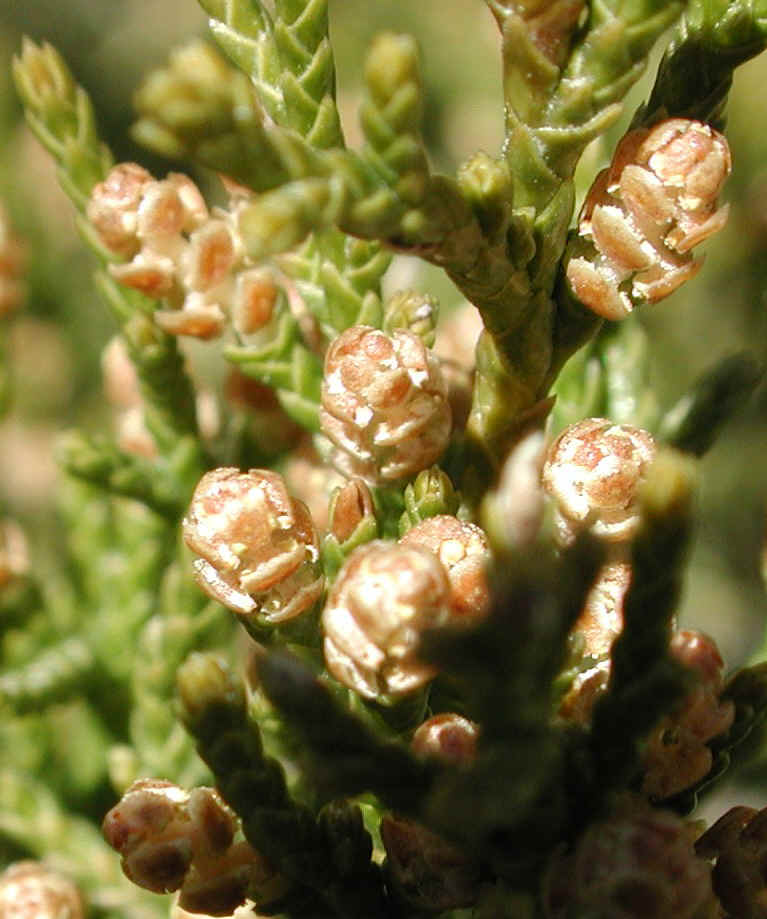
Female flowers of Virginia juniper
Leaves opposite in pairs, less often in whorls of three, needle-like, spreading, linear-lanceolate in shape, base attenuate, with a stomatal band above, undivided or with a longitudinal midvein. In young plants leaves are often needle-like; in adults they are small, scale-like, appressed to the shoots, opposite in pairs, less often in three-membered whorls.
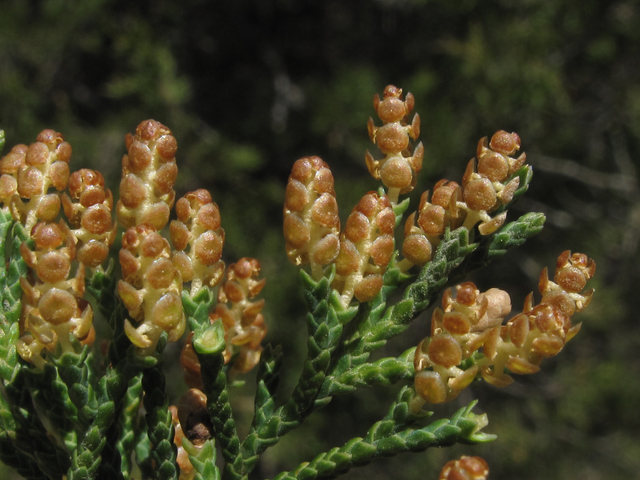
Male flowers of Virginia juniper (Alan Cressler 2011)
The plant is dioecious. Male spikes grow singly or in several, located in the leaf axils on last year’s shoots or at the ends of lateral shoots; they consist of scaly stamens arranged in whorls or opposite in pairs of three, on which 3-6 anthers open longitudinally. Female spikes grow on axillary short shoots or terminally:
- may consist of one whorl of scaly carpels, with 3 ovules arranged opposite or alternating with them.
- consist of 1-3 pairs or 4-membered whorls of carpels, each with 1-2 ovules.
- some species have a single terminal ovule surrounded by scaly sterile carpels.
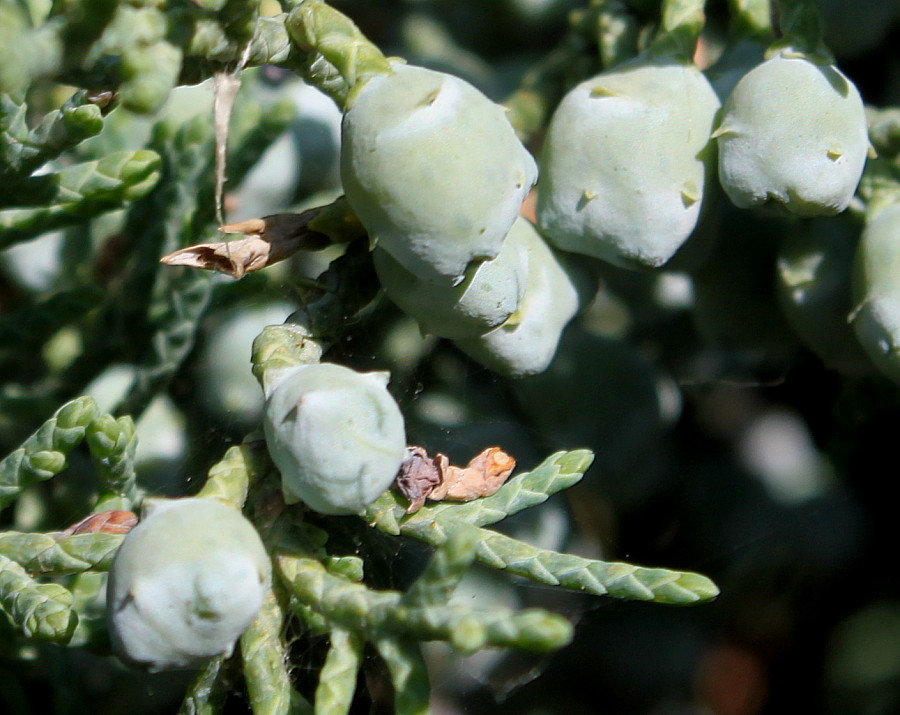
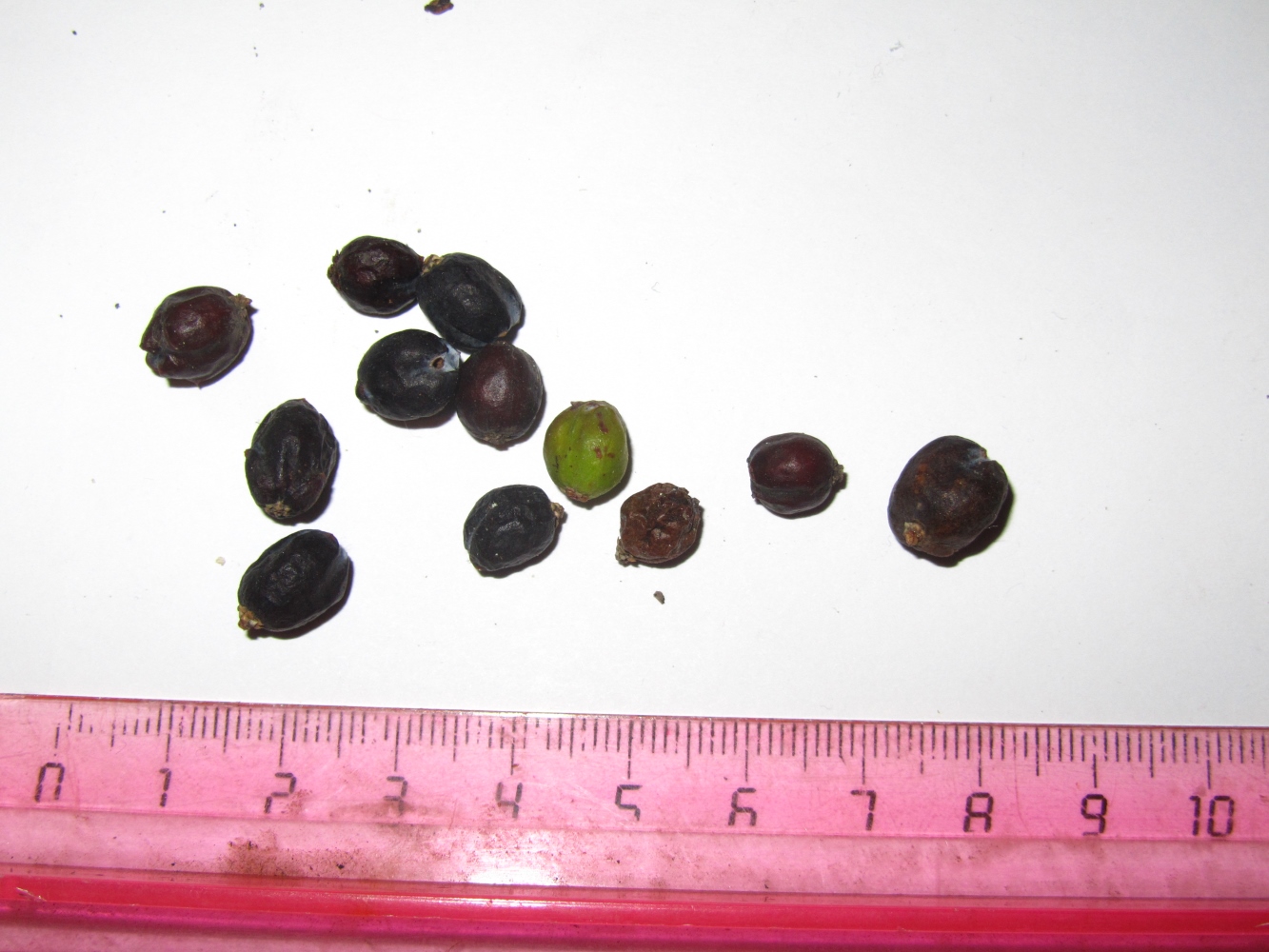
The cone-berries do not open; the scales are tightly closed, fleshy, globose or slightly elongated, with separate, less often fused 1-10 seeds. They ripen in the second year.
Rocky juniper
Species: the genus includes 71 species, 9 of which grow in Ukraine (common juniper, J. sibirica, J. virginiana)
- Cossack juniper - Juniperus sabina
- Tall juniper - Juniperus excelsa
- Chinese juniper - Juniperus chinensis
- Daurian juniper - Juniperus davurica
- Prostrate, or drooping juniper - Juniperus procumbens
- Virginia juniper - Juniperus virginiana
- Common juniper, or heather - Juniperus communis
- Horizontal, or spreading juniper - Juniperus horizontalis
- Western juniper - Juniperus occidentalis
- Prickly, or red juniper - Juniperus oxycedrus
- Coastal, or clustered juniper - Juniperus conferta
- Siberian juniper - Juniperus sibirica
- Rock juniper - Juniperus scopulorum
- Scale-leaved juniper - Juniperus squamata
- Rigid, or stiff juniper - Juniperus rigida
Hardiness: 3-7 (-40°С)

Site: many are light-loving, most are drought-tolerant and undemanding to soil, although they prefer light and fertile soils. They suffer from smoke and soot.
Planting: recommended spacing between plants 0.5 or 1.2-2 m. Planting depth – 70 cm. Drainage if necessary: crushed brick or sand, layer 15-20 cm. Soil mix: turf soil, peat and sand in the ratio 1:2:1.
Care: In spring (April-May) apply nitroammophoska 30 - 40 g/m2. In dry summers it is recommended to water the plant 2-3 times per season and perform evening spraying once a week. Mulching with peat or sawdust in a layer of 5-8 cm. In winter columnar forms are recommended to be tied, as branches break under snow.
Pruning: clipping or pruning depends on the species. Basically only dead branches are removed.
Diseases: rust (Arcerid (50 g per 10 l of water) spray 4 times at 10-day intervals), shot blight, Biatoropsis and Nectria canker, alternariosis
Pests: aphids (Fitoverm (2 g per 1 l of water) spray 2 times at 10-14 day intervals), leaf-mining moth (Decis (2.5 g per 10 l) spray 2 times at 10-14 day intervals), spider mite (Karate (50 g per 10 l)), scale insect (carbophos (70 g per 10 l of water)), galls, sawfly, shoot moth, pine looper.
Propagation: propagated by seeds (seedlings appear after a year), cuttings (harvested in early autumn), layering (for prostrate species), grafting (for rare or valuable species).
Companions: heather, Erica, groundcover pines, roses, ornamental grasses, wild perennials.
Usage: tree-form junipers are used in park plantings, for creating small groups, as specimen plantings. Dwarf and prostrate forms are used for stabilizing and covering slopes and embankments, for rock and stone gardens. Some species are used to create hedges and protective plantings in forest parks.