
Deciduous trees
Holly
Ilex L.
Synonyms: ostrolist, Agrifolium Hill, Aquifolium Mill., Macoucoua Aubl., Pileostegia Turcz., Prinos L., holly, Ilicioides Dum. Cours., Nemopanthus Raf.
Holly (Ilex L.) – a genus of dioecious shrubs and trees in the holly family (Aquifoliaceae). The Latin name of the genus comes from «Quercus ilex», which means «holm oak» or «evergreen oak». The genus was first classified by Carl Linnaeus in 1753 in "Species Plantarum 1".
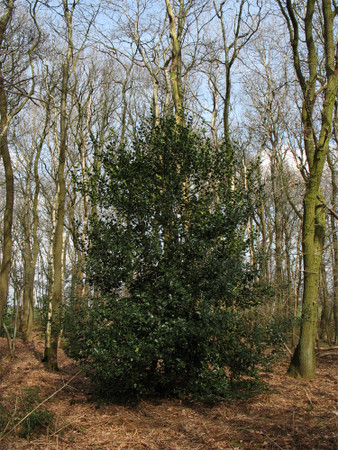
Ilex aquifolium L
Fossils show that holly was widespread even before the end of the Cretaceous period. It is assumed that the common ancestor of most modern holly species appeared in the Eocene, approximately 50 million years ago.
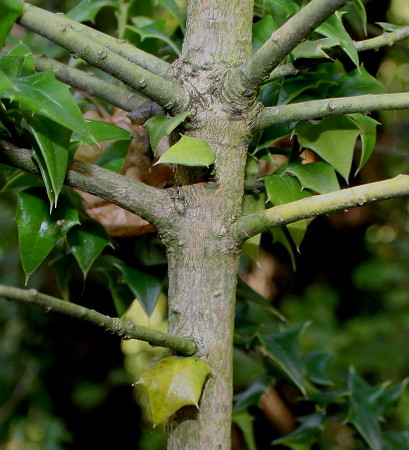
Ilex bioritsensis Hayata
Members of the genus are found almost worldwide. They grow in forests of tropical and temperate climates.
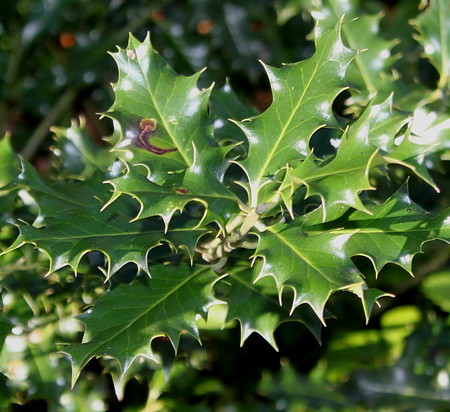
Ilex aquifolium L
These are evergreen, less often deciduous trees or shrubs, rarely lianas. Young shoots are pointed.
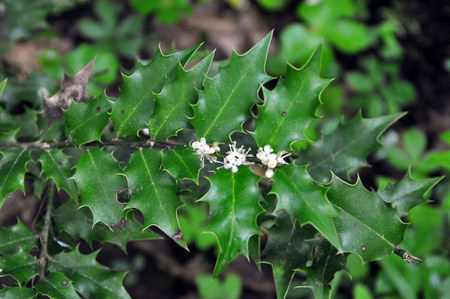
Ilex colchica Pojark.
Leaves simple, alternate, with entire or toothed spiny tips, thick, leathery, dark green or bicolored. In winter they may turn reddish or bronze. The spines on the leaves are very sharp, even on old fallen leaves.
Flowers are unisexual, small, inconspicuous, appear in leaf axils, 4-parted.
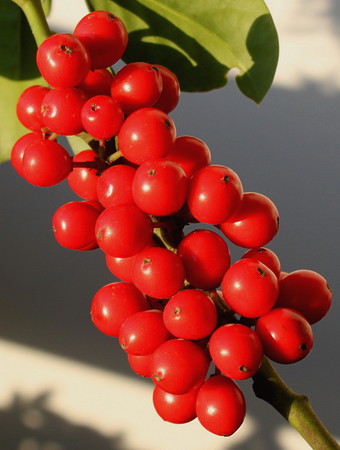
Ilex aquifolium L
Fruits – drupes bright red, orange, yellow, white, or black.
Species: consists of 400–600 species. The most commonly cultivated:
- Wrinkled holly — Ilex rugosa Fr. Schmidt
- English holly, or common holly — Ilex aquifolium L (type species).
- Colchic holly - Ilex colchica
- Japanese holly, crenate holly — Ilex crenata Tunb.
- Winterberry - Ilex verticillata
- Blue holly - Ilex meserveae
- Paraguayan holly - Ilex paraguariensis
- Ilex altaclerensis
- Ilex opaca
- Smooth holly - Ilex glabra
- Ilex verticillata
Hardiness zone: 3-9.

Location: can grow in shady or semi-shady places. Varieties with bicolored leaves should be planted in the sun. Tolerates urban conditions well. Sensitive to bright winter sun.
Soil: prefers light, rich, well-moistened and well-drained forest soil. Poorly tolerates drought.
Planting: it is recommended to plant young plants; mature plants tolerate transplantation poorly. In regions with mild winters planting is done in winter, elsewhere in early spring. For abundant fruiting consider cross-pollination, so it is recommended to plant 2 or 3 plants.
Pruning: formative pruning is carried out after the end of fruiting. English holly is used in bonsai. It also makes attractive topiary.
Care: young plants need protection from bright winter and early spring sun. In dry, hot summers they require watering.
Propagation: propagated by seeds and cuttings. The most common method (especially for ornamental forms) is semi-ripe cuttings. For this, current-year shoots with 1-2 internodes are cut in August to a length of 5-6 cm. Make a slanted lower cut under a bud and a slanted upper cut above a bud. Place in a 15-cm container with a mixture of sand and peat at a depth of 2 cm in a protected, not hot place, maintaining humidity by misting and watering. After root formation (2-3 weeks) transplant cuttings individually into pots. It can also be propagated by grafting onto English holly – from March until late spring, or by bud grafting in summer. In October propagate by layering – make a cut on a long branch and bury it.
Pests: leaf-mining fly
Diseases: Phytophthora
Companions: Mahonia, hydrangeas, euonymus.
Uses: valued for dark glossy leaves and fruits. Used in landscape design in group plantings, as understory, on edges, in formal garden-park compositions, and in shelterbelts of natural and wild gardens. Fruits are eaten by birds.