
Flowering shrubs
Chinese lilac
Сhinensis Willd.
Synonyms: Syringa chinensis Bunge Mém., Syringa × chinensis Willd., Марли, Lilac × media (Dum.Cours.) Dum.Cours., Lilac × persica var. dubia (Pers.) Jacques & Hérincq, Lilac × persica var. rothomagensis (Renault) Mirb., Lilac × rothomagensis (Renault) Poit. & Turpin, Lilac × varina Dum.Cours., Liliacum × rothomagense Renault, Syringa × correlata A.Braun, Syringa × dubia Pers., Syringa × dubia f. alba Dippel, Syringa × media Dum.Cours., Syringa × metensis Dippel, Syringa persica var. ovata Stokes, Syringa × rothomagensis (Renault) A.Rich., Syringa × rothomagensis var. alba G.Kirchn., Syringa × rothomagensis var. bicolor Lemoine, Syringa × rothomagensis var. saugeana Loudon, Syringa × rubra Lodd. ex Dippel, Syringa × saugeana (Loudon) Leroy, Syringa × sibirica Loudon, Syringa × speciosa DC.(not used), Syringa × vulgaris var. dubia (Pers.) Franch.
Chinese lilac (Syringa chinensis Willd.) – a species of deciduous shrubs in the olive family (Oleaceae). A hybrid discovered in the Rouen botanical garden (France) in 1777, it originated from the crossing of Syringa persica and Syringa vulgaris (S. persica x S. Vulgaris). It was first described by the German botanist Carl Ludwig Willdenow in 1796 in his "Berlinische Baumzucht". In cultivation since the early 19th century.
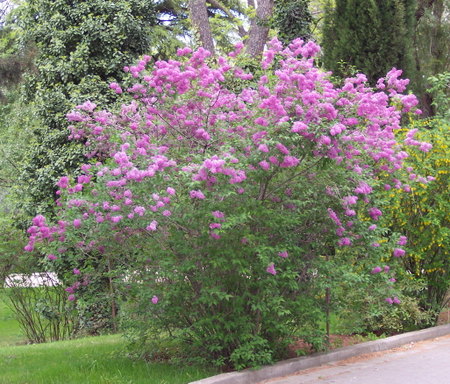
It is an upright shrub 3-6 m in height with a broadly ovate or pyramidal crown. Bark gray, peeling. Branches thin, erect, curved archwise at the top. Shoots light green, later becoming reddish-brown, glabrous, covered with numerous, prominent light-colored lenticels.
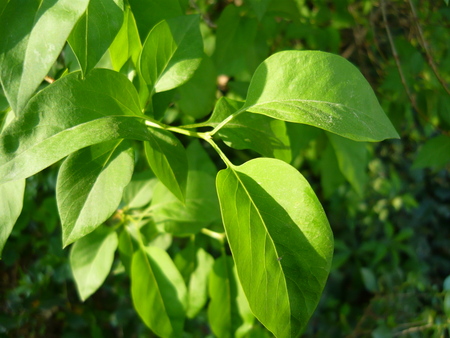
Leaves 4-8 cm long and 2-4 cm wide, ovate or ovate-lanceolate in shape, cuneately tapered at the apex, with an acuminate tip and a rounded or broadly cuneate base, glabrous, semi-leathery, bright green, slightly paler beneath. Petioles thin, up to 1.2 cm long.
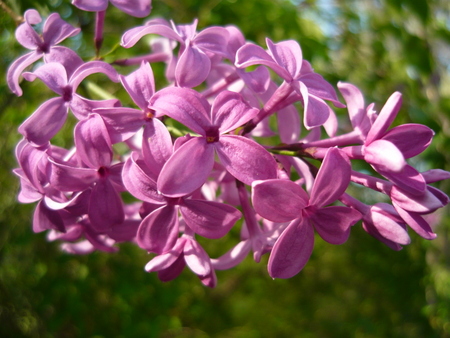
Flowers large, up to 1.8 cm in diameter, gathered in loose, slightly drooping panicles up to 17 cm long and 9-10 cm wide, of a regularly rounded-pyramidal shape. They form from (1) 3-10 pairs of axillary lateral buds on last year's shoots, creating compound panicles that in good conditions can reach 30-40 (80) cm in length. Flowers are lilac, reddish or lilac-reddish in color, with a strong pleasant fragrance. Corolla 0.8-1.2 cm long, tube narrowly funnel-shaped, lobes of the limb elongate-ovate. Blooms very abundantly from May to June for about 2-3 weeks, almost simultaneously with common lilac. The species is practically sterile.
Forms:
- Syringa x chinensis f. duplex. – double purple flowers.
- Syringa x chinensis f. metensis. – pale purple flowers.
- Syringa x chinensis f. Saugeana. – light violet flowers.
- Syringa × chinensis f. alba Dieck – white flowers
- Syringa × chinensis f. bicolor (Lemoine) H.Jaeger – bicolored flowers
Hardiness zone: 4a (-34°C).

Location: prefers sites sheltered from strong winds with good light, but can also grow in shade (does not flower). Does not like low, waterlogged or temporarily flooded in spring (autumn) sites. Prefers moderately moist, fertile, well-structured, humus-rich soil with an impermeable soil horizon. Likes loamy soil and chernozems, with organic or mineral fertilizers. Recommended pH 6-7; on acidic soils liming is essential. Distinctly drought-tolerant.
Planting: recommended to be carried out at the end of August and up to the beginning of September. Shrubs transplanted with developing buds take very poorly and practically do not produce growth in the first year after planting. Can also be planted in mid-July. The root collar after planting should be 3-4 cm above the soil. When planting into leaf-mold soil add 15-20 kg of well-rotted manure or compost and 200-300 g of wood ash.
Care: apply mineral fertilizers or an ash solution twice per season – over the snow and after flowering. Once a year also apply to each shrub one bucket of cow manure or poultry droppings, which should be covered with soil in a ring trench 20-30 cm deep at a distance of 50-60 cm from the trunk. The root circle is loosened 3-4 times a year and in winter is covered with peat or leaves up to 10 cm thick. Standard trees in the first 2-4 years after planting are recommended to be wrapped in burlap for the winter.
Pruning: to form a shrub, leave the first pair of buds at a height of 12-15 cm; for forming a standard on the trunk remove buds at a height of 50-80 cm, leaving only the top 5-6 pairs, above the last cut off the shoot tip and in the upper pair leave only 1 bud. In the 3rd-4th year after planting perform formative pruning, leaving 5-10 main, the most regular and attractive branches and shorten the main shoot. Formed shrubs are thinned in February-March. After flowering remove the faded inflorescences. For bouquets it is recommended to cut up to 2/3 of the flowering shoots, which improves flowering.
Propagation: does not produce seeds. Propagates well by grafting, green cuttings and layering.
Diseases: gray rot, powdery mildew, rust, wilt.
Pests: nematodes, spider mite, beet aphid, scale insects, bugs, snails and slugs, rodents (field mouse, brown rat).
Uses: the most decorative species among all lilacs. Used as a specimen or in small groups in well-visible places, in compositions with other trees or shrubs, for creating freely growing hedges, in spacious gardens, for creating dense thickets; low-growing forms are planted at the back of flower beds or rock gardens. Used for cutting and forcing branches, cut in autumn after the formation of flower buds.