
Climbing plants
Ivy
Hedera L.
Ivy (Hedera L.) — Ivy (Hedera L.) — a species of evergreen climbing shrubs of the genus Hedera (family Araliaceae). It was first described by Carl Linnaeus in 1753 in Species Plantarum, Tomus I: 202. The genus name derives from the Greek "oedon" — "singer, bard" (some botanists believe that the genus name comes from the Celtic "hedea" — "cord").
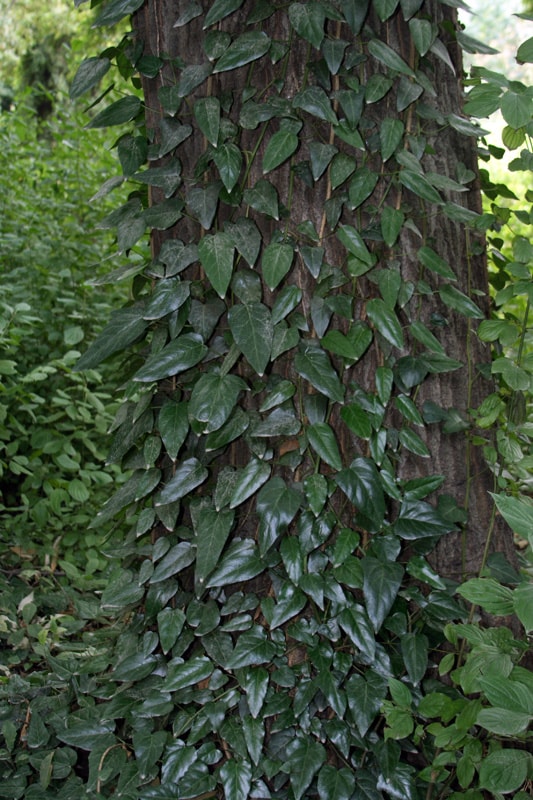
Pastuchov's ivy. Author A. Aziyev
In nature it is found in oak and beech forests, in lowlands and foothills. It grows in practically all countries of the Northern Hemisphere and in Australia.
It is a climbing evergreen plant up to 30 m long, creeping or climbing onto supports by numerous adhesive roots. As groundcover it reaches a height of 10–30 cm. It grows slowly. Bark gray. Vegetative shoots are stellately pubescent with long white hairs, with adhesive roots 0.6–1.0 cm long.
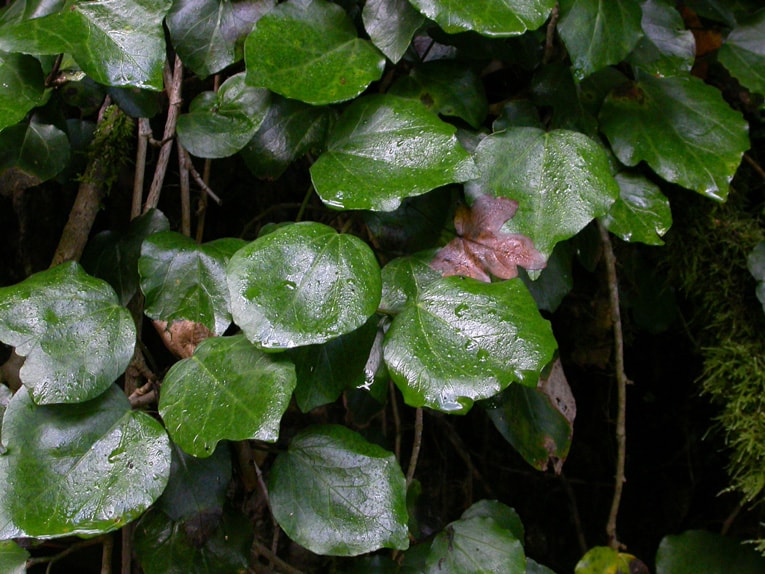
Colchis ivy. Author S. Melnytsky
Leaves are thick, leathery, of two kinds: on non-flowering shoots — dark green, angular-lobed; on flowering shoots — light green, entire, lanceolate, oblong or ovate. There are no stipules.
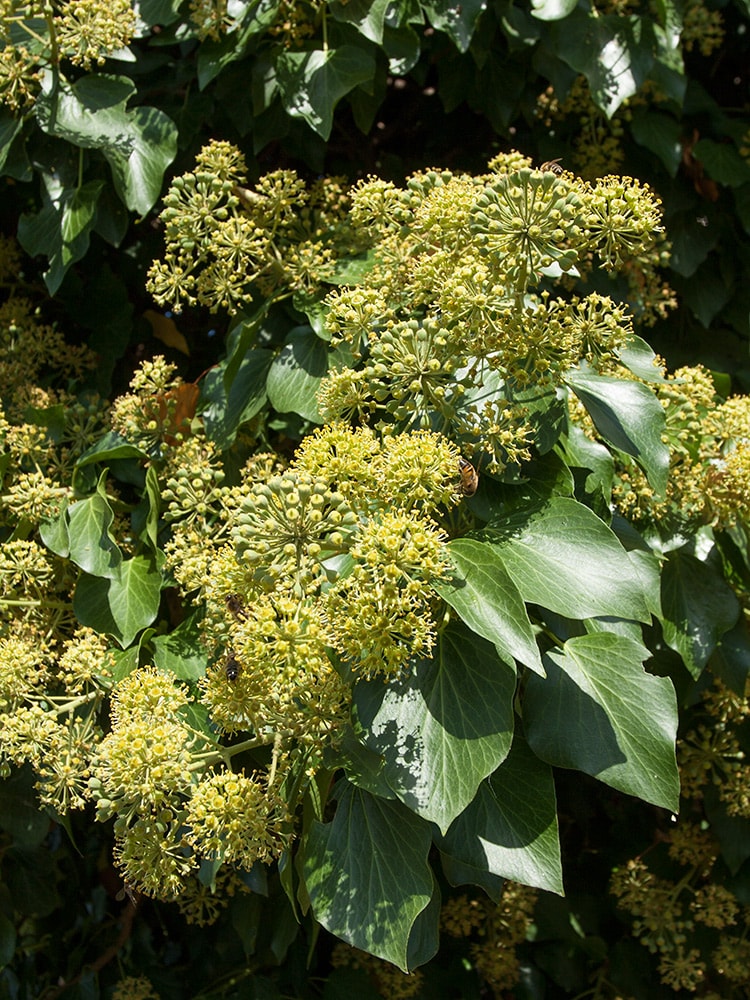
Colchis ivy. Author D. Oreshkin
Flowers are small, gathered in heads, umbels or racemes. Flowers without bracts or with very small ones. Calyx weakly developed, entire or five-toothed; corolla five-petaled, valvate in bud; stamens five; pistil with an inferior, semi-inferior or superior five-loculed ovary, with a short style surrounded at the base by a fleshy disk.
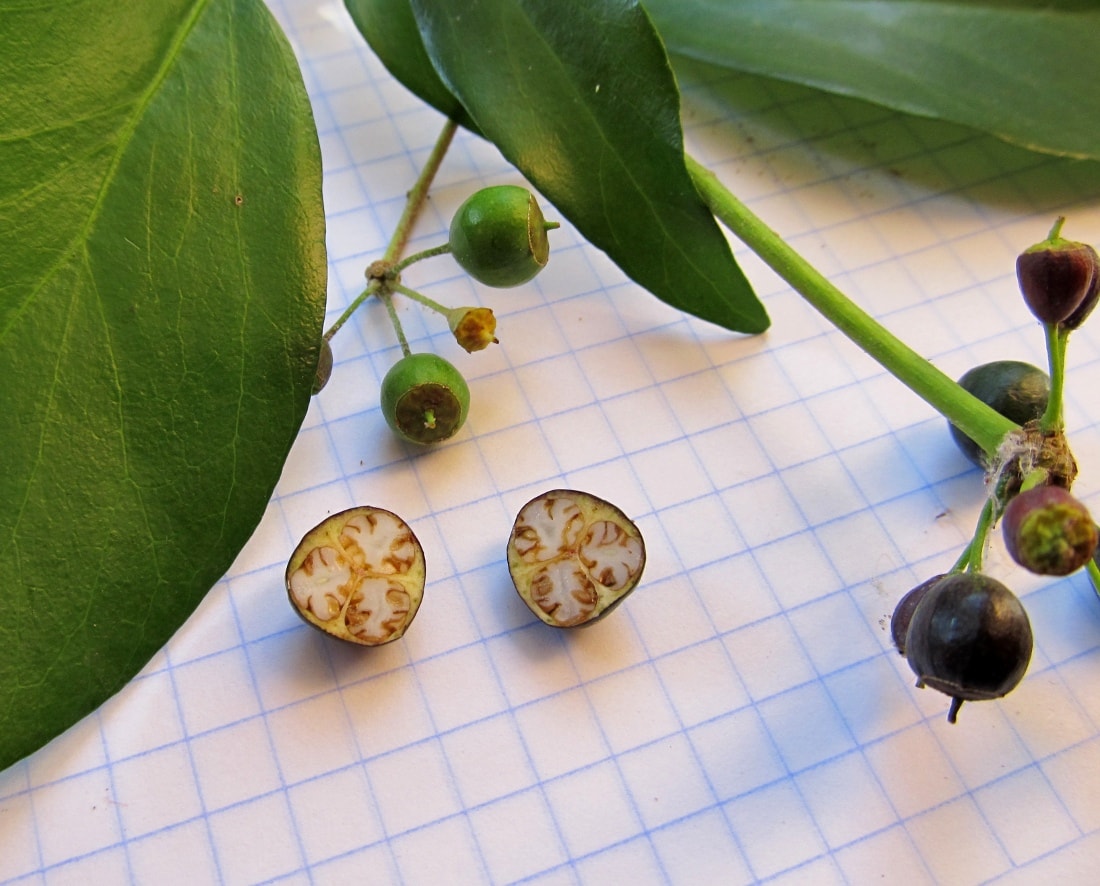
Irish ivy. Author N. Zamkova
Fruits black or yellowish, rounded berries with 3–5 seeds inside. Seeds with an elongated embryo in a wrinkled-folded endosperm.
Species: the genus includes 16 species (according to Wikipedia)
- Hedera algeriensis Hibberd
- Hedera azorica Carrière
- Hedera canariensis Willd. — Canary ivy
- Hedera caucasigena Pojark.
- Hedera colchica (K.Koch) K.Koch — Colchis ivy
- Hedera cypria McAll.
- Hedera helix L. — Common ivy (type species)
- Hedera hibernica (G.Kirchn.) Carrière
- Hedera iberica (McAll.) Ackerf. & J.Wen
- Hedera maderensis K.Koch ex A.Rutherf.
- Hedera maroccana McAll.
- Hedera nepalensis K.Koch
- Hedera pastuchovii Woronow — Pastuchov's ivy
- Hedera rhombea Siebold & Zucc. ex Bean
- Hedera sinensis (Tobler) Hand.-Mazz.
- Hedera taurica (Hibberd) Carrière — Crimean ivy
Hardiness zone: 6a (-23°C). Overwinters under snow.

Location: shade-tolerant, drought-resistant, grows well in fertile soils but tolerates poor soils. Resistant to smoke and gas.
Planting: seedlings are planted in May, at a distance of at least 50 cm from each other.
Care: it is not recommended to allow the soil under the plant to dry out. It is also recommended to fertilize 2–3 times during the growing season (twice at the beginning of the growing season, in May with an interval of 10–12 days, and once in August).
Pruning: tolerates pruning well. It is recommended to trim young long shoots to stimulate the appearance of lateral shoots.
Diseases: rarely affected by diseases.
Pests: common spider mite, red spider mite, mealybugs, scale insects and false scales, aphids.
Propagation: readily propagated vegetatively — by stems, layering, and cuttings. Cuttings: made from spring, summer, and autumn green or semi-ripe shoots, which are planted vertically or at an angle in pots and boxes (spring cuttings can be planted directly into open ground). For rooting under cover a soil mixture of sand with leaf mold is used. For layering: long lower shoots are pressed to the ground with staples or simply stones. When the shoot roots, it is carefully separated from the parent plant and transplanted to a new location. Propagation by stems: this method is usually used to obtain a large number of seedlings. A shoot having on average 10 leaves is pressed and horizontally buried in sand so that the leaves remain on the surface. After 10–12 days underground roots will appear on the shoot where the buds of aerial roots are located. After that the shoot is pulled out of the sand and cut into cuttings so that each piece has a leaf and roots. This allows obtaining a large amount of planting material in a short time.
Uses: a highly decorative and undemanding evergreen plant, ornamental for its evergreen foliage. Widely used for vertical greening of walls, fences and unsightly areas of the garden. A good nectar plant. Can be grown as a houseplant.