
Fruit trees
Steppe cherry
Fruticosa 'Globosa'
Synonyms: Cerasus chamaecerasus (Jacq.) Loisel. (1812), Cerasus chamaecerasus var. silvestris Dierb. (1827), Cerasus chamaecerasus (Jacq.) Loisel. (1812), Cerasus chamaecerasus var. silvestris Dierb. (1827), Cerasus fruticosa (Pall.) Woronow (1925), Cerasus humilis Host (1831), Cerasus pumila (L.) Pall. (1771), Cerasus sibirica hort. ex L.H.Bailey (1901), Prunus cerasus var. pumila L. (1753), Prunus chamaecerasus Jacq. (1786), Prunus chamaecerasus f. salicifolia hort. ex Zabel (1903), Prunus chamaecerasus var. pendula (Dippel) Behnsch (1905), Prunus fruticosa f. pendula Dippel (1893), Prunus fruticosa var. pendula (Dippel) C.K.Schneid. (1906), Prunus fruticosa var. typica Beck (1892), Prunus intermedia Poir. (1804), Prunus pumila (L.) Georgi, (1800), nom. illeg.
Steppe cherry or shrubby cherry – a species of flowering dicotyledonous plants of the genus Prunus (plum) of the family Rosaceae. Some botanists consider that this species is one of the wild ancestral species of the modern common cherry. Cultivated since 1784.
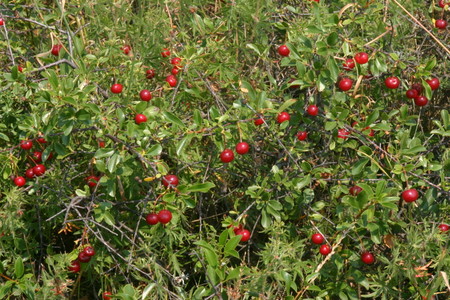
The range extends from Western Europe to Siberia and northern Asia (the northeastern part of Kazakhstan, as well as the southern Ural). Also found in southern Germany, northern Italy, and central regions of Poland.
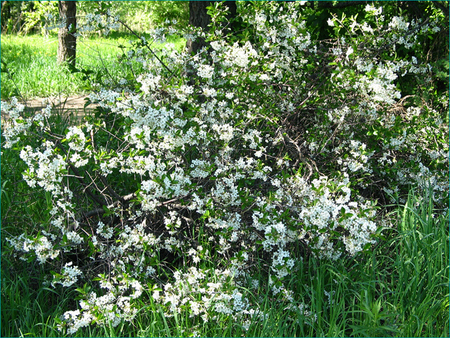
It is a low shrub up to 2 m tall. Crown spreading. Young branches green, later becoming purplish-brown, glabrous.
The root system consists of long horizontal roots that extend annually by 50–100 cm and lateral roots that branch from the horizontal, relatively short feeder roots. The horizontal roots serve for passive propagation.
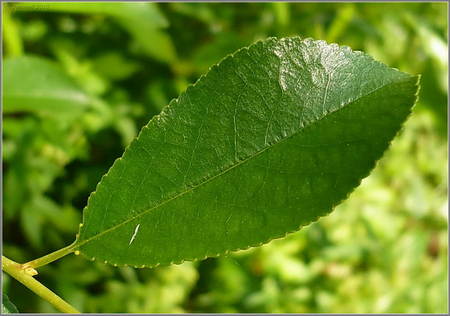
Leaves lanceolate or obovate, 3–6 cm long and 1.5–2.5 cm wide, glabrous, narrowed at the base, margins bluntly serrate. Petioles glabrous, up to 1.5 cm long. Upper surface of the leaf blade dark green, lower surface light green. Stipules toothed, linear.
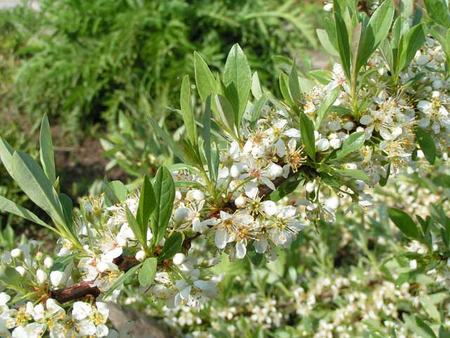
Flowers solitary or grouped in umbels of 2–4, white, appearing before leaf emergence or together with the leaves. Sepals reflexed or erect. Petals obovate with rounded tips. Pistil glabrous.
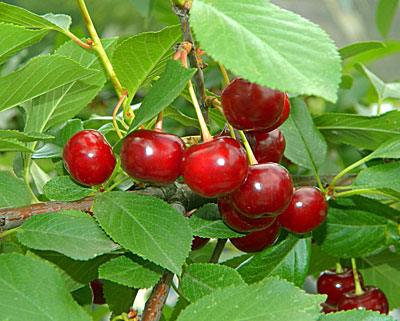
Steppe cherry «Zmeinogorskaya»
Fruits – edible ovoid, rounded or pyriform drupes, slightly flattened below and pointed at the apex, up to 2.5 cm in diameter, color ranging as they ripen from pink to almost black. Skin of medium thickness. Flesh juicy, red. Stone elliptical or ovoid, smooth, with a "suture".
Cultivars: Steppe cherry served as the basis for the work of the well-known Russian breeder I.V. Michurin. The most popular cultivars: Алтайская крупная, Алтайская ласточка, Алтайская ранняя, Ашинская, Болотовская, Вузовская, Желанная, Змеиногорская, Иртышская, Кристина, Курчатовская, Максимовская, Мечта Зауралья, Новоалтайская, Новоселецкая, Обь, Память Барсукову, Пламенная, Полевка, Преемница, Прозрачная, Пионерка, Ранняя степная, Саламатовская, Свердловчанка, Селиверстовская, Сердечко, Субботинская, Шадринская, Рубиновая.
Hybrids: Prunus ×eminens Beck, 1892 [Prunus cerasus × Prunus fruticosa]; Prunus ×javorkae Kárpáti, 1944 [Prunus fruticosa × Prunus mahaleb]; Prunus ×mohacsyana Kárpáti, 1944 [Prunus avium × Prunus fruticosa]; Prunus ×stacei Wójcicki, 1991 [Prunus cerasus × Prunus fruticosa × Prunus avium].
Hardiness zone: zone 1a (-50°C)

Location: can grow in sun and shade. Prefers neutral or slightly alkaline, fertile soil with good drainage. Resistant to urban conditions. Grows on weakly podzolized chernozems, chestnut and dark-chestnut soils. In the northern part of the range prefers calcareous soils, but may also occur in pine forests with acidic reaction, where it coexists with heather and bilberry and other plants.
Planting: planting is recommended in spring. Before planting, soil should be improved. The planting site should be dug to a spade's depth and fertilizers applied: manure or compost in an amount of 8-10 kg/m², superphosphate - 150-200 g, potassium fertilizers – 100 g or complex fertilizers – 150-200 g/m². Recommended soil reaction pH 6.5-7. It is also recommended to add fertilizers into the planting hole – 10 kg of humus, non-acid peat or well-rotted compost, and 500 g of ash. The hole should be dug and prepared 2 weeks before planting.
Pruning: from 2-3 years of age pruning should be performed – remove suckers, lower branches to form the trunk, shorten the leader by training to a lateral branch, and thin the crown. Pruning is carried out in early spring before bud swell.
Care: care consists of regular pruning.
Diseases: drupe weevil (Anthonomus druparum), witches' broom (Exoascus minor), false tinder fungus (Phellinus igniarius), moss (Pylaisia polyantha), Thekospora padi, T. Pseudocersi and others.
Pests: brown fruit mite, cherry sawfly, cherry slug sawfly, cherry shoot-borer, yellow plum sawfly, sapwood borer, western unpaired bark beetle, tussock moth, fruit striped moth.
Propagation: actively produces root suckers, through which it is continuously renewed. Also propagated by seeds; germination of stratified seeds 80%.
Uses: can be used as a rootstock for common cherry or to obtain prostrate forms. Easily cultivated and can be used in ornamental gardening. Can be used in solitary or group plantings, and for creating hedges. Used in shelterbelt afforestation and for stabilizing slopes and edges of developing gullies. Fruits are consumed fresh, dried and preserved.