
Flowering shrubs
Meadowsweet
Filipendula [Tourn.] Mill.
Synonyms: Ulmaria Mill., meadowsweet, Thecanisia Raf.
Meadowsweet (Filipendula [Tourn.] Mill.) – a genus of perennial herbs in the Rosaceae family (Rosaceae). The genus was first distinguished by the English botanist Philip Miller in his work «The Gardeners Dictionary...Abridged...fourth edition vol. 1» in 1754.
The name comes from the Latin words 'filum' — thread and 'pendulus' — hanging (the root tubercles hang on thread-like roots).
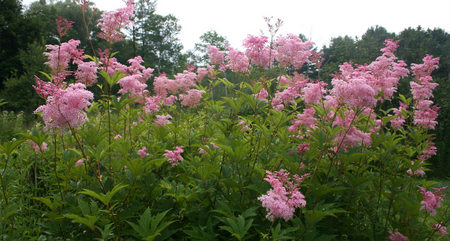
Most species grow in the temperate zone of the Northern Hemisphere; 7 are endemic to China. They grow in damp meadows and swampy forests.
It is an herbaceous plant with an erect stem. The rhizome is horizontal, finger-thick, branching and bearing numerous buds, from which new stems grow in mid-summer.
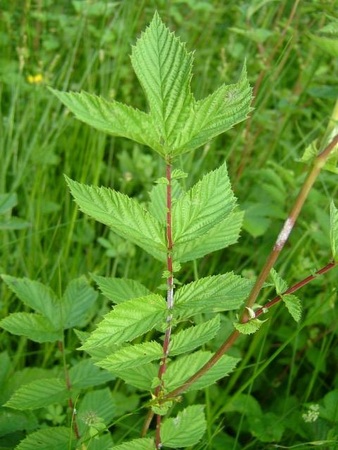
Leaves pinnate, less often palmate. Stipules large or small, cordate or ovate-lanceolate.
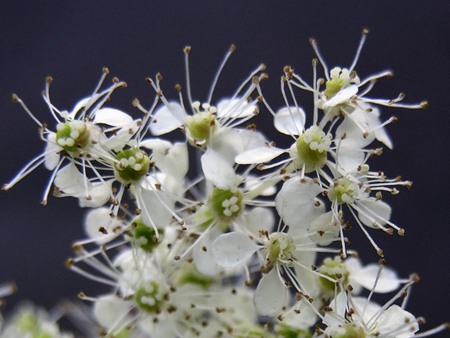
Flowers numerous, white, pink or red, arranged in terminal corymbose-panicle inflorescences. Blooms in early summer. Flowers hermaphroditic, less often unisexual. Sepals 5, they reflex after flowering. Petals 5, arranged imbricately, clawed at the base. Stamens 20-40. Carpels 5-15. Perianth double.
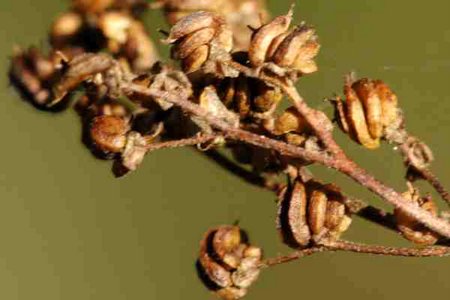
Fruits – many achenes, elongated, densely ciliate at the margin or completely glabrous, appearing at the ends of shoots.
Species: according to Wikipedia:
- Filipendula angustiloba
- Filipendula glaberrima
- Filipendula kamtschatica
- Filipendula kiraishiensis
- Filipendula multijuga
- Filipendula occidentalis
- Filipendula palmata
- Filipendula purpurea
- Filipendula rubra
- Filipendula ulmaria
- Filipendula vestita
- Filipendula vulgaris
Hardiness zone: 4a-8b. In severe winters, annual shoots may suffer frost damage.

Location: prefers well-lit sites but can tolerate partial shade. Requires consistently moist or partly waterlogged soil, not acidic, slightly loamy but fairly light in texture, with sufficient organic matter and good aeration. Undemanding.
Planting: planting is done in autumn, at a depth of no more than 5 cm. The rhizome is laid horizontally, parallel to the soil, directing the large pointed buds upward. Recommended spacing about 50 cm (depending on species).
Care: in summer, abundant watering is recommended; the soil should not be allowed to dry out (except for the common meadowsweet).
Pruning: flowering shoots are cut at the end of July – beginning of August. In hot weather it needs watering.
Diseases and pests: wireworm, aphids. Rust, powdery mildew.
Propagation: propagated vegetatively and by seeds. In autumn, rhizomes are dug up and divided into pieces 5-7 cm long and immediately planted in soil or stored in a cool place in moist sawdust or sand. For seed propagation, seeds are collected in autumn and stratified, scarified with sandpaper — or soaked in a 2% sulfuric acid solution for one day. Seeds germinate better when sown in autumn. Sow seeds at a depth of 2 cm.
Uses: can be used as an underplanting for trees or shrubs on wet soil, for creating large landscape masses, as a large and lush foundation for a bog garden, and for decorating pond banks.