
Deciduous shrubs
Spindle (Euonymus)
Euonymus
Synonyms: Evonymus L., orth. var., Kalonymus (Beck) Prokh., Pragmotessara Pierre, Pragmotropa Pierre, Quadripterygium Tardieu, Sphaerodiscus Nakai; in Dahl's dictionary - bereskled, beresdren, kurinaya slepota, brukhmelya, bruzhmel, bruslina, brusynina, burusklen, meresklet, kislyanka, zhigalok, brusnika, brusklet, brukhmel, kizlyanka (kozlyanka, kislyanka), meresklet; according to Fasmer - bruzhmel, bruzhavél, brukhmel, brusklén, brusklét, vereskled; according to Brockhaus and Efron - bozhyi glazki, biryuchina, volchye lyko, saklak, volchiye sergi, slepokurnik (according to Lepehin).
Euonymus (Euonymus) - a genus of woody plants in the family Celastraceae. The name author is Carl Linnaeus, who first named the genus 'Evonymus', later he used another transcription - 'Euonymus', which is used today. The name comes from the Greek words «ευ» — «eu, good» and «όνομα» — «onoma, name», meaning a plant with a «good name». Since it was previously considered that the word 'Euonymus' was feminine, names such as Euonymus europaea, Euonymus verrucosa, etc. are often encountered. Starting from 2006 it began to be written Euonymus europaeus. Cultivated since ancient times.
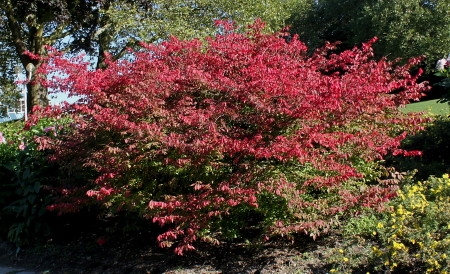
Winged spindle
Distributed in the understory of mixed and broad-leaved forests, in the temperate or subtropical zone in both hemispheres (except the extreme northern regions); they are also found in the tropics.
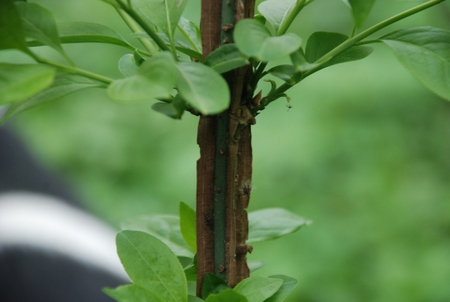
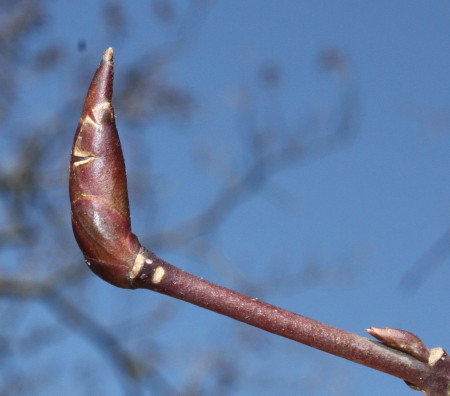
Members of the genus are deciduous or evergreen shrubs or small trees with an ovate crown, erect, less often climbing or sprawling, but not twining. Shoots are quadrangular or rounded, often with corky outgrowths along the ridges in the form of warts, broad wings or ribs. Bark green, gray or brown, young shoots greenish or brown. Buds ovate, small, with oppositely arranged scales.
Leaves opposite, simple, smooth, entire, petiolate, brightly colored in autumn, with filiform deciduous stipules, margin entire or serrate.
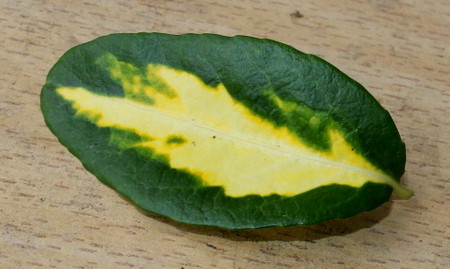
Fortune's spindle
Flowers after leafing, in May–June. Inflorescences usually in the form of umbellets or solitary, lateral. Flowers actinomorphic, small, bisexual. Calyx consists of 4–5 sepals bent downward or spreading. Petals 4–5, free, greenish, yellowish-white, more rarely purple or brownish, usually reflexed to the side. Stamens 4–5, attached by short filaments to a fleshy disc below the pistil. Ovary 4-loculed, superior, with 2 ovules in each locule.
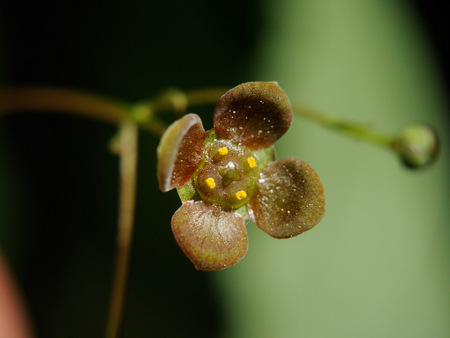
Warty spindle
Fruits are leathery 3–5-valved capsules, brightly colored, rarely lobed, winged or wingless. Seeds white, red or brown-black, wholly or partially covered by a bright red or pink aril, 1–2 seeds located in each chamber. Fruits ripen in August–September.
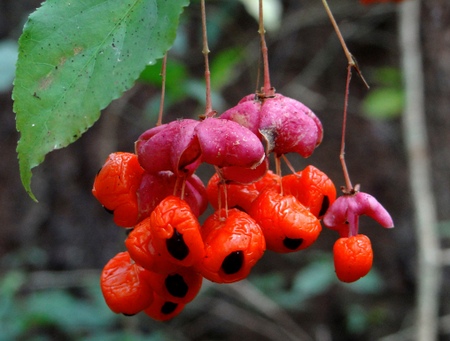
Warty spindle
Species: Includes about 220 species, of which 130 are evergreen and 42 are used in ornamental horticulture. Most species grow in Southeast Asia.
Some ornamental species:
- Winged spindle, sacred – Euonimus alatus (Thunb.) Sieb.
- American spindle – Euonimus americanus L.
- Dark-purple spindle – Euonimus atropurpureus Jacq.
- Bunge's spindle – Euonimus bungeanus Maxim.
- European/intermediate spindle – Euonimus europaeus L.
- Fortune's spindle – Euonimus fortunei (Turcz.) Hand.-Mazz.
- Hamilton's spindle – Euonimus hamiltonianus Wallich.
- Japanese spindle – Euonimus japonicus Thunb.
- Broad-leaved spindle – Euonimus latifolius (L.) Mill.
- Large-winged, Ussuri spindle – Euonimus macropterus Rupr.
- Dwarf, Koopman’s spindle – Euonimus nanus Bieb.
- Obovate spindle – Euonimus obovatus Nutt.
- Mountain spindle – Euonimus oresbius W.W.Sm.
- Acid-loving spindle – Euonimus oxyphyllus Miq.
- Cork-winged spindle – Euonimus phellomanus Loes.
- Flat spindle – Euonimus planipes (Koehne) Koehne.
- Sakhalin spindle – Euonimus sachalinensis (F.Schmidt) Maxim.
- Blood-red spindle – Euonimus sanguineus Loes.ex Diels.
- Semenov's spindle – Euonimus semenovii Reg.et Herd.
- Warty spindle – Euonimus verrucosus Scop.
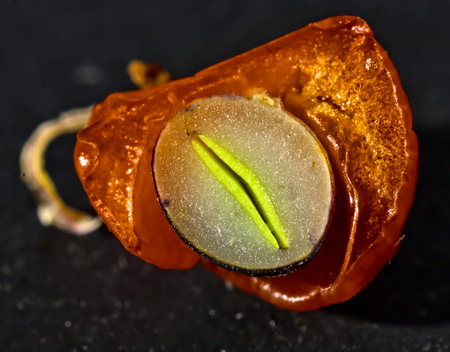
Warty spindle
Hardiness zone: 4a (-34.4°C).

Location: light-loving. Some deciduous species can grow in shade, but they lose ornamental value there – they flower less and lose bright autumn leaf color. Evergreen species prefer semi-shade and in southern locations need protection from the midday hot sun. Moisture-loving, but drought-tolerant and do not like waterlogging. Undemanding to soil, grow on ordinary well-drained garden soils, prefer slightly alkaline. Tolerant of urban conditions.
Planting: the best time for planting is early spring. The hole should be twice as large as the root system. Soil mix – leaf mold, peat-compost and sand in proportions 1:2:1 with the addition of wood ash or lime. During root establishment they need frequent watering – the soil should not dry out, but do not overwater either. After rooting, watering can be reduced.
Care: Most representatives of the genus are fairly drought-resistant, so to maintain ornamental appearance it is sufficient to give 3–4 abundant waterings during severe drought. Ornamental forms and young plants in the first 2 years are recommended to be winter-covered with conifer branches or a 15-cm layer of dry leaves. For improved fruiting, organic and mineral fertilizers can be applied; in clay soils it is recommended to add sand.
Pruning: tolerates clipping and pruning well. Considering their decorative value, formative pruning is recommended after fruiting. For more intensive branching, it is recommended to pinch young shoots in spring.
Propagation: deciduous species can be propagated by seeds, which should be sown in winter or in spring after 4–5 months of stratification. They can also be rooted in sand by layering, root suckers or cuttings. Evergreen species root poorly throughout the year. Sometimes grafting in February in greenhouses onto the European spindle is used.
Diseases: powdery mildew
Pests: fairly heavily damaged by pests, the most common of which are Euonymus scale, various aphids, mealybugs, apple moth, hawthorn moth, spider mite and red flat mite. Interestingly, on spindle planted near fruit trees one can observe a huge number of caterpillars, while on nearby apple trees there may be none.
Uses: almost all species are poisonous. Ornamental due to attractive habit, brightly colored leaves and ornamental fruits. In landscape design used in solitary and loose group plantings, on lawns, for creating borders and clipped hedges, for dressing fences, decorating outbuildings and composting areas. Low-growing species can be used as groundcover in rock gardens and for creating borders. Climbing species, when used with a support, can be grown as shrub-like vines for vertical greening. From the bark of roots high-quality gutta (material for making gutta-percha) is obtained. The pale yellow, dense and hard wood is highly valued and used for making decorative handicrafts.