
Deciduous shrubs
Horizontal cotoneaster
Cotoneaster horizontalis Decne.
Synonym: var. Horizontalis, fan-shaped cotoneaster
Horizontal cotoneaster (Cotoneaster horizontalis Decne.) – a species of spineless shrubs in the genus Cotoneaster of the family Rosaceae. It was first described in 1877 (1878) by the French botanist Joseph Decaisne in the "Annales Générales d'Horticulture". In cultivation since 1880.
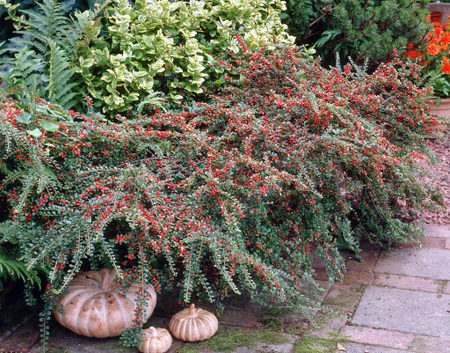
Native to the central part of China, where it occurs on mountain slopes. Widely distributed in cultivation, as well as in botanical garden collections and urban plantings in Europe, North America and East Asia. Ornamental longevity 25-30 years.
It is a semi-evergreen shrub up to 1 m in height. Grows quickly and spreads strongly sideways. In youth the crown is cup-shaped, later becoming widely spreading. Branches are flat, pinnately branched and almost pressed to the ground, arranged in one plane, black-brown, initially slightly pubescent, later glabrous.
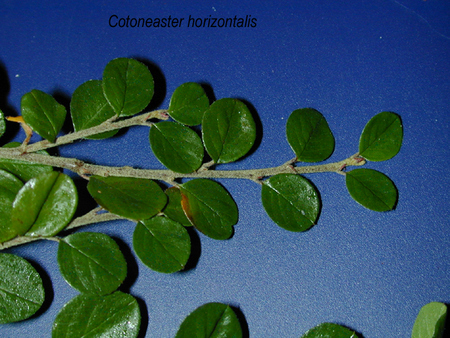
Petiole 1-3 mm long, pubescent. Stipules brown, deciduous, awl-shaped or lanceolate, 2-4 mm long, slightly pubescent. Leaf blade nearly round or broadly elliptic, less often obovate, with an acute-cuneate apex, 6-14 mm long and 4-9 mm wide, dark green, leathery, glossy.
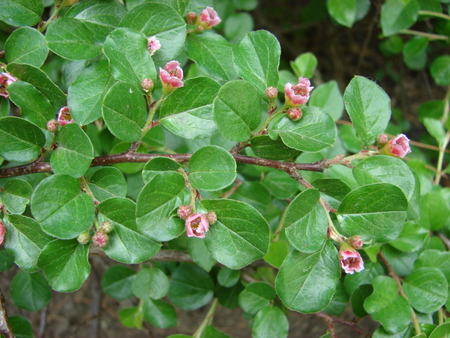
Flowers from late May until mid-July for about 3 weeks. Inflorescences 1-2 flowered. Pedicel short or practically absent. Flowers 5-7 cm in diameter. Hypanthium campanulate. Sepals triangular, 1-1 mm in length and 1-2 mm in width, with an acute apex. Petals erect, pink, reddish or whitish, 3-4 mm long and 2-3 mm wide, with a blunt tip. Stamens 12, shorter than the petals. Ovary pubescent at the top.
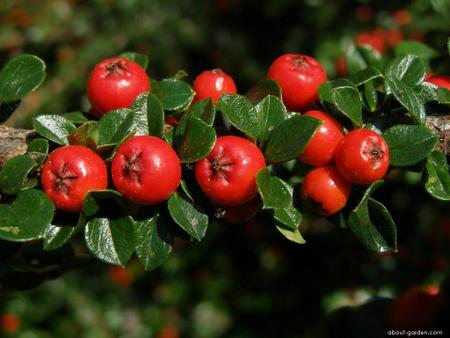
Fruits bright red, glossy, nearly spherical or elliptical in shape, 5-7 mm in diameter, with 2-3 stones. Ripen in September and persist on the branches until December, on branches in the lower part of the shrub they hang until spring.
Forms:
- Cotoneaster horizontalis var. Horizontalis (syn. Cotoneaster acuminatus var. prostratus Hook. ex Decne., Cotoneaster symonsii Loudon ex Koehne)
- Cotoneaster horizontalis var. perpusillus C.K. Schneid. (syn. Cotoneaster distichus var. perpusillus (C.K. Schneid.) C.K. Schneid., Cotoneaster perpusillus (C.K. Schneid.) Flinck & Hylmö)
- Cotoneaster atropurpureus 'Variegatus
Hardiness zone: zone 4 (-35°C).

Location: sun-loving but shade-tolerant. Tolerates urban conditions well. Drought-tolerant.
Propagation: propagated by seeds and vegetatively. Green cuttings root faster under film. Cuttings are taken in the second half of July. Substrate – peat and sand in equal proportions. Does not tolerate prolonged waterlogging and stagnant moisture, requires good drainage. Seed germination 15%. Rooting of cuttings 100% after treatment with a 0.01% solution of IMK for 16 hours.
Soil: demands fertile soil. Prefers light, peaty, neutral or slightly acidic, fertile loams.
Planting: planting mix – compost consisting of topsoil, peat and sand in proportions 2:1:2.
Care: in hot and dry summers, to maintain its ornamental appearance it is recommended to water the plant 1-2 times a month at the rate of 1-2 buckets per plant.
Pruning: tolerates trimming and pruning well. After pruning it regrows well while retaining its growth habit. When shaped it produces dense hedges and sculptural groups. Recommended pruning – to 1/3 of the length of the annual shoot, but in places where a dense and compact habit is required.
Diseases: Fusarium (remove and burn affected parts)
Pests: apple aphid, plum sawfly, cotoneaster mite.
Uses: one of the most attractive cotoneaster species. Ornamental with an unusual crown, pinnate branching, delicate flowering and abundant bright fruiting; in autumn the foliage acquires beautiful purple-scarlet tones. An ideal groundcover plant. Used for decorating areas in parks or squares, in solitary plantings on lawns or flowerbeds, in rockeries and rock gardens, for stabilizing and decorating slopes and retaining walls, and for cascading or terraced plantings.