
Deciduous shrubs
Franchet's cotoneaster
Cotoneaster franchetii Bois
Synonym: кизильник вечнозеленый, Cotoneaster amoenus E. H. Wilson; C. franchetii var. cinerascens Rehder; C. insculptus Diels; C. mairei H. Léveillé; C. mairei var. albiflorus H. Léveillé, Franchet's cotoneaster, dwergmispel, oranje cotoneaster, xi nan xun zi, Franchets Zwergmispel, wintergrüne Zwergmispel, koralloxbär.
Кизильник Франчетти (Cotoneaster franchetii Bois.) – a species of non-spiny shrubs of the genus Cotoneaster in the Rosaceae family. The species was named after the French botanist Adrien Réne Franchet (1834-1900), who described the flora of China and Japan. In cultivation since 1895. Grown in North Africa, Australia and New Zealand, Europe, and North America.
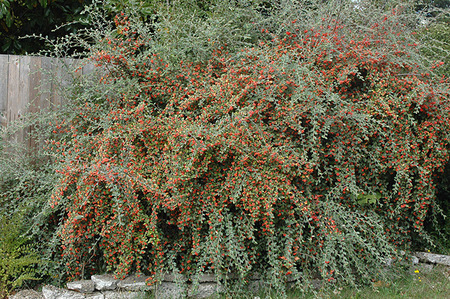
Native to the northeastern part of China (Guizhou, Sichuan, Tibet Autonomous Region, Yunnan), it is also found in northern Myanmar and in northern Thailand. It forms thickets in rocky sunny mountain areas and is also found on open slopes. Occurs at elevations of 1600-2900 m above sea level.
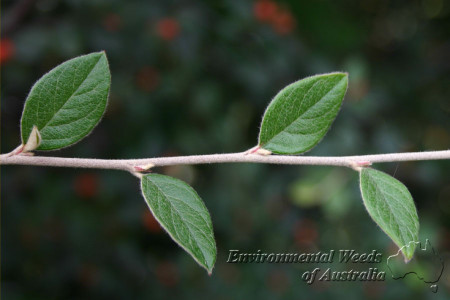
It is an evergreen shrub 2-3 m high and up to 3 m in diameter. Crown loose, upright, graceful, side branches arching and drooping to the ground. Shoots thin, spreading, arcuately curved, densely pubescent. Branches dark gray-brown or grayish-black, initially grooved, later smooth.
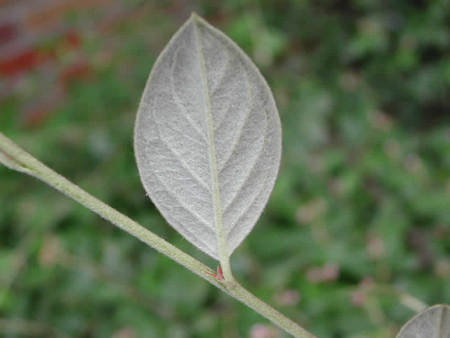
Leaves 2.5-3 cm long, oval or obovate, glossy green above, cuneate at the base, acute or with a bluntly narrowed apex, pubescent (especially beneath) when unfolding, later glabrous above and felt-pubescent beneath with grayish or mustard-yellow hairs. Petiole 2-4 mm long, felt-pubescent. Stipules linear-lanceolate, 2-4 mm long, initially felt-pubescent, later glabrous.
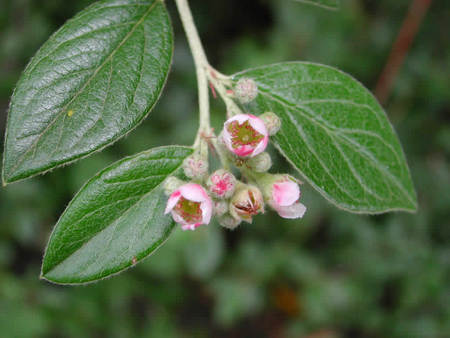
Flowers in May-June. Flowers white, pink outside, small, 6-7 mm in diameter, gathered in numerous corymb-like clusters of 5-15. Calyx white, densely felt-pubescent. Petals 5, small, erect, obovate. Stamens 20, shorter than the petals. Ovary pubescent at the apex.
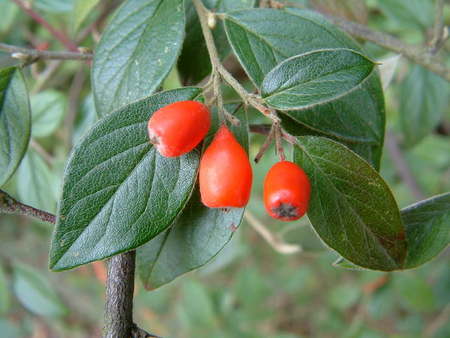
Fruits ovoid or ovoid-globose, orange-scarlet in color, 0.6-0.8 cm long, at first pubescent, later glabrous, gathered in clusters of 3-5. Seeds usually 3, rarely 5. Fruits in September.
2n = 68
Forms:
- cotoneaster franchetii var. Sternianus
- cotoneaster franchetii var. cinerascens Rehd.
- cotoneaster franchetii var. franchetii.
Hardiness zone: zone 45-8 (-23°C). May suffer from late frosts.

Location: A light-loving mesoxerophyte, mesotroph, mesotherm. Tolerates urban conditions well. Drought-resistant.
Propagation: Propagated by seeds and vegetatively. Green cuttings root faster under film. Cuttings are taken in the second half of July. Substrate – peat and sand in equal proportions. Does not tolerate prolonged waterlogging and stagnant moisture; requires good drainage.
Soil: Not demanding regarding soil fertility. Grows on all garden soils.
Planting: Planting mix – compost consisting of sod soil, peat and sand in proportions 2:1:2.
Care: In hot and dry summers, to maintain ornamental appearance it is recommended to water the plant 1-2 times per month at a rate of 1-2 buckets per plant.
Pruning: Tolerates clipping and pruning well. Regrows well after pruning while maintaining its growth habit. When shaped, forms dense hedges and sculptural groups. Recommended pruning – shorten by 1/3 of the length of the annual shoot, in places where a dense and compact habit is desired.
Diseases: Fusarium (remove and burn affected parts)
Pests: apple aphid, plum sawfly, cotoneaster mite.
Uses: Ornamental for its graceful crown that hangs to the ground, and for its red fruits, which in mild winters can persist until spring. Used in rock gardens, rockeries, along paths, as solitary plantings on lawns, and also looks good in small groups.