
Deciduous shrubs
Spreading cotoneaster
Cotoneaster divaricatus Rehder & E.H. Wilson
Spreading cotoneaster (Cotoneaster divaricatus Rehder & E.H. Wilson) – a species of non-spiny shrubs of the genus Cotoneaster of the Rose family (Rosaceae). It was first described in the book «Plantae Wilsonianae an enumeration of the woody plants collected in Western China for the Arnold Arboretum of Harvard University during the years 1907, 1908 and 1910», whose authors were Alfred Rehder and Ernest Henry Wilson, edited by Charles Sprague Sargent. The book was published in 1912.
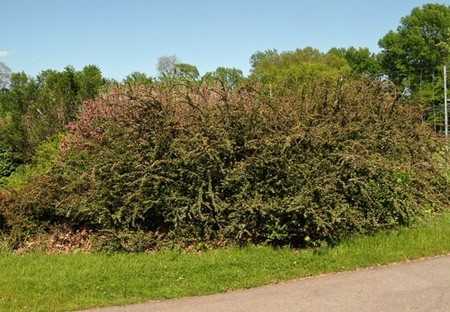
Occurs in the wild in China (Anhui, Gansu, Guizhou, Hubei, Hunan, Jiangxi, Shaanxi, Sichuan, Xinjiang, Tibet Autonomous Region, Yunnan, Zhejiang), where it is found on rocky slopes, in forests and shrub thickets. In the mountains it rises to elevations of 1600-3400 m above sea level.
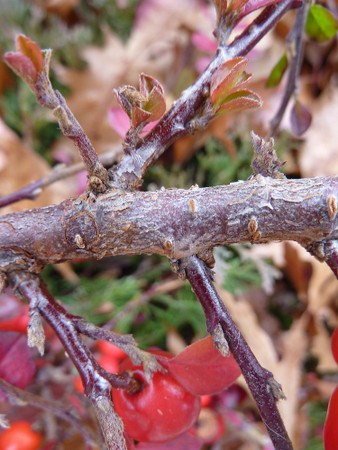
A deciduous shrub 1-2 m tall. Grows rapidly, up to 50 cm per year. Crown erect, less often branched, tent-shaped. Shoots dark, reddish-brown or gray-brown, circular in cross-section, slender, initially grooved, later glabrous.
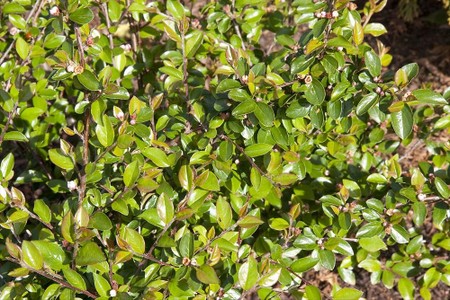
Petiole 1-2 (-3) mm, pubescent. Stipules caducous, linear-lanceolate, 2-5 mm long, sparsely pubescent. Leaf blade elliptic or broadly elliptic, less often obovate, 0.7-2 cm long and 5-10 mm wide. Both surfaces of the leaf initially pubescent, later almost glabrous, base broadly cuneate, apex acute, less often obtuse, sometimes acuminate. Leaves dark green, glossy. In autumn they acquire dark orange or brownish-orange tones.
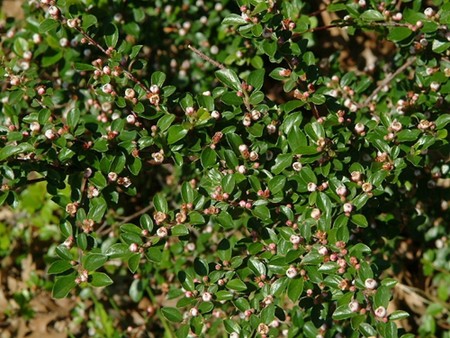
Inflorescences 5-6 mm in diameter, consisting of 2-4 flowers. Bracts caducous, linear-lanceolate, sparsely pubescent. Pedicel 1-2 mm long, rarely pubescent. Flowers 3-4 mm in diameter. Hypanthium sparsely pubescent. Sepals triangular, 1-2 mm long, with an acute apex. Petals erect, pink, ovate or oblong, 3-4 mm long and 2-3 mm wide, base clawed, apex obtuse. Stamens 15-20, shorter than the petals. Ovary pubescent at the apex. Styles 2, free, not exceeding the stamens in length. Flowering occurs sporadically from April to June.
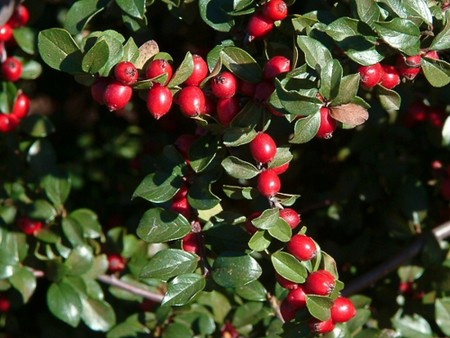
Fruits red, ellipsoid, 5-7 mm in diameter, rarely pubescent, with 1-2, less often 3 stones inside. Fruits abundantly in September-October. The fruits persist on the branches for a long time.
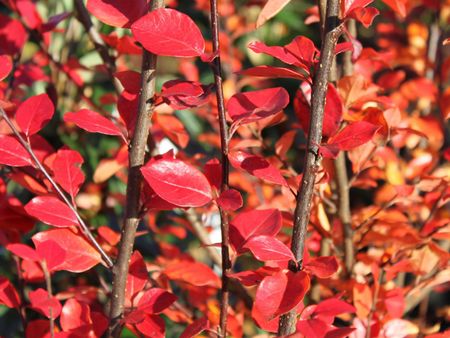
Hardiness zone: zone 5 (°C -29°C).

Location: sun-loving, but tolerates light shading. Tolerates urban conditions well. Drought- and heat-resistant. Prefers fresh, moist, slightly acidic or alkaline nutrient-rich soil.
Propagation: propagated by seed and vegetatively. Cuttings root poorly. Cuttings are taken in the second half of July. Substrate – peat and sand in equal proportions. Seeds require stratification.
Soil: prefers sandy, loamy-sandy, sandy-clay and loamy moderately moist soils. Optimal pH level 5.5-7.5.
Planting: planting mix – compost consisting of topsoil, peat and sand in proportions 2:1:2. Planting should be done to a depth of at least 40-50 cm. Recommended spacing between plants – 1.5-2.4 m.
Care: in hot and dry summers, to maintain decorative appearance it is recommended to water the plant 1-2 times a month at a rate of 1-2 buckets per plant.
Pruning: tolerates clipping and pruning well. After pruning it regrows well, retaining its growth form.
Diseases: Fusariosis (remove and burn infected parts)
Pests: apple aphid, plum sawfly, cotoneaster mite.
Uses: Ornamental with an elegant sprawling crown, unusual dark green foliage, many small pink flowers, autumn leaf coloration, and numerous red fruits. Used for creating espaliers, looks impressive in single and group plantings. Attracts birds to the garden.