
Deciduous shrubs
Grey cotoneaster
Cotoneaster dielsianus
Synonym: Diels' cotoneaster
Grey cotoneaster (Cotoneasterdielsianus E.Pritz. exDiels.) – a species of unarmed shrubs of the genus Cotoneaster in the rose family (Rosaceae). The species received its name and was first described by the German botanist Ernst Georg Pritzel in 1900. It is named in honor of the German botanist Ludwig Diels.
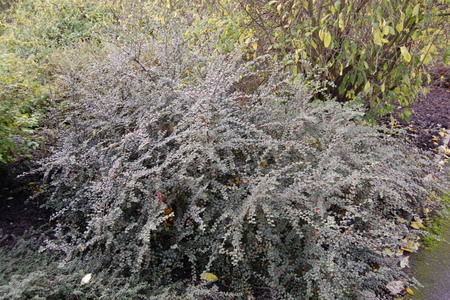
The natural range is in China in the provinces Gansu, Guizhou, Hubei, Sichuan, Yunnan, Xizang. It is found in steppes, shrub thickets and dry forests. In the mountains it rises to altitudes of 1000–3600 meters above sea level.
It is a low deciduous or semi-evergreen shrub 1–2 (3) m in height and up to 2–3 m in diameter. The crown is graceful, loose, and branchy, often of irregular shape. Shoots are thin, gray-black or black-brown, round in cross-section, initially densely hairy or yellowish-hairy, later glabrous.
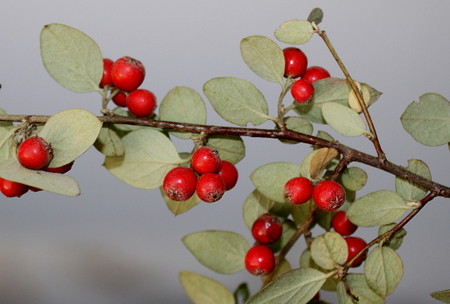
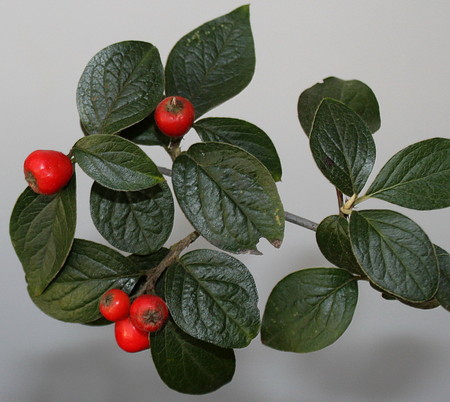
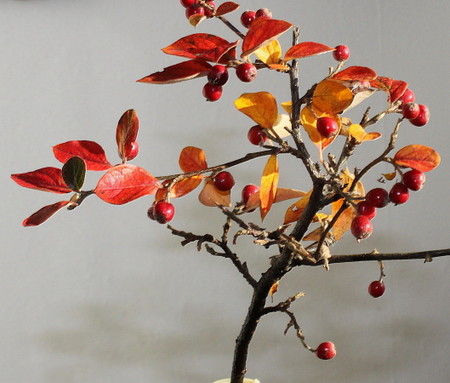
Leaves consist of a petiole and a blade. Petiole short, 1–3 mm long, pubescent. Stipules linear-lanceolate, at first pubescent, later glabrous. They persist until partial fruit ripening. Leaf blade simple, oval or ovate, 0.6–2.5 cm long and 0.8–1.5 cm wide, with an acute, less often obtuse tip and a rounded or broadly cuneate base. Leaves glossy, dark green, sparsely pubescent or almost glabrous; the underside of the leaf is densely hairy, slightly hairy, or almost glabrous, yellowish-gray or gray-woolly. In autumn the leaves take on reddish-brown tones.
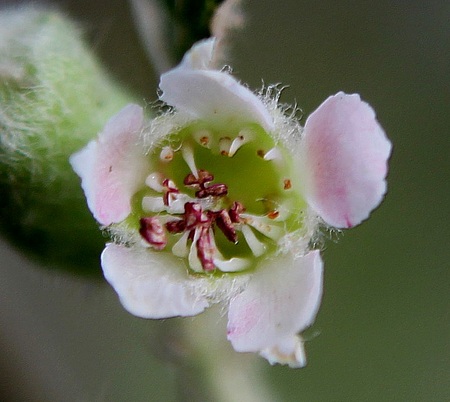
Flowers small, grouped 3–7 in loose corymb-like clusters 1–3 cm long. Calyx densely pubescent. Bracts linear-lanceolate, 2–3 mm long, densely pubescent. Flowers 6–7 mm in diameter. Sepals triangular, acute, less often obtuse or emarginate, 1–2 mm long and 1.5–2.5 mm wide. Petals erect, light pink, round or obovate, 3–4 mm long, with a blunt or acute tip and a narrowed base. There are 15–20 stamens, they are shorter than the petals. Styles 3, less often 4, they are free-standing and very short. Flowers in June to July.
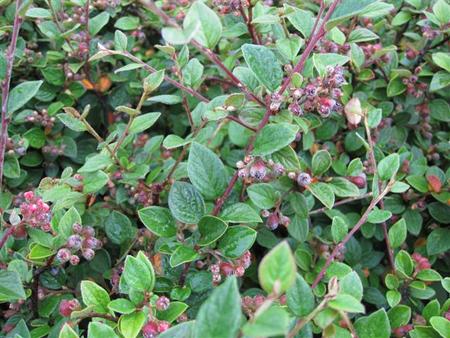
Fruits dark coral or scarlet red, rounded or obovate, 5–8 mm in diameter, with 3–5 stones (pyrenes) inside. Fruits ripen in September–October. Fruits abundantly.
Forms:
- Cotoneasterdielsianusvar. major
- Cotoneasterdielsianusvar. Dielsianus
- Cotoneasterdielsianusvar. elegansRehder& E. H. Wilson
Hardiness zone: zone 5–8 (-29°C).

Location: in nature it grows on moderately dry or fresh soil, acidic or alkaline, rich in nutrients. Prefers sunny warm sites but can also grow in partial shade.
Propagation: Propagated by seeds and softwood cuttings. Seeds require scarification and stratification for 12–15 months at 1–5 °C. Rooting of cuttings without treatment – 20%.
Soil: prefers moderately moist soil. Grows on sandy loam, loam-sandy, sandy-clay or loamy soils with pH around 6.5–7.5.
Planting: planting mix – compost consisting of garden soil, peat and sand in proportions 2:1:2.
Care: in hot and dry summers, to maintain decorative appearance it is recommended to water the plant 1–2 times per month at a rate of 1–2 buckets per plant.
Pruning: tolerates trimming and pruning well. After pruning it regrows well while maintaining its growth form. When shaped it gives dense hedges and sculptural groups. Recommended pruning – up to 1/3 of the length of the annual shoot, in places where a dense and bushy habit is required.
Diseases: Fusariosis (remove and burn affected parts)
Pests: apple aphid, plum sawfly, cotoneaster mite.
Uses: a highly ornamental species. Widely used in group and solitary plantings in parks, landscape plantings, and urban greening. Suitable for creating living hedges and also looks impressive in naturalistic gardens.