
Deciduous shrubs
Creeping cotoneaster
Cotoneaster adpressus Bois.
Synonym: Cotoneaster horizontalis var. adpressus (Bois) C.K.Schneid., creeping cotoneaster
Creeping cotoneaster – a species of spineless shrubs of the genus Cotoneaster of the family Rosaceae (the rose family). Native to Western China (Sichuan, Yunnan, Gansu, Qinghai, Shaanxi, Tibetan Autonomous Region), India (Nepal), Myanmar. Grows in mountain forests and rises to an altitude of 1900-4000 m above sea level. Named for its prostrate growth form and shoots pressed to the ground. Some branches can root. In cultivation since 1895. The species was first described in 1904 by the French botanist, gardener, agronomist, professor of agriculture Désiré Georges Jean Marie Bois.
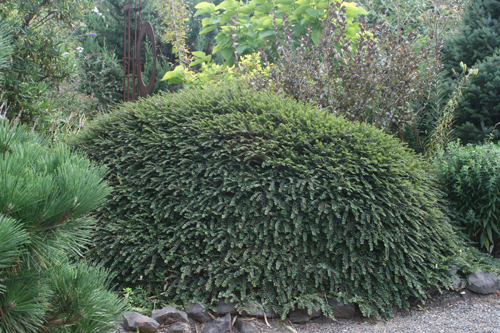
It is a creeping, low-growing shrub with a crown pressed to the ground, forming dense mats. It reaches 25-45 cm in height, while spreading 1-1.5 m in width. Shoots are widely spreading, creeping and prostrate, rooting, irregularly and densely branched, with branches ascending. Bark reddish-brown, grayish-brown or gray-black.
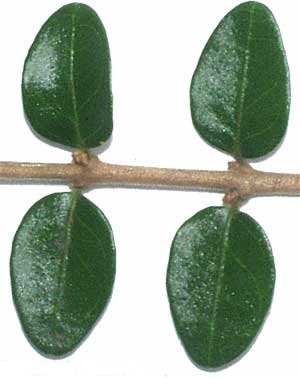
Leaves broadly ovate or obovate in shape, slightly undulating, 0.6-1.5 cm long and 0.4-1 cm wide, base broadly cuneate or rounded, shortly acuminate, with a short mucro or small point at the apex, often rounded, dull and densely green above, glabrous, below – light green and slightly pubescent. In autumn they turn scarlet to dark wine-red. Petioles very short.
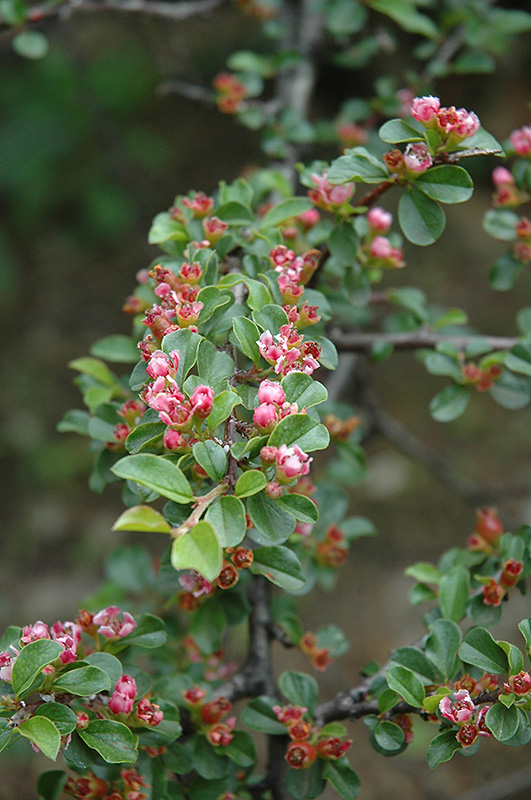
Flowers small, borne in pairs or singly, white, reddish-pink at the tip. Petals 5, small, obovate, erect. Sepals oval, triangular, pointed, shorter than the petals. Stamens 10-15. Flowers in May–June. A good nectar plant. Begins to flower and fruit at 9 years of age.
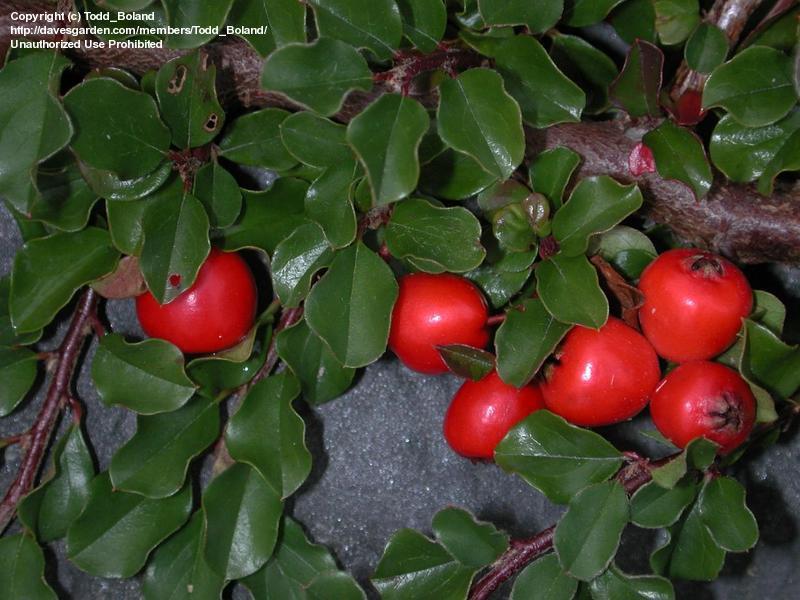
Fruits globose, up to 0.6 cm in diameter, bright red, with 2 small stones inside. Ripen in September.
Cultivars: 'Little Gem' ('Tom Thumb'), 'Praecox' (cotoneaster adpressus var praecox),
Hardiness zone: zone 5-8 (-23°C). Overwinters under snow.

Location: Light-loving mesoxerophyte, mesotroph, mesotherm; can tolerate light shade. Tolerates urban conditions well. Drought-resistant.
Propagation: Seed germination is medium. Propagated by layering and cuttings.
Soil: Not demanding with respect to soil fertility. Grows on all garden soils that are well-drained. In nature it occurs on moderately dry to fresh soils, from slightly acidic to strongly alkaline, on sandy-loamy gravel, rich in nutrients.
Planting: planting mix – compost consisting of garden soil, peat and sand in proportions of 2:1:2.
Care: In hot and dry summers, to maintain ornamental appearance it is recommended to water the plant 1-2 times a month at a rate of 1-2 buckets per plant.
Pruning: tolerates clipping and pruning well. After pruning it regrows well while retaining its growth form. When shaped it forms dense hedges and sculptural groups. Recommended pruning – by 1/3 of the annual shoot length, especially where a dense and compact habit is required.
Diseases: Fusarium (remove and burn affected parts)
Pests: apple aphid, plum sawfly, cotoneaster mite.
Uses: widely used in solitary and group plantings on rock gardens.