
Deciduous shrubs
Sharp-leaved cotoneaster
Cotoneaster acutifolius
Synonyms: Cotoneaster acutifolius f. Glabriusculus, Cotoneaster acutifolius var. laetevirens, Cotoneaster acutifolius var. Pekinensis, Cotoneaster hurusawaianus, Cotoneaster konishii, Cotoneaster laetevirens, Cotoneaster niger var. Acutifolius, Cotoneaster ottoschwarzii, Cotoneaster pekinensis, sharp-leaved cotoneaster, Cotoneaster acutifolius Turcz., Cotoneaster acutifolia, Cotoneaster sinensis hort. ex Rehder. , Cotoneaster niger var. acutifolius (Lindl. ex Ledeb.) Wenz., Cotoneaster acutifolius var. pekinensis Koehne, Cotoneaster acutifolius f. glabriusculus Hurus.
Sharp-leaved cotoneaster (Cotoneaster acutifolius) – a species of non-spiny shrubs of the genus Cotoneaster of the family Rosaceae. It was first described by the noted Russian botanist-systematist Nikolai Stepanovich Turczaninow in 1832. In cultivation since 1883.
In the wild it grows on slopes, in foothills, gullies, forests and forest thickets, fields, mountain valleys, on open meadows. It ascends to altitudes of 1000-3700 m. Grows in China (provinces Anhui, Gansu, Hebei, Henan, Hubei, Central Mongolia, Qinghai, Shaanxi, Shanxi, Sichuan, Taiwan, Tibet Autonomous Region, Yunnan), Korea, Taiwan, also in Mongolia and Russia (Buryatia, Irkutsk region).
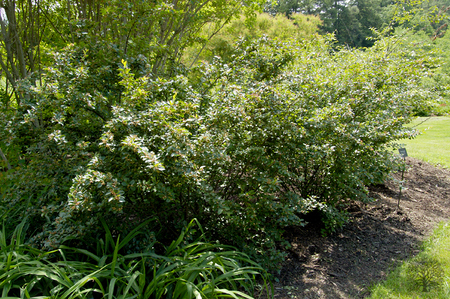
It is a small deciduous shrub up to 2-4 m in height and the same in width. It grows rapidly. Crown spreading, dense with widely outstretched brown branches. Shoots pubescent, later glabrous, reddish-brown in color.
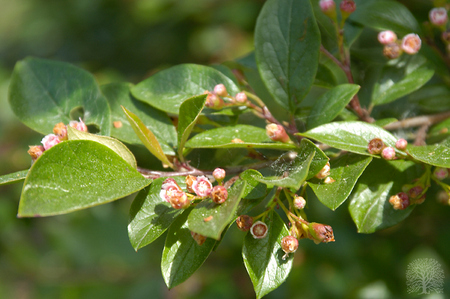
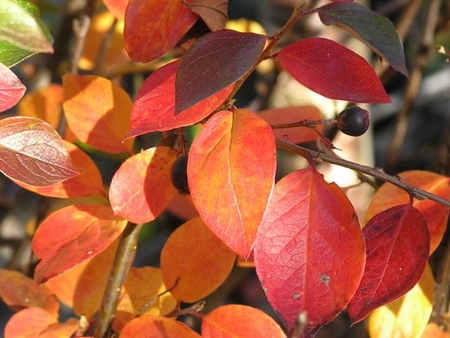
Petiole 2-5 (10) mm long, pubescent, red. Stipules deciduous, brown, linear-lanceolate, 3-5 mm long, slightly hairy. Leaf blade elliptic-ovate to oblong-ovate, 2-4 (5) cm long and 1-2 (3) cm wide, acute or slightly drawn out to an acuminate tip, with a broadly cuneate base, firm, dull green above, initially pubescent on both sides, later glabrous. In autumn the leaves take on crimson-yellow tones.
Flowers small, grouped 2-5 together in small corymbs 2-4 cm in diameter. The main axis of the flowering shoot and the pedicels are covered with hairs. Bracts linear-lanceolate, 3-5 mm, slightly hairy. Pedicel 3-5 mm. Flowers 7-8 mm in diameter. Hypanthium campanulate or later cylindrical, glabrous or covered with hairs. Sepals triangular, 1-2 mm long and 1.5-2 mm wide, with an acute or obtuse apex. Petals erect, white with a reddish tint, broadly obovate or oblong, 3.5-4.5 mm long and 3-4 mm wide, glabrous, with a slightly tapered base and blunt tip. Stamens 10-15, shorter than the petals. Styles 2, free, not exceeding the stamens in length. Flowers in May-June.
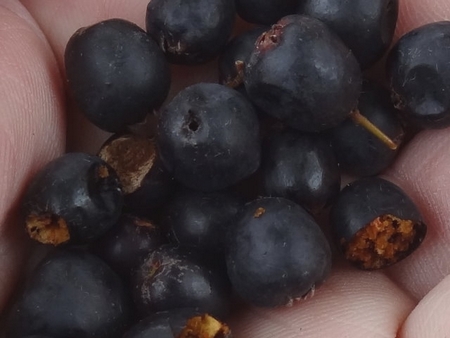
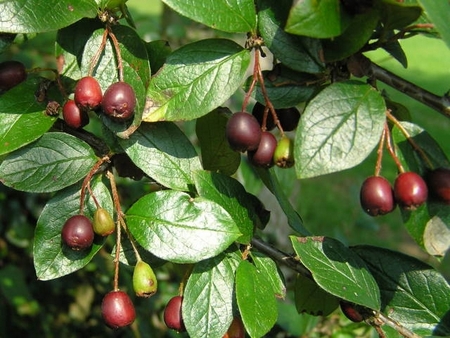
Fruits blue-black, ellipsoid, obovoid or almost spherical, 6-8 (10) mm in diameter. Ripen in September-October. Begins to fruit at 5 years.
Forms:
- Cotoneaster acutifolius var. Acutifolius
- Cotoneaster acutifolius var. Lucidus
- Cotoneaster acutifolius var. villosulus
Hardiness zone: zone 5 (-29°C).

Location: sun-loving, but tolerates light shade. Tolerates urban conditions well. Drought-tolerant.
Propagation: propagated by seeds and vegetatively. Cuttings root poorly. Take cuttings in the second half of July. Substrate – peat and sand in equal proportions. Seeds require stratification.
Soil: prefers light sandy, loam-sandy, sandy-clay, loamy, moderately moist soils. Optimal pH level 5.5-7.5.
Planting: planting mixture – compost consisting of turf soil, peat and sand in proportions 2:1:2. Planting should be carried out to a depth of at least 40-50 cm. Recommended spacing between plants – 1.5-2.4 m.
Care: in hot and dry summers, to maintain ornamental appearance it is recommended to water the plant 1-2 times a month at a rate of 1-2 buckets per plant.
Pruning: tolerates clipping and pruning well. After pruning it regrows well while maintaining its growth form.
Diseases: Fusarium (remove and burn affected parts)
Pests: apple aphid, plum sawfly, cotoneaster mite.
Uses: Ornamental for its dense spreading crown, autumn leaf color and black fruits. Used for creating low and high hedges, also effective as a freely grown specimen in solitary planting, in compositions with other shrubs or perennials, can be grown in a container. Attracts birds to the garden.