
Deciduous shrubs
Large Hazel 'Purpurea'
Corylus maxima purpurea
Synonyms: Corylus maxima 'Purple Filbert'
Large hazel "Purpurea" – a cultivar of large hazel. It was awarded the Royal Horticultural Society Award of Garden Merit (RHS). The cultivar was raised in England in 1836.
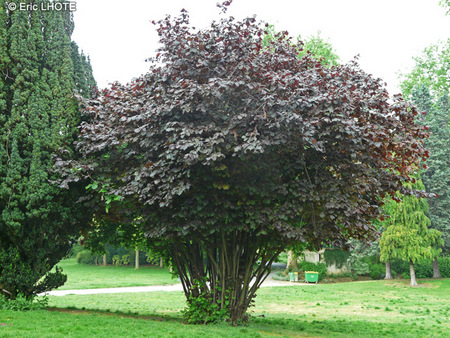
It is a large deciduous shrub with numerous stems and a vertically broad-spreading, umbrella-shaped crown. Young plants grow slowly at first, later faster. Reaches 4-6 m in height and width. Young shoots are brownish, densely pubescent.
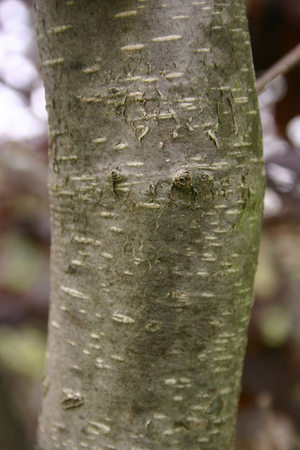
Bark ash-gray, smooth.
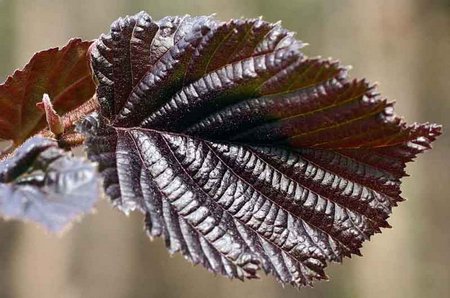
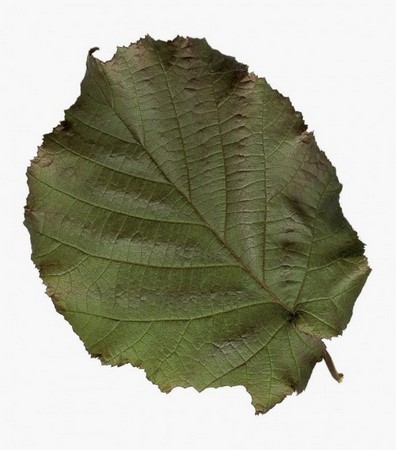
Leaves rounded heart-shaped, 8-14 cm long, slightly lobed and shortly acuminate, dark red with a metallic sheen when emerging, less intense in summer, becoming brownish-green in shade, covered with fine hairs along the veins, borne on a short petiole.
Root system shallow with numerous roots, sensitive to compaction.
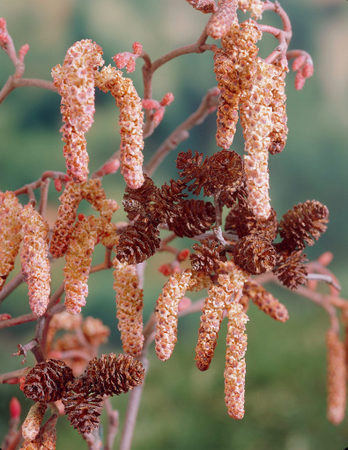
Blooms in April-May, before leaf emergence. Flowers are numerous yellow-red catkins up to 10 cm long and 1 cm wide. The plant is monoecious, with cross-pollination.
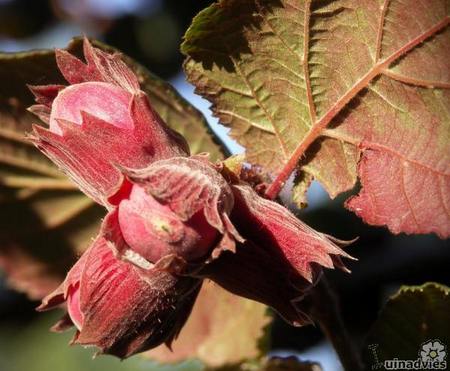
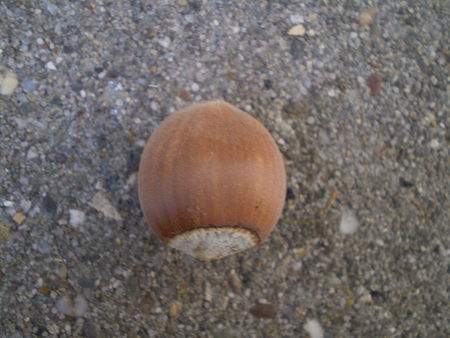
Fruits large cylindrical edible nuts up to 2 cm in diameter, borne in clusters of 3-6 on stalks, enclosed in fleshy bracts twice as long as the nut, initially tightly fitting, later elongated into a tube split into narrow toothed lobes, burgundy in color.
Hardiness zone: 5 (−15°C). In severe winters the tips of shoots may suffer frost damage.

Position: Grows on all soils from slightly acidic to alkaline, from dry to moist. Prefers fertile soils. Performs poorly on strongly acidic and waterlogged soils. Light-loving but tolerates partial shade. In shade it flowers very little and loses the burgundy leaf color. Does not tolerate drought. Performs well in urban conditions.
Planting: Optimal seedling age is 2 years. Planting is best done in autumn. Planting hole size 50x60 cm. Into the hole add 10-15 kg of humus, 200 g superphosphate, 50 g potash and mix with the top layer of fertile soil. Before planting, seedlings should be cut back to 20-25 cm, and roots dipped in a slurry of clay and manure. Spacing between plants 4-5 m, slightly closer in a hedge. Requires several pollinating cultivars for good pollination.
Care: consists of shallow cultivation of the root circle, mulching (for example with mown grass). Watering is recommended during dry periods.
Pruning: should be carried out in early spring before the start of sap flow. Requires only sanitary pruning.
Propagation: cuttings root poorly. Seeds require stratification. For this they are first soaked in warm water for 48 hours, then kept in warmth for 2 weeks, after that subjected to 3-4 months of cold stratification. Germinates in 1-6 months at 20°C.
Pests: hazel leaf beetle, nut weevil, hazel leafroller, bud mite, rodents.
Diseases: anthracnose, gray mold and fruit rot.
Uses: grown as a fruit-producing plant. Also attractive as a specimen or in group plantings, and in woody-shrub or color-themed groups.