
Deciduous shrubs
Clethra
Clethra L.
In the wild it is often found along the edges of forest streams or bogs, where it often forms dense thickets.
A shrub in the Ericaceae family reaching up to 2 m in height. The species Clethra blooms with very fragrant white "candles" resembling bird cherry clusters, beginning at the end of July, and the latest of the cultivars, "September Beauty" in mid-September. Other cultivars flower in between.

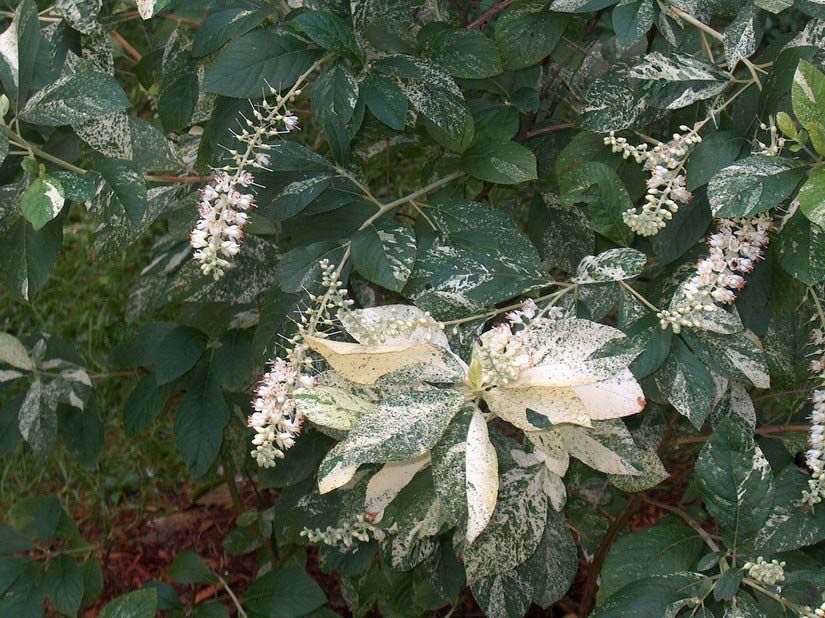
There are many white cultivars that mainly differ by flowering time, and pink ones ranging from the pale pink "Rosea" to the dark pink "Ruby Spice". There is a very interesting variegated form "Creel Calico". Almost all of them grow to 2.5 m (in 5 years), but there are miniature cultivars "Hummingbird" and "16 Candles" that reach 0.8–0.9 m. It flowers on current-year shoots, so sanitary and formative pruning can be carried out either in late autumn or in spring.
It's not easy to propagate Clethra yourself. The thing is that in our climate seeds ripen only in a long warm autumn, and cuttings root rather poorly (as with the vast majority of the Ericaceae) and only after treatment with rooting stimulants. Pre-sowing seed treatment is not required. Sowing depth: 0.2 cm.

In ornamental gardening it is practically indispensable for plantings in partially waterlogged (in this case it even tolerates full sun) or seasonally wet shady lowlands. It is also very often used in mixed plantings with rhododendrons, azaleas and Kalmia, since cultural requirements are practically the same, but Clethra provides flowering at a time when they have long since finished blooming.
One drawback is the late leafing; the shrub is completely covered with foliage only closer to the end of May, but this drawback is more than offset by the fact that the bright yellow autumn foliage persists into late autumn. As with deciduous rhododendrons, you need to find the right balance of sun and shade when planting for full flowering and autumn leaf color.

Source: http://flower.onego.ru