
Deciduous shrubs
Grey willow
Cinerea L.
Synonyms: grey willow, ash-grey willow, Salix acuminata Mill., Salix aquatica Sm., Salix deserticola Goerz ex Pavlov.
Grey willow (Salix cinerea L.) – a species of deciduous shrubs in the genus Salix (Salix) of the family Salicaceae. In nature it occurs practically throughout Europe, Asia Minor, the Transcaucasus, Western Siberia and Kazakhstan; in Ukraine it grows across the whole territory except the highlands of the Carpathians. Naturalized in New Zealand and Australia. Grows in marshy places, grassy and mossy bogs, in mixed wet forests, near ditches, and on floodplain meadows. Grows as separate shrubs or forms tussocks; in some places it forms extensive thickets.
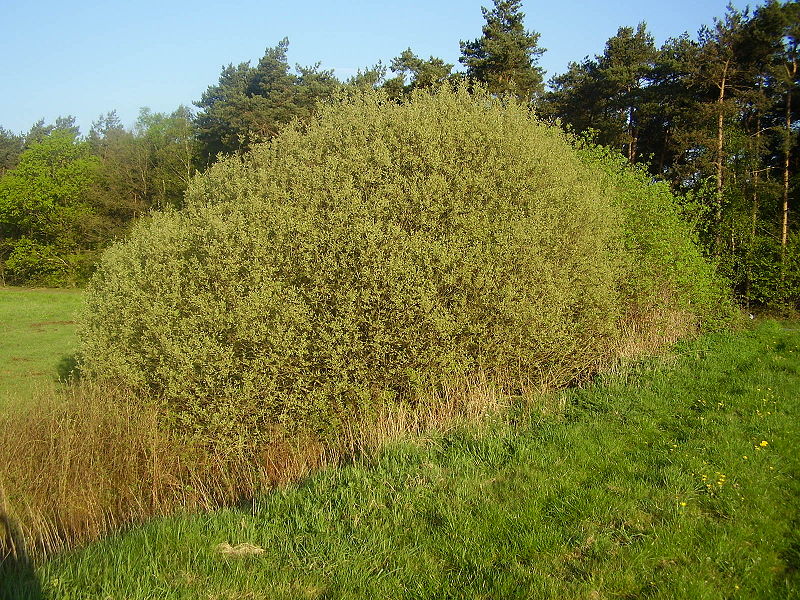
It is a tall shrub up to 3-5 (6) m in height and 3-5 m in diameter. Grows quickly, 30-50 cm per year. Crown dense, rounded. Bark on old branches and trunk ash-grey. Branches brittle, thick, densely leafy, greenish-grey. 1-2-year shoots densely covered with grey or dark grey hairs, rarely with a velvety, almost black felt. On exposed wood long numerous scars are noticeable.
Buds flattened, blunt, spreading, brown, grey-hairy, up to 4 mm long and 2 mm wide. Stipules semi-cordate or bud-shaped, toothed.
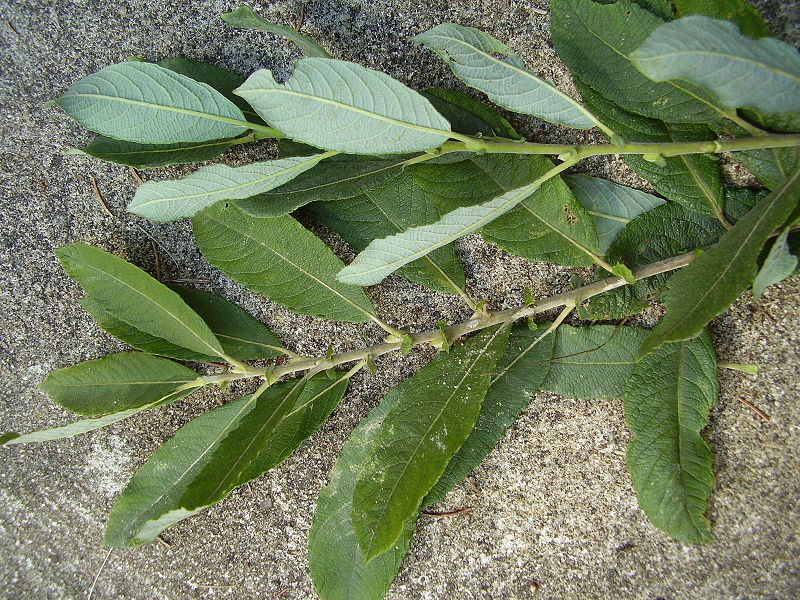
Leaves from obovate to narrowly lanceolate, with a cuneate base, shortly and cuneately acuminate, with a short triangular tip, 4-12 cm long and 1-3 cm wide, with a toothed or indistinctly crenate, less often entire margin, dark green, weakly wrinkled above, with somewhat impressed veins, grey-green or ash-grey beneath, grey and curly-hairy. Petioles short, pubescent.
Bract scales brown, darker above, spatulate, covered with long white hairs.
 |
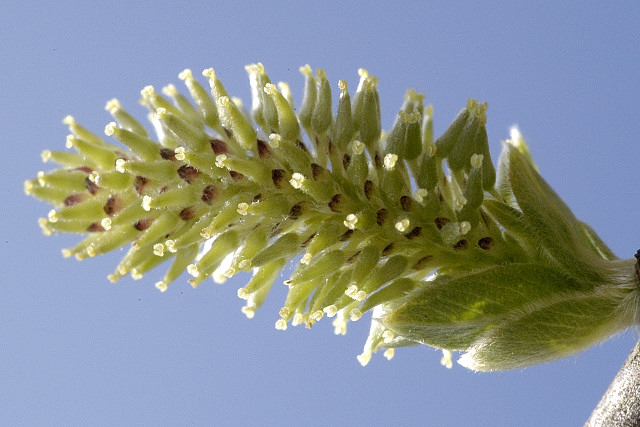 |
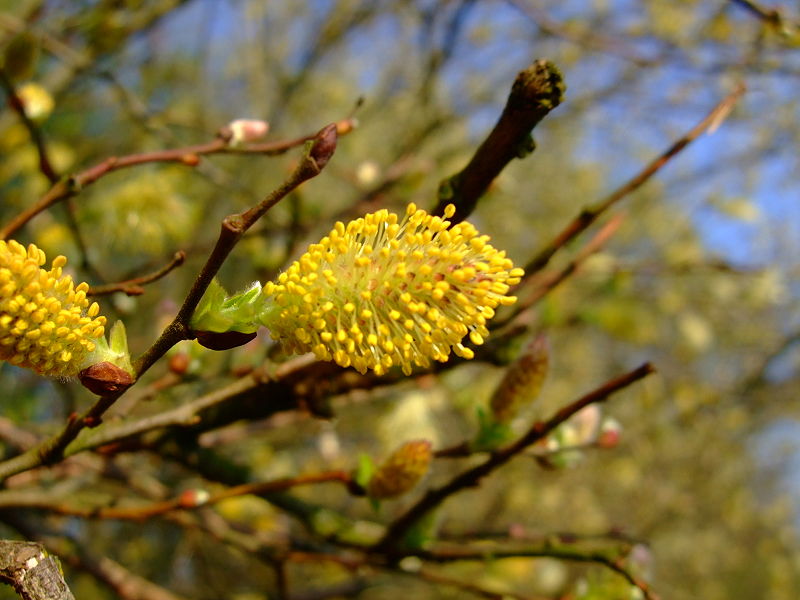
| Male catkins | Female catkins |
Flowers in April, before leaf unfolding or simultaneously. Male catkins thin, almost sessile, densely flowered, 2 cm long, grey-silky, later yellow, with 3-7 small bracts at the base. Stamens 2, anthers golden-yellow, nectary oblong, solitary, posterior. Female catkins cylindrical, greenish, 3-4 cm long, up to 8 cm when fruiting, ovary grey-woolly, elongated-conical; style short, sometimes divided.
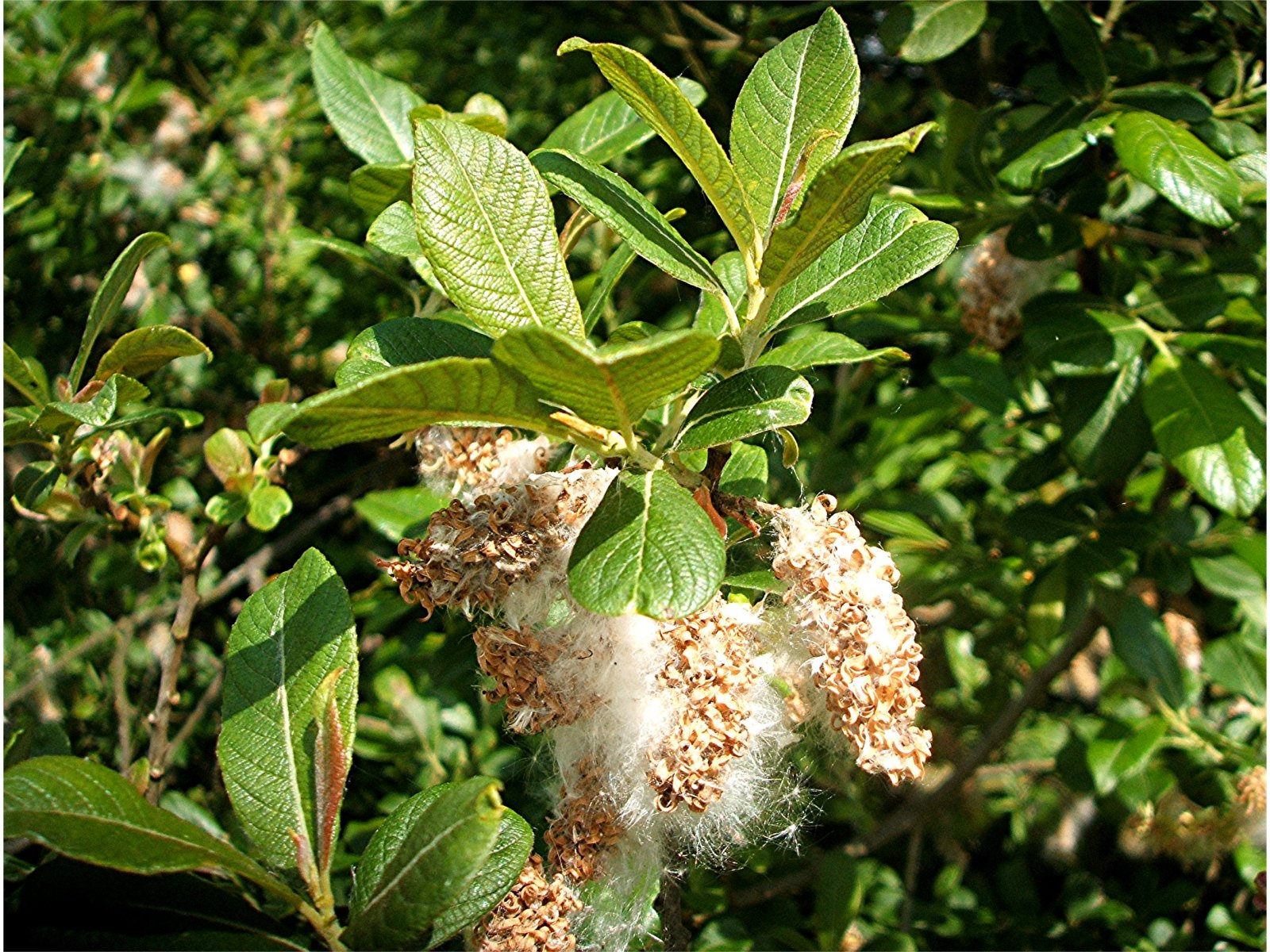
Fruits – small capsules up to 3 mm long, on a short stalk.
Hybrids:
- with Salix aurita L. – Salix × multinervis Doell
- with Salix caprea L. – Salix × reichardtii Kern.
- with Salix fragilis L. – Salix × boulayi F. Gerard
- with Salix myrsinifolia Salisb. – Salix × puberula Döll
- with Salix phylicifolia L. – Salix × laurina Sm.
- with Salix starkeana Willd. – Salix × coerulescens Döll
- with Salix triandra L. – Salix × eriophora Borbás
- with Salix viminalis L. – Salix × holosericea Willd.
Forms: f. acuminata Rafin., f. obovata Gan., f. longifolia Anderss., f. angustifolia Doll.
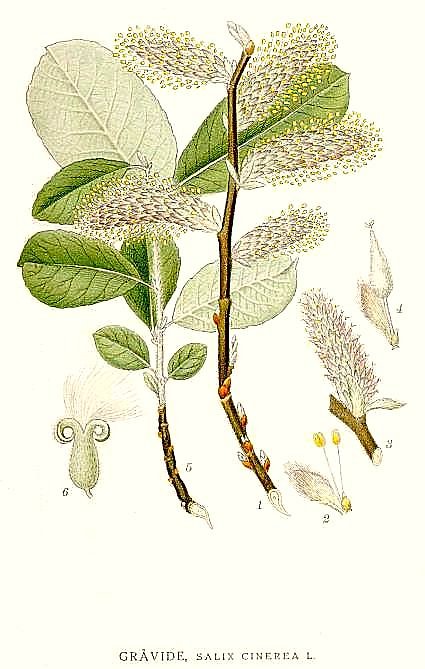
K. A. M. Lindman «Bilder ur Nordens Flora», 1917—1926
Hardiness zone: 3a (-45°C)

Location: light-loving, moisture-loving, easily tolerates over-wetting and temporary flooding, can grow on waterlogged soil. Undemanding and very hardy, tolerates urban conditions well.
Soil: does not like calcareous soils.
Planting: Best planted in spring before budburst. When establishing a "ivnyak" (willow stand) it is recommended to cultivate the soil in autumn to a depth of 30-80 cm, depending on its fertility and dryness. The top organic layer should be turned upside down. Recommended spacing between seedlings should be not less than 0.6-2 m, depending on the species. Planting depth – 40-70 cm. Transplanting is recommended up to 3-4 years of age. On heavy soils drainage with crushed stone or sand with a layer of 20-30 cm is recommended.
Pruning: tolerates trimming and pruning well. Regular pruning of dead shoots and shaping of the trunk and crown is recommended. For creating living hedges annual cutback to the stump (coppicing) is necessary.
Care: practically requires no care.
Propagation: by cuttings and seeds. Seeds lose viability after 10 days. Winter cuttings practically do not root; green cuttings treated with Kornevin root 100%. Can also be propagated by grafting onto other Salix species.
Pests: Cecidomya saliciperda, Cecidomya salicis, Tortrix (Helias) Chlorana, Agrotis vallugera, Bombyx Salicis, Curculio crux, Phratora vulgarissima, Phratora vitellinae, Galer ucacapreae, Galer lincola, Arvicola terrestris.
Diseases: affected by fungal diseases – fungi of the genera Melampsora, Rhytisma, Erysiphe.
Uses: used for planting along ditches and water bodies. A good honey plant, honey productivity reaches 120-150 kg/ha. Considered the best tanning willow. Shoots can be used for coarse weaving. Bark and leaves are used in medicine.