
Conifers
Weeping Himalayan cedar
Cedrus deodara 'Pendula'
A large evergreen, monoecious tree that in appearance often resembles a larch. The cedar genus consists of 4 species, one of which grows in the western Himalayas, and the others in the Mediterranean. These species vary greatly, so classifying old trees is fairly difficult. In addition, differences in branching disappear with age. Cedars are characterized by large cones, upright, solitary, barrel-shaped or elongate-ovoid, maturing in 2–3 years and then disintegrating.
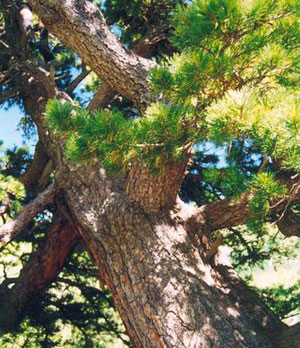 Weeping Himalayan cedar is a medium-sized, picturesque ornamental tree for solitary planting on lawns and in gardens. In the wild it occurs in the northwestern Himalayas and Afghanistan. The tree reaches 15–20 m in height and 2–4 m in width. A weeping crown with an upright trunk and arching branches that hang to the ground. Needles are gray-green, 3–5 cm long, up to 30 in a bundle on short shoots. Prefers nutrient-rich, permeable soil and sunny, wind-protected locations. Winter protection is necessary, especially for young plants. Hardiness zone 4.
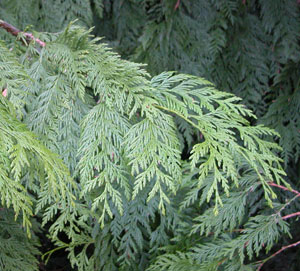 The tree has a broad conical crown. In mature trees it is flat-topped with drooping branchlets on spreading branches. Young shoots are pubescent. The cedar's foliage is light green in bundles and slightly longer than in other species (5 cm). Cones reach 10 cm, ovoid in shape. Young cones have a bluish tint, later becoming reddish-brown. Himalayan cedar (weeping) is a long-lived and fast-growing species. It tolerates shade better than other species and prefers high humidity.
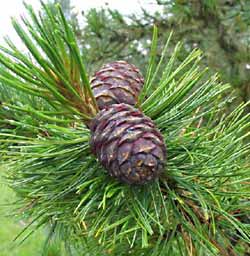 It should be noted that this cedar is demanding regarding soil. It tolerates temperatures down to -25°C without significant damage. However, it suffers greatly from a high amount of lime in the soil; the cedar is susceptible to a disease—chlorosis. When diseased, its needles turn yellow and growth slows. Overall, the Himalayan cedar is a very striking and beautiful tree. Its forms are widely used in park landscaping; it looks magnificent and stands out among other trees with elegant crown outlines and richly green foliage. The weeping Himalayan cedar is also popular for solitary and avenue plantings in squares and parks. Cedar tolerates pruning well, thereby forming living hedges. The tree has been in cultivation since 1822.
Description: a medium-sized, slow-growing tree.
Root system: tolerates being covered with porous materials well.
Light requirements: sun.
Hardiness: zone 4.
Growing conditions: may lose needles when space is limited, prefers cool, moist locations, wind-resistant. Soil should be well-drained, from dry to fresh.
Care requirements: requires special care.