
Conifers
Cedar
Cedrus
Cedar – an oligotypic genus of coniferous trees in the family Pinaceae. The main range is the countries of the Mediterranean (1000-2200 m above sea level) and the Himalayas (1500-3200 m above sea level).
Members of the genus are evergreen trees 30-40 m in height, less often 60 m, with a spreading crown. Slow-growing in youth. Bark on young trees smooth, on old trees scaly, fissured, dark gray. Shoots are elongated and shortened, the former with spirally arranged needles.
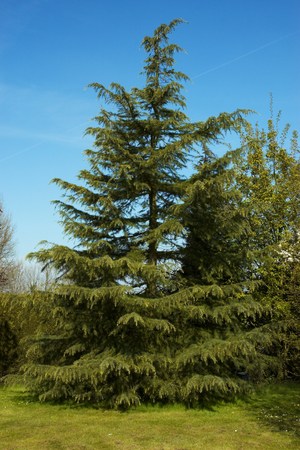
Himalayan cedar
Needles three- or four-sided, needle-like, prickly, stiff, from dark or blue-green to silvery-gray. Stomatal lines are located on all sides, gathered in fascicles of 30-40, borne on leaf cushions. Two resin ducts are located in the epidermis.
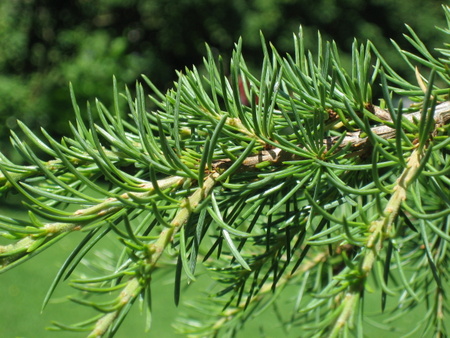
Needles of the Lebanon cedar
It flowers in autumn. Male catkins are borne singly, at the ends of short shoots, at the base surrounded by tufts of needles, erect. Female catkins reach 5 cm in length, stamens numerous, arranged spirally, almost sessile. Each stamen has two fused anthers that split longitudinally. Pollen has air sacs.
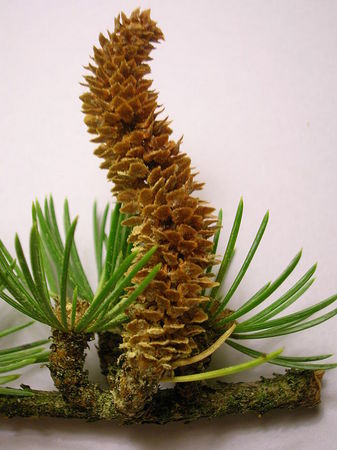
Male catkin of the Lebanon cedar
Cones erect, solitary, ovoid-elongated or barrel-shaped, ripen in the second or third year and disintegrate during autumn or winter. Seed scales numerous, arranged spirally, imbricate and appressed, with two seed cavities at the base. Bracts (covering scales) small, not visible externally.
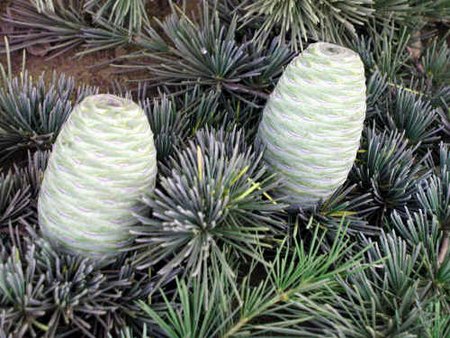
Cones of the Himalayan cedar
Seeds triangular, 10-15 mm long, with resin cavities, with a thin coat. Wings large, 20-30 mm long, attached to the upper side. The weight of the wings is 10% of the total weight of the seeds.
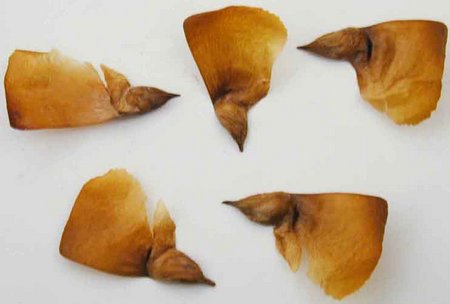
Seeds of the Lebanon cedar
Classification: The genus is divided into 2 species and 5 subspecies:
- Himalayan cedar (Cedrus deodara)
- Lebanon cedar (Cedrus libani):
- Atlas cedar (Cedrus libani var. Atlantica)
- Lebanon cedar (Cedrus libani var. Libani)
- Cyprus cedar (Cedrus libani var. Brevifolia)
- Turkish cedar (Cedrus libani var. Stenocoma)
According to the old classification, these subspecies were considered separate species.
Hardiness zone: 5a (-27°C)

Location: requires well-aerated and well-drained soil, very sensitive to waterlogging. Grows well on poor calcareous soils. Prefers sunny open sites, but can grow with slight shading.
Planting: Recommended spacing between plants – 4-8 m. When planting in clay soil it is recommended to add sand to the planting hole. Size of the planting hole – 50-70x70 cm. Fill the hole with a mixture of topsoil and humus in a ratio of 3:1, and also a cup of wood ash or 200-250 g of a balanced mineral fertilizer.
Care: In the first year after planting it is recommended to cover the seedling with a thin layer of gauze or covering material from March to April. If a white coating appears on the shoots, it is recommended to use a weak solution of onion skins or household soap; specific fungicides may also be used. If webs appear on the tips of shoots, treat with insecticides (Actellic, Decis).
Pruning: do not remove lateral branches
Diseases: mottled-red trunk rot, seed mold, rust fungus, pishchukha, brown central and prismatic rot, Schweinitz's polypore, white root rot.
Pests: adelgid, flower chafers, small black chafer, cone gall midge, conifer looper, spruce seed moth, moth (tortricid), Siberian silk moth, gypsy moth, monk moth, coniferous tussock moth, cedar leafroller, conifer looper, black-and-yellow and red pine sawflies, six-toothed bark beetle, large black spruce longhorn beetle, Siberian engraver, Siberian spruce sawyer, cedar bark borer.
Propagation: by seeds, cuttings, grafting. Seeds require stratification.
Conservation status: not under protection.
Uses: Widely used in park plantings, in groups and solitary plantings. Used in the perfume industry. Wood is very valuable and durable, used for construction, furniture and shipbuilding.