
Deciduous shrubs
Calycanthus or Sweetshrub
Calycanthus
The name derives from the Greek 'kalix' — a cup; 'anthos' — a flower, with a little cup like petals. Calycanths are deciduous, medium-sized shrubs whose shoots and leaves have a persistent, pleasant fragrance. Leaves are opposite, entire, rough to the touch, and fragrant when crushed. The perianth consists of numerous reddish-brown, narrow, uniform tepals. The fruit is a capsule up to 7 cm, resembling a poppy capsule.

The plant is not widely available for sale or in collections, despite being remarkably beautiful! It is a desirable acquisition for any garden. Indeed, in the CIS countries Calycanthus is extremely rare, and then only in cultivated plantings, since the plant is native to the forests of the southeastern United States, where it occurs in the wild from Virginia and North Carolina to Florida. The genus Calycanthus includes only four species. Three of them are found in cultivation in the southern regions of the Black Sea coast of the Caucasus, in Transcaucasia and in the countries of Central Asia. All three species are fairly heat-loving shrubs. With some light protection they also grow in the northern regions of Ukraine.

The most fragrant species, whose leaves and flowers are scented, but especially strongly the bark when dried. Because of this aroma the plant is regarded as a spice and is called the clove tree and Jamaica pepper (Allspice). It naturally occurs in the southeastern part of the USA — from Virginia to Mississippi.
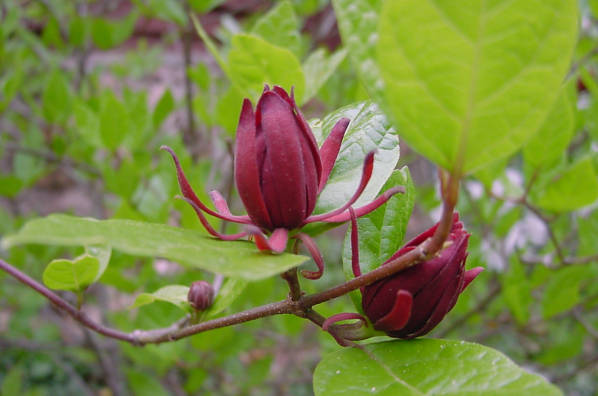
The most attractive species. It is a shrub 1–3 m tall with spreading branches and softly pubescent, ribbed, olive-brown shoots. Young leaves are densely hairy, later dense hairiness remains only on the underside of the leaves. Very beautiful are the unusually colored dark reddish-brown large, up to 5 cm in diameter, fragrant and appearing velvety flowers, which appear in June–July. After flowering an impressive pitcher-shaped fruit up to 7 cm in size is formed. The plant tolerates frosts down to -25 C.
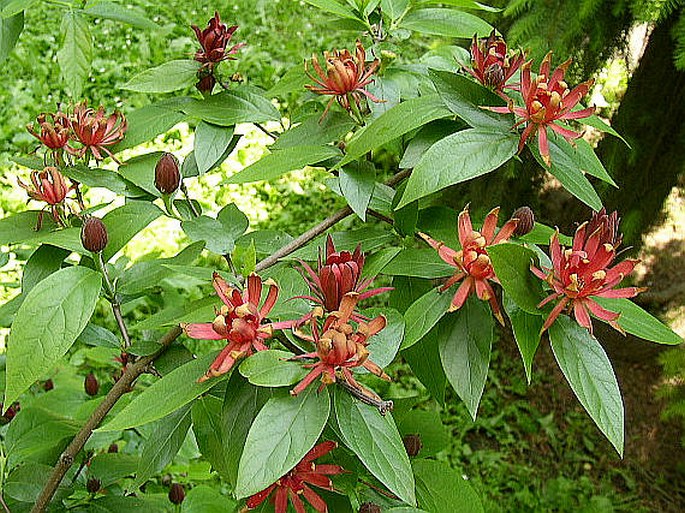
In cultivation abroad since the mid-17th century, and since the 19th century — in the southern Baltic region, the North Caucasus, Crimea and Belarus. In the central part of Russia it is very rare. A decorative form with ovate leaves is known (f. Ovatus), as well as cultivars 'Atheus' and 'Margarita' with ornamental flowers.
Calycanthus occidentalis — Calycanthus occidentalis Hook. et Am.
Occurs in western North America.

A spreading, loosely-branched shrub with twiggy shoots. Young branches are olive-green in color. Growing shoots are pubescent. The leaves of this species are the largest — 12–20 cm long and 5–8 cm wide, oblong-ovate, sometimes almost lanceolate, pointed at the tip, glossy green above, and light- or yellow-green below with sparse pubescence, sometimes glabrous. In June–July large flowers 5–7 cm in diameter are formed, brick-red in color with a slightly sour scent. It flowers less abundantly than C. floridus. After flowering ovoid fruits 4–5 cm long develop. The plant tolerates frosts down to -22 C.