
Deciduous shrubs
Thunberg's Barberry 'Kobold'
Berberis Thunbergii 'Kobold'
Synonyms: kobold japanese barberry
Thunberg's Barberry 'Kobold' – a cultivar of Thunberg's barberry. It was obtained by Van Klavern (Van Klavern) in Boskoop, the Netherlands, around 1960. Patent PP3,038 was granted in 1971.
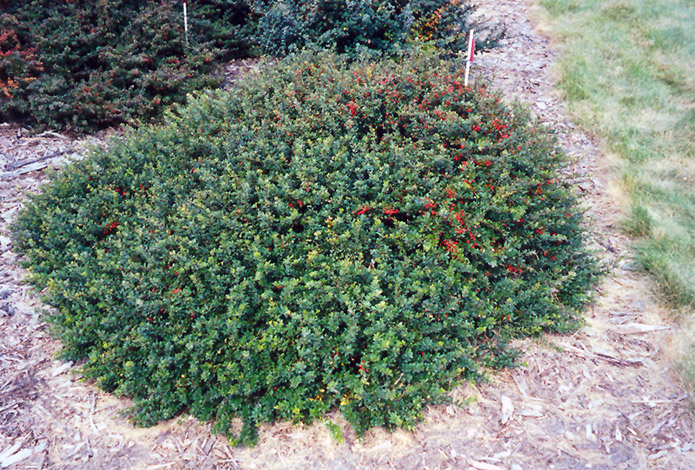
It is a small deciduous shrub with a cushion- or globe-shaped dense crown. It reaches 0.5 m in height and width. It grows slowly. The bark is reddish-brown. Shoots are curved, short, covered with light-brown bark and small three-part sharp spines.
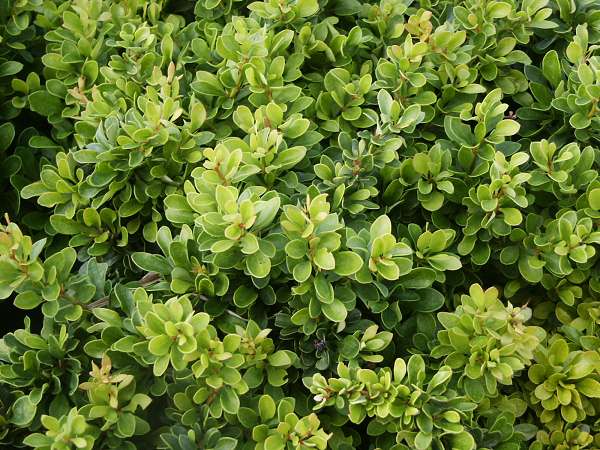
Leaves ovate, alternate, up to 1.5 cm long, small, emerald green, glossy. In autumn they turn yellow or scarlet red.
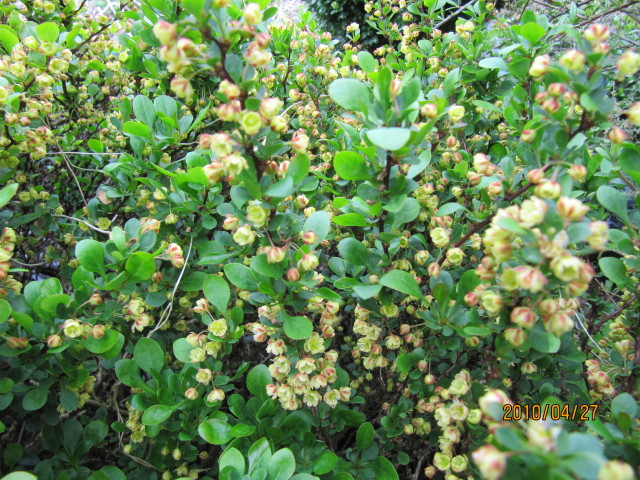
Flowers bloom rarely, in May. The flowers are small, bell-shaped, up to 1 cm in diameter, borne in small inflorescences, yellow, red on the outside, arranged along the stem.
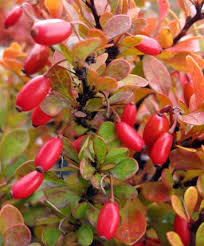
Fruiting occurs rarely; the fruits are pink or bright red, glossy, oblong-ellipsoid in shape, edible. They ripen in September and persist on the branches throughout the winter.
Hardiness zone: 4-6.

Location: light-loving, but tolerates partial shade. Heat-tolerant, winter-hardy, drought- and wind-resistant. Does not tolerate prolonged waterlogging. Prefers fertile, moderately moist soil. Tolerates urban conditions well.
Planting: planting is best done in spring or autumn. If the pH is above 7, it is recommended to lime the soil. Planting mix: peat, topsoil, humus, 400 g of slaked lime (if pH>7) and 200 g of wood ash. Planting hole dimensions: 40x40 cm. For single planting, the distance between plants should be 1.5-2 m. For creating a hedge, prepare a trench and place shrubs at a rate of 2 bushes per 1 linear meter.
Care: care consists of shallow loosening of the root circles and mulching. Watering is recommended at least once a week with 2-3 buckets per plant. In spring, a year after planting, nitrogen-containing fertilizers can be applied. Subsequently, nitrogen feeding is done no earlier than every 3-4 years. In the first 2-3 years it needs to be covered with conifer boughs.
Pruning: does not require trimming, as it forms a beautiful dense crown.
Propagation: by seeds and vegetatively.
Diseases: bacterial canker, powdery mildew, septoria leaf spot, infectious branch dieback, Phyllosticta leaf spot, leaf spot, rust fungus Puccinia graminis.
Pests: barberry aphid, barberry sawfly, barberry fruit moth, leaf-feeding insects.
Uses: used on rock and alpine gardens, rockeries, mixed borders, and for creating borders.