
Deciduous shrubs
Thunberg's barberry f. purple-leaved
Berberis Thunbergii 'Atropurpurea'
Synonyms: Berberis thunbergii var. atropurpurea Chenault, Berberis thunbergii f. atropurpurea (Chenault) Rehder, Berberis thunbergii DC, red japanese barberry
Thunberg's barberry f. purple-leaved – a form of Thunberg's barberry. Native to Japan. Cultivated since 1870.
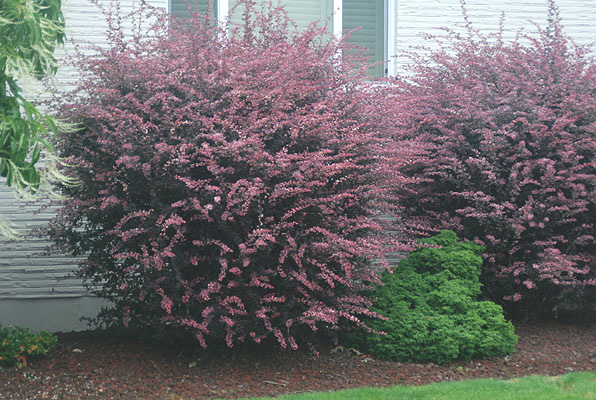
It is a deciduous shrub with a branched, broadly rounded crown. Main shoots grow vertically upward, lateral ones are arching. Reaches 1.5-2 m in height and width. Growth rate medium, 20-30 m per year. Shoots are light red, angled, covered with solitary small spines. Bark light gray to brown, irregularly furrowed.
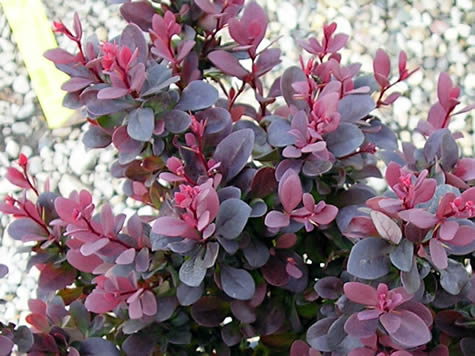
Leaves rounded or ovate, with entire margins, 3-3.5 cm long, purple-red in color, turning coral-red in autumn.
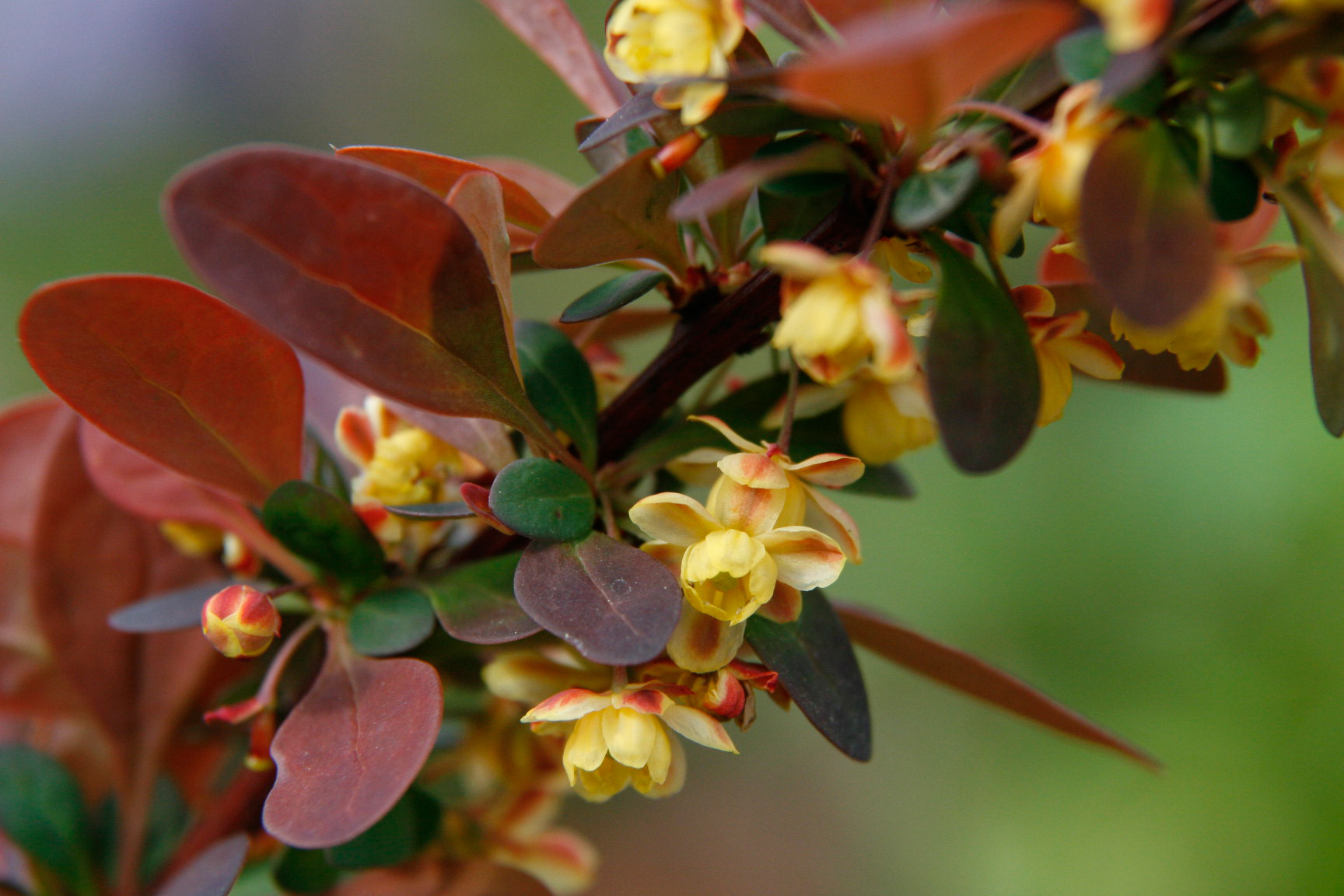
Flowers small, consisting of 6 petals, 5-6 mm in diameter, solitary, yellow-red, gathered in inflorescences of several flowers. Blooms abundantly in late May – early June, for about 20 days.
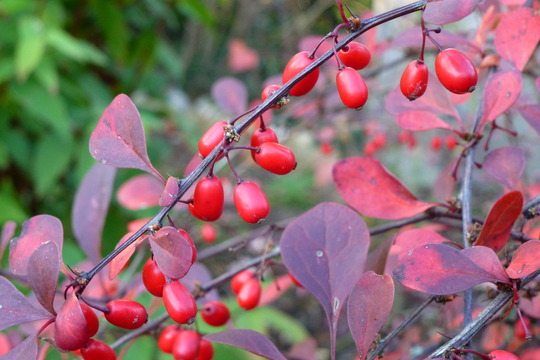
Fruits coral-red, fleshy, oblong, 0.8-1.1 cm long, ripen in September and remain on the branches for a long time. Seeds oblong, light brown, 2-5 mm long.
Cultivars: Berberis thunbergii Atropurpurea Nana, Berberis thunbergii 'f. atropurpurea Harlequin', Berberis thunbergii var atropurpurea 'Rose Glow', Berberis thunbergii f. atropurpurea Gentry (syn Royal Burgundy), Berberis thunbergii var. atropurpurea 'Helmond Pillar', Berberis thunbergii var. atropurpurea 'Concorde'.
Hardiness zone: 4-8(-29°C).

Location: sun-loving; with insufficient light the leaf coloration may fade. Heat-tolerant, winter-hardy, drought- and wind-resistant, relatively smoke-resistant. Does not tolerate prolonged waterlogging. Not demanding to soil, but prefers fertile, moderately moist, acidic or slightly alkaline soils. Adapts well to urban conditions.
Planting: planting is best done in spring or autumn. If soil pH is above 7, liming is recommended. Planting mix: peat, topsoil, humus in ratio 1:1:1, 400 g slaked lime (if pH>7) and 200 g wood ash. Planting hole size: 40x40 cm. For solitary planting, spacing between plants should be 1.5-2 m. To create a hedge, prepare a trench and place shrubs at a rate of 2 shrubs per running meter.
Care: care consists of loosening the root circles, but not deeply, and mulching. Watering is recommended at least once a week with 2-3 buckets per plant. In spring, one year after planting, nitrogenous fertilizers can be applied. Thereafter nitrogen feeding is done no earlier than every 3-4 years. In the first 2-3 years it needs to be covered with conifer boughs.
Pruning: tolerates clipping well.
Propagation: by cuttings, dividing the bush, by root suckers.
Diseases: bacterial canker, powdery mildew, leaf spot. Resistant to rust fungus.
Pests: barberry aphid, barberry sawfly, barberry fruit moth, leaf-eating insects.
Uses: a good nectar plant. Widely used in solitary plantings and for creating clipped hedges and tall espaliers. Can also be used in a loosely outlined group. Looks good in landscape compositions, in a formal area, can complement any group or serve as its focal point.