
Deciduous shrubs
Barberry × media 'Parkjuweel'
Berberis × media 'Parkjuweel'
Synonyms: Berberis ×hybrido-gagnepainii 'Park Juweel', Berberis ×media Park Jewel, Berberis 'Park Jewel', Berberis × hybridogagnepainii 'Park Juweel' Suringar
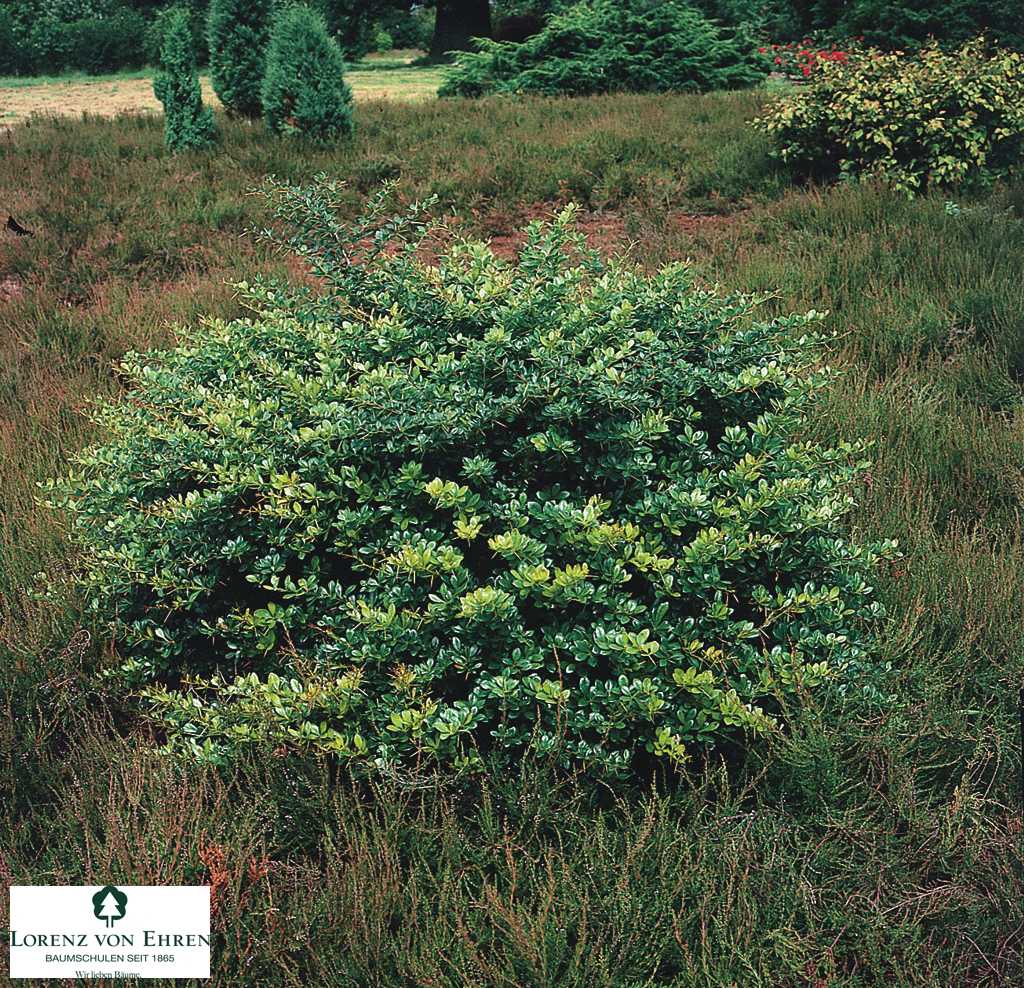
Barberry × media 'Parkjuweel' – a cultivar of Barberry × media. It is a hybrid of Berberis gagnepaini chenaultii, which belongs to the hybrids of Berberis gagnepaini and Berberis verruculosa. It was obtained in the mid-1950s in the Netherlands. The cultivar received the AGM award of the English Horticultural Society.
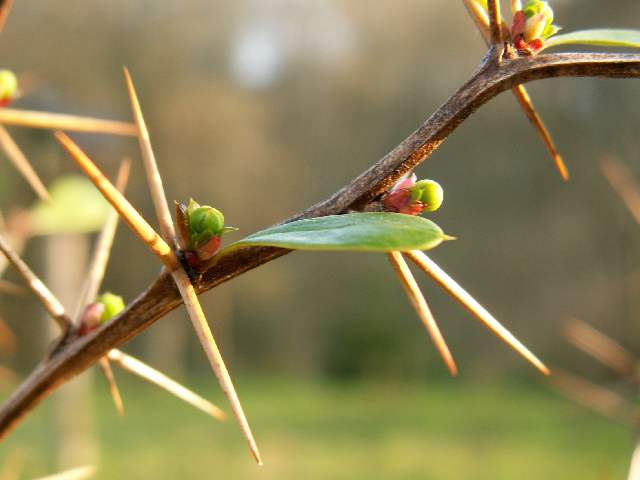
It is a semi-evergreen shrub. It reaches 1.5 m in height and 2 m in width. The crown is dense and rounded. Branches grow vertically, becoming arching to the sides with age. Bark ranges from reddish-brown to gray-brown, furrowed. Thorns are single or three-parted, up to 2.5 cm long, glossy, reddish-brown.
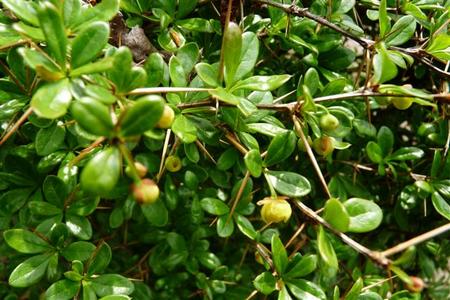
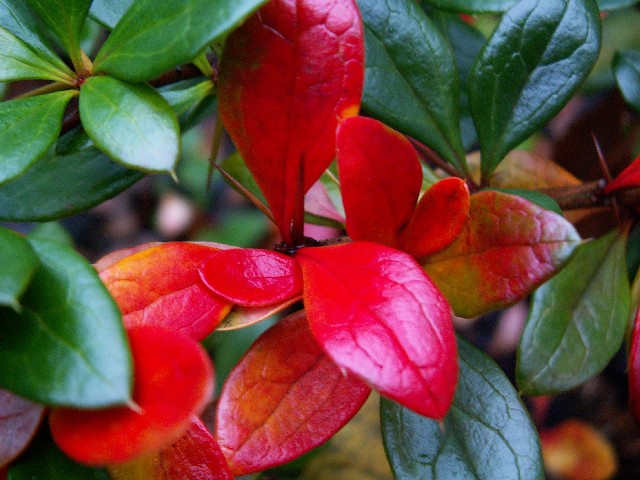
Leaves are obovate or rounded, large, up to 5 cm long, dark green above and bluish-green beneath, rigid, dense, with an entire or slightly serrated margin and a spine at the tip. In winter they acquire orange-red tones.
Blooms in May–June. Flowers are numerous, small, up to 8 mm in diameter, yellow, solitary or in racemes, fragrant. Fruits are black elongated berries, inedible.
Hardiness zone: 6a (-15°C).

Location: sun-loving, but can tolerate light partial shade. Heat-tolerant, winter-hardy, drought- and wind-resistant, relatively smoke-tolerant. Does not tolerate prolonged waterlogging. Not demanding to soil, but prefers fertile, moderately moist, acidic or slightly alkaline (pH = 4.5 – 7). Tolerates urban conditions well, resilient.
Planting: planting is best done in spring or autumn. If soil acidity is above pH 7, liming the soil is recommended. Planting mix: peat, topsoil, humus in a ratio of 1:1:1, 400 g of slaked lime (if pH>7) and 200 g of wood ash. Planting hole dimensions: 40x40 cm. For single planting, spacing between plants should be 1.5–2 m. To create a hedge, prepare a trench and place shrubs at a rate of 2 plants per 1 linear meter.
Care: care consists of shallow cultivation of the root collar areas (not deep), and mulching. Watering is recommended at least once a week with 2–3 buckets per plant. In spring, one year after planting, nitrogen fertilizers can be applied. Subsequently, nitrogen feeding is carried out no earlier than every 3–4 years. In the first 2–3 years it needs to be covered with conifer boughs.
Pruning: tolerates pruning well.
Propagation: by cuttings, division of the bush, and root suckers.
Diseases: bacterial canker, powdery mildew, leaf spot. Resistant to rust fungus.
Pests: barberry aphid, barberry sawfly, barberry fruit moth, leaf-eating insects.
Uses: used to create low borders, in planting compositions, and in rock and alpine gardens.