
Deciduous shrubs
Barberry
Berberis L.
Barberry – a diverse, large and botanically complex genus of shrubs, less often small trees from the family Барбарисовые (Berberidaceae). Widely distributed in central and southern Europe, in Ukraine (Crimea), Russia (northern part of the Petersburg area), in Persia, the Caucasus, Eastern Siberia, in North America, and Central Asia (including the Zailiysky Alatau in Kazakhstan).
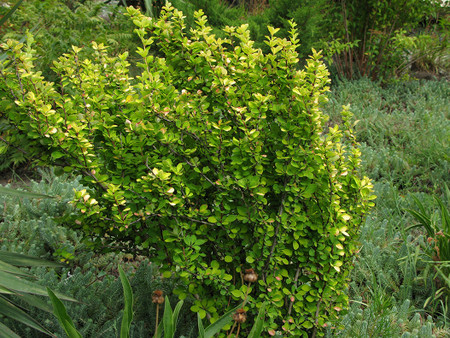
Common barberry
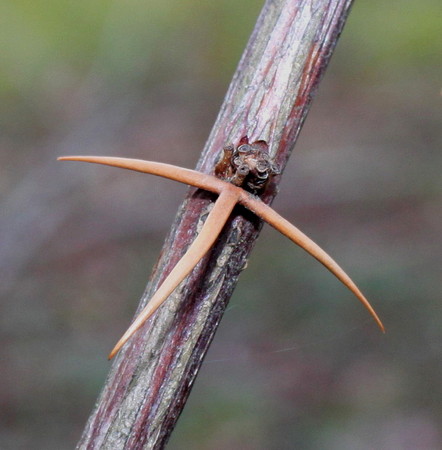
Members of the genus are evergreen, semi-evergreen or deciduous shrubs, less often small trees. Shoots are thin, erect, ribbed, branching at an acute angle, often covered with spines. Bark brownish- or grayish-brown.
Berberis hakeoides
Buds are bare or covered with sharp small scales (1-2 mm long), reaching 3-7 mm in length. In evergreen representatives of the genus the outer bud scales remain at the base of the young shoot.
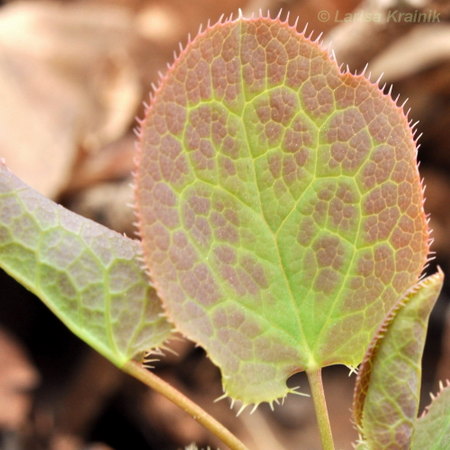
Amur barberry
Leaves are alternate, gathered in clusters of 4 (2-7), growing on shortened shoots; ovate, obovate, lanceolate or elliptic, glabrous, on short petioles. The leaf blade is bluish-green above, bluish and lighter below, margins entire, spiny-toothed or finely ciliate. Stipules are spiny-toothed, leaf-like or transformed into 1—3—5-part spines, which are larger and more robust on root suckers. In autumn leaves take yellow and red tones.
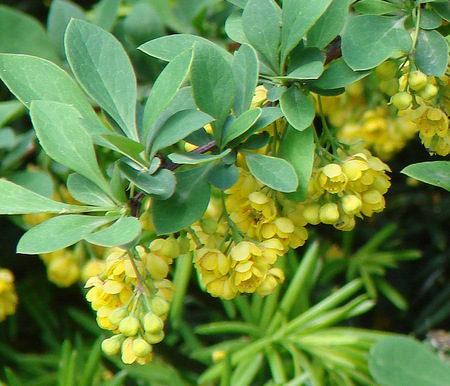
Thunberg's barberry
Flowers are arranged in racemes and located on short lateral shoots, less often in small-flowered clusters at the tips of shortened shoots. There are 8-9 sepals, colored and externally similar to petals, the outer ones smaller than the inner. The corolla consists of 6 yellow petals, each with two nectaries at the base. Stamens 6. Pistil 1. Style short with a unilocular ovary and a small number of ovules.
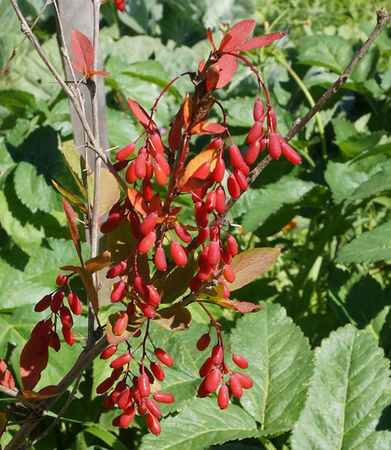
Common barberry
Fruits are elliptical, ovoid or almost spherical berries 0.8–1.2 cm long, black or red in color, with a dried persistent stigma and 1–5 seeds, not falling until winter. Seeds are ribbed, cylindrical, narrowed at the ends, shiny, brown, 4–6 mm long and 1.8–3 mm wide.
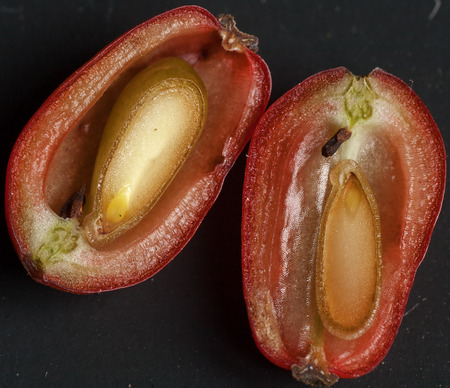
Common barberry
Species: the genus comprises about 580 species. Some of them:
- Berberis verruculosa Hemsl. & E.H.Wilson — Warty barberry
- Berberis hookeri Lem. — Hooker's barberry
- Berberis thunbergii DC. — Thunberg's barberry
- Berberis julianae C.K.Schneid. — Juliana's barberry
- Berberis gagnepainii C.K.Schneid. — Gagnepain's barberry
- Berberis vulgaris L. — Common barberry
- Berberis candidula (C.K.Schneid.) C.K.Schneid. — Bluish-white barberry
- Berberis ×stenophylla Lindl. - Narrow-leaved barberry
Hardiness zone: 4a.

Location: hardy, drought-tolerant. Not demanding regarding soil and can grow on poor soils. Grows well on dry and sandy soils. Prefers soil of neutral acidity but can also grow in higher acidity. Does not tolerate waterlogging. Light-loving.
Planting: planting is best carried out in spring or autumn. If acidity is above pH 7, liming the soil is recommended. Planting mix: peat, sod soil, humus, 400 g slaked lime (if pH>7) and 200 g wood ash. Planting hole dimensions: 40x40 cm. For single planting, spacing between plants should be 1.5–2 m. For creating a hedge, prepare a trench and place shrubs at a rate of 2 shrubs per linear meter.
Care: care consists of shallow loosening of the root circles and mulching. Watering is recommended at least once a week, 2–3 buckets per plant. In spring, one year after planting, nitrogen fertilizers may be applied. Further nitrogen feedings are carried out not earlier than every 3–4 years.
Pruning: many species tolerate formative trimming well.
Propagation: produces abundant suckers from the stump. Also propagated by seeds, division of the bush, and summer cuttings. Seeds require stratification immediately after collection. They can also be sown in autumn. Seeds are collected from September to November.
Diseases: bacterial canker, powdery mildew, septoria leaf spot, leaf rust, infectious dieback of branches, Phyllosticta leaf spot, leaf spot.
Pests: barberry aphid, barberry sawfly, barberry fruit moth, leaf-chewing insects.
Uses: Good nectar plant; the honey has a beautiful golden-yellow color and a sweet delicate taste. A yellow dye is obtained from the bark and wood. Berries are edible, widely used in medicine and for making drinks, candies, pastila, jams, and as seasonings. Wood is used for small turned items, shoemaker's nails, and for inlaying because of its decorative color and texture. Some species tolerate pruning well and are used to create hedges. Widely used for creating borders and edgings.