
Deciduous shrubs
Hooker's barberry
Berberis hookeri var. hookeri
Synonyms: Himalayan barberry, bluish-white barberry, little white barberry, white barberry, soft barberry, silvery barberry, Berberis wallichiana sensu Hook.f. non DC, Berberis Walichii
Berberis hookeri – a species of barberry from the genus Berberis (Berberis) of the family Berberidaceae. It occurs in the Himalayas, Sikkim (India), Bhutan. In the mountains it rises to an altitude of 2100-2900 m above sea level. It was discovered in 1859 on the summit of Sheopur (Sheopur, Nepal) by Dr. Wallich and around the same time by Dr. Joseph Dalton Hooker in the eastern Himalayas. In the same year it was introduced into cultivation.
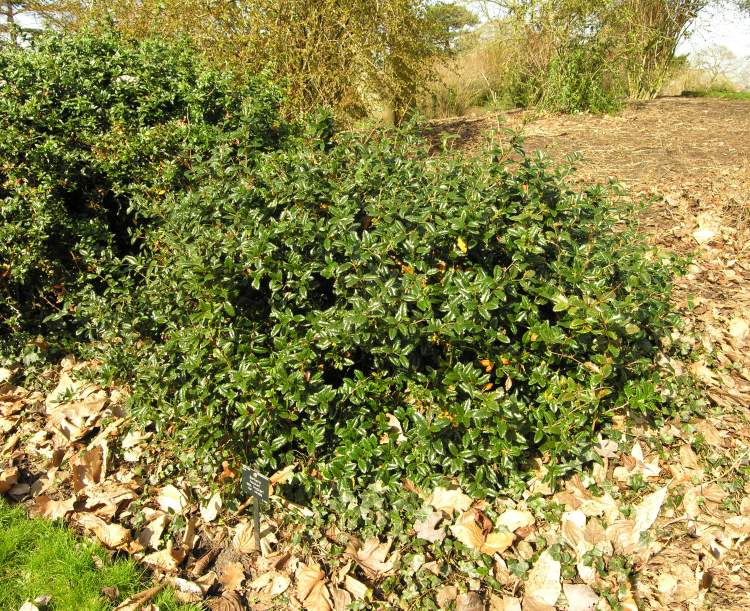
It is an evergreen shrub with densely arranged, vertically growing and slightly pendent branches. Reaches 2-3 m in height, in nature grows up to 70 cm. Crown spreading, broadly rounded. Shoots gray-brown, slightly grooved, branches yellow or gray-yellow, covered with stiff spines up to 3 cm long. The root system consists of a strong taproot and numerous thin roots.
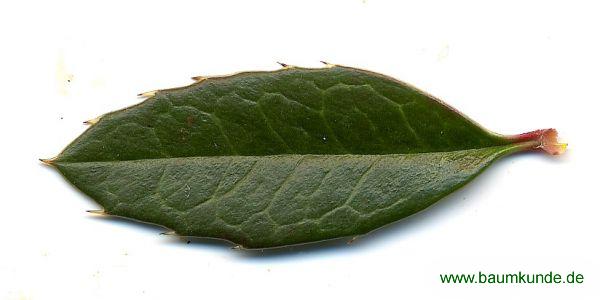
Leaves alternate, from elliptic to lanceolate, with 2 or 3 forward-pointing teeth on each leaf, glossy, green above, white-blue beneath, 4-8,5 cm long and 1-2.5 cm wide.
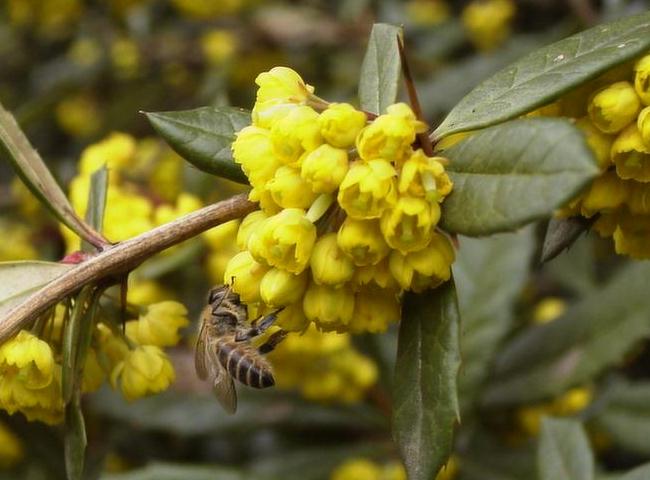
Flowers in May-June. Flowers numerous, greenish-yellow, 1.8 cm in diameter, borne in clusters of 2-6.
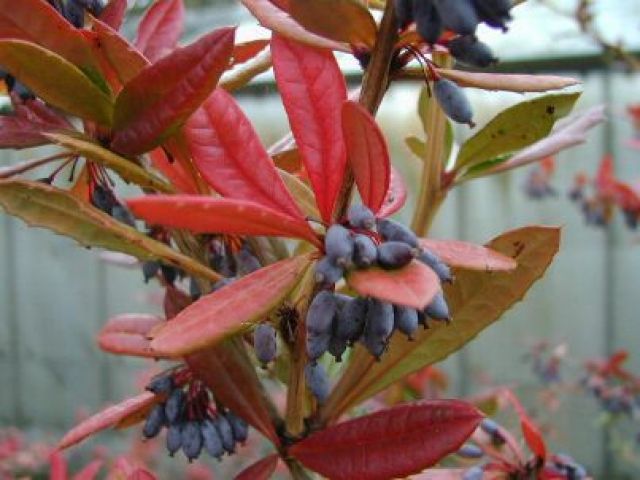
Fruits elongated, black-purple, shiny, edible, persist long on the branches. Ripen in September-October.
Forms: B. hookeri var.candidula C.K. Schneid., B. hookeri var. viridis C.K. Schneid., B. hookeri var. latifolia hort. (syn. Berberis manipurana).
Hybrids: hybrid with warty barberry var. viridis — the hybrid Berberis ×interposita
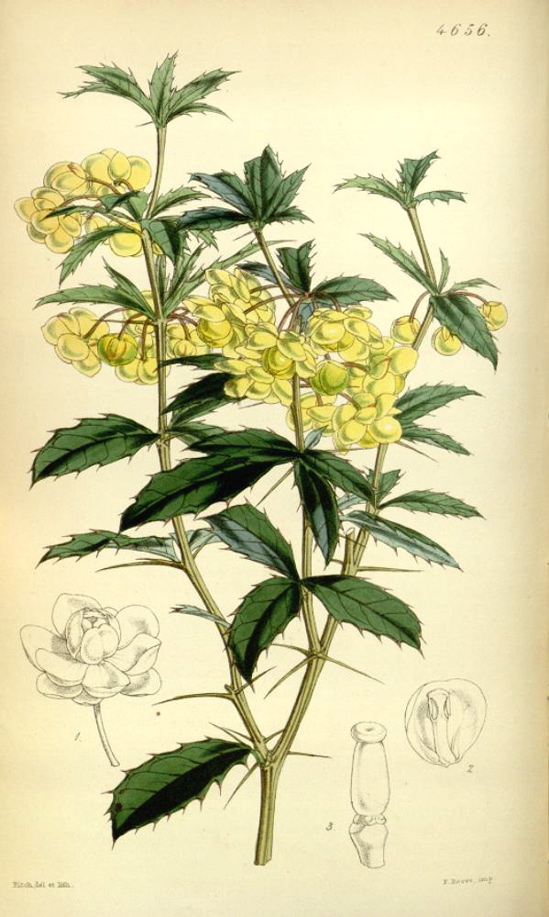
Berberis hookeri Lem. | BM t.4656/1852 | BHL
Hardiness zone: 4 (-29°C). In severe winters it may suffer frost damage.

Location: hardy, drought-tolerant. Undemanding. Grows well on dry and sandy soil. Prefers acidic or slightly alkaline soil. Does not tolerate waterlogging. Light-loving, but shade-tolerant. Tolerates urban conditions well, wind-resistant.
Planting: planting is best done in spring or autumn. If soil acidity is above pH 7, liming is recommended. Planting mix: peat, topsoil, humus, 400 g of slaked lime (if pH>7) and 200 g of wood ash. Size of planting hole: 40x40 cm. For solitary planting, the distance between plants should be 1.5-2 m. For creating a hedge, prepare a trench and place bushes at a rate of 2 plants per linear meter.
Care: care consists of shallow loosening of the root circles and mulching. Watering is recommended at least once a week with 2-3 buckets per plant. In spring, a year after planting, nitrogen fertilizers can be applied. Thereafter nitrogen feeding is carried out no sooner than every 3-4 years.
Pruning: tolerates trimming well.
Propagation: for spring sowing of seeds stratification at a temperature of 1 - 5°C for 3-4 months is required. Seeds can also be sown in autumn without stratification immediately after harvest or after removal of the pulp. Sowing depth 2-3 cm. Rooting of summer cuttings 80-90%. Seed viability 92%.
Diseases: bacterial canker, powdery mildew, Septoria leaf spot, infectious dieback of branches, Phyllosticta leaf spot, leaf spot. Not affected by rust.
Pests: barberry aphid, barberry sawfly, barberry fruit moth, leaf-chewing insects.
Uses: Used in landscape design in solitary plantings, in landscape compositions, and as a border plant. The fruits are used in cooking and medicine.