
Deciduous shrubs
Box-leaved Barberry 'Nana'
Berberis buxifolia 'Nana' Schneid
Box-leaved Barberry 'Nana' – an attractive shrub cultivar of the box-leaved barberry. Native to Argentina and the northern part of Chile.
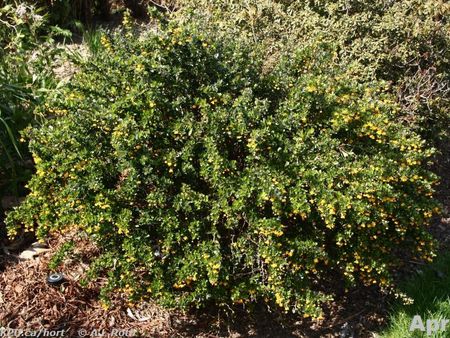
It is a small evergreen shrub with a spreading, broad, dense crown. It reaches 0.5 m in height and 0.8 m in width. It grows slowly.
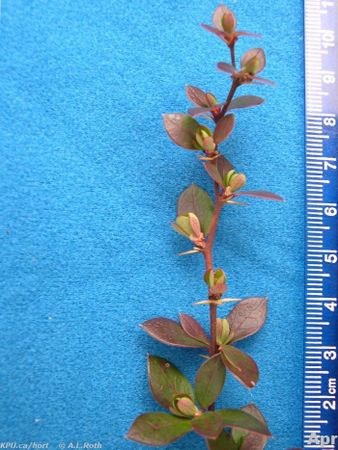
Shoots with small 3-parted spines or almost without them, reddish-brown.
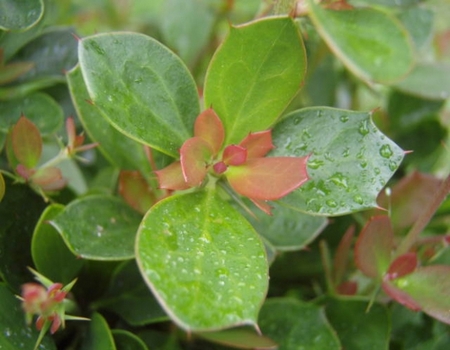
Leaves alternate, elliptical, 1-2 cm long, dark green with a red margin in summer, turning reddish tones in autumn, slightly leathery, with 1 or 3 spines at the tips.
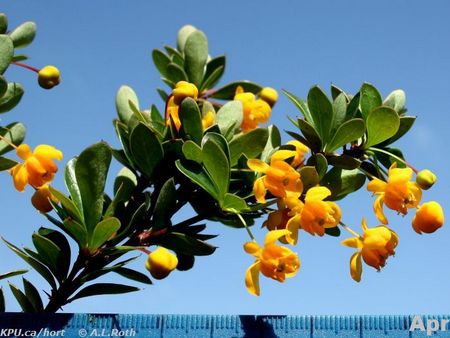
Flowers rarely. Flowering occurs in April-May. Flowers are small, yellow-orange, showing up effectively against the dark foliage.
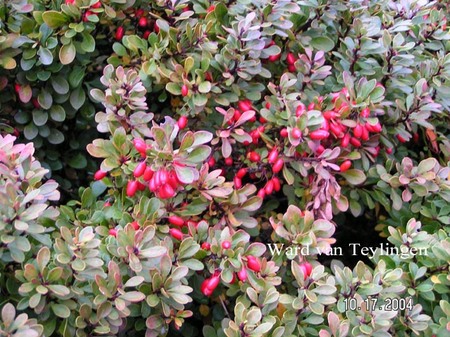
Fruits – elongated dark-red berries with a glaucous bloom, up to 8 mm long, edible, aromatic.
Hardiness zone: 5a (-29°C). In severe winters the non-woody parts of the shoots may freeze back. Young plants are recommended to be covered for the winter.

Position: winter-hardy, drought-tolerant. Not demanding to soil, can grow on poor soils. Grows well on dry and sandy soils. Prefers soil with neutral acidity, but can also grow on higher (more acidic) acidity. Does not tolerate waterlogging. Light-loving but shade-tolerant. Tolerates urban conditions well, wind-resistant.
Planting: planting is best done in spring or autumn. If pH is above 7, liming the soil is recommended. Planting mix: peat, topsoil, humus, 400 g slaked lime (if pH>7) and 200 g wood ash. Planting hole size: 40x40 cm. For single plantings, spacing between plants should be 1.5-2 m. To create a hedge, prepare a trench and place the bushes at a rate of 2 shrubs per 1 linear meter.
Care: care consists of shallow loosening of the soil around the trunk, and mulching. Watering is recommended at least once a week with 2-3 buckets per plant. In spring, one year after planting, nitrogen-containing fertilizers can be applied. Further nitrogen feeding should be carried out no earlier than every 3-4 years.
Pruning: tolerates trimming well.
Propagation: for spring sowing of seeds stratification is required at 1-5°C for 3-4 months. Seeds can also be sown in autumn without stratification immediately after collection or cleaned of pulp. Sowing depth 2-3 cm. Rooting rate of summer cuttings 80-90%. Seed viability 92%.
Diseases: bacterial canker, powdery mildew, septoria leaf spot, infectious dieback of branches, phyllosticta leaf spot, leaf spot. Not affected by rust.
Pests: barberry aphid, barberry sawfly, barberry fruit moth, leaf-eating insects.
Uses: a good nectar plant. In landscape design used in solitary plantings, in landscape compositions, and also as a border plant.