
Conifers
Winged yew
Baccata 'Nissens President'
Yew (Taxus) is a dioecious evergreen plant reaching heights of up to 15-20 m and belongs to the family Taxaceae. Such a coniferous tree grows very slowly and can reach an age of 1000-3000 years. It can grow as a medium-sized tree with an irregular crown or as a shrub with spreading branches. It occurs in Europe, North America and East Asia. As a wild plant, yew is often found in mountains (in the Alps), on plains, in coniferous and deciduous forests, and also as an ornamental plant in parks and gardens.
Yew has a high shoot-forming ability, which is very important for plantations. The tree forms suckers on stumps. The root system is well developed and plastic. Thanks to this, yew adapts to various conditions. The plant occurs on rocky, fresh and loose soils. It is of particular interest for shaped compositions, solitary and group plantings, hedges and green construction. For specimen planting in large parks the winged yew with a widely spreading, strong habit is well suited. It reaches 2 m in height and 5 m in width. Needles are dark green in color.
Size: length 2.5-3.5 m, width 1-2 m.
Description: a medium- or fast-growing climber, without pruning the majority of all leaves and flowers are located in the upper third of the plant.
Flowers / fruits: flowers are large, 10-15 cm in diameter, purple-pink with greenish-white stamens. Flowering - September.
Leaves: compound, pinnate, dark green.
Root system: superficial, sensitive to high temperatures, so the root collar should be kept in the shade.
Light requirements: sun, partial shade.
Hardiness: zone 5.
Growing conditions: soils fresh or moist, well drained; sensitive to late frosts. If necessary, heavy spring pruning is carried out, up to 30-50 cm.
European yew
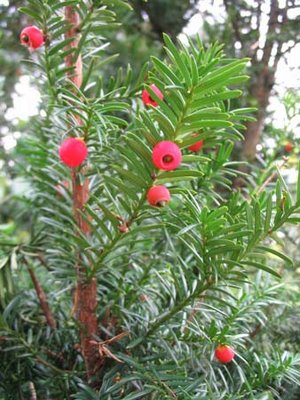
The European yew or berry-tree (Taxus baccata) is the most widespread species in the territory of Ukraine. It is a dioecious, shade-tolerant coniferous tree 10—22 m high. It grows slowly, but at the same time is long-lived. In the Ivano-Frankivsk region such yew naturally occurs on an area of about 200 ha. In the Caucasus the European yew is a dominant plant and covers an area of over 70 ha. In turn, the largest area of yew distribution is located in Eastern Georgia and occupies 700 ha.
In the conditions of Ukraine the European yew grows as a large shrub or tree. Its trunk is covered with reddish-brown or reddish-chestnut bark. In a young plant it is smooth, later it becomes cracked and peels off longitudinally. The crown of such yew is dense with dark-green foliage, of ovate or pyramidal shape. The seeds have a bright red fleshy aril, which makes them look like berries, hence the name - berry yew. The plant is very demanding of soil and air moisture.
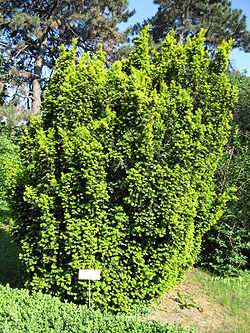
The "eternal" wood of the European yew is very valuable and durable. It is considered a strong bactericidal agent, as it kills harmful microorganisms. In addition, today the European yew is recognized as the best material for topiary art. From such yew very beautiful, decorative paths and borders are obtained, which are planted along lawns and terrace edges. Today the European yew is very popular in landscaping plots.