
Deciduous shrubs
Eared willow
Aurita L.
Synonyms: ear willow, Salix aurta
Eared willow (Salix aurita L.) – a species of deciduous shrubs of the genus Salix (willow) in the family Salicaceae. It grows in Northern Europe (Norway, Finland, Iceland, Sweden, the United Kingdom), Central Europe (Austria, Hungary, Belgium, Poland, Germany), Eastern Europe (Ukraine, Belarus, Latvia, Lithuania, Estonia), Southern Europe (France, Italy, Spain, Albania, the former Yugoslav countries, Bulgaria, Romania), and also in Russia (Western Siberia).
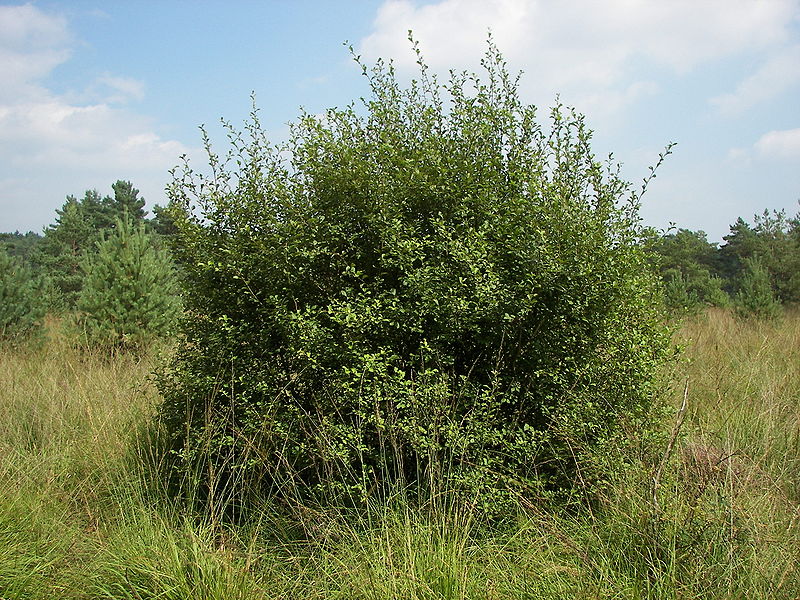
Grows in open woods, in wet shrub thickets, on the edges of bogs, in damp lowlands and hollows, along roadsides, on wet meadows, in ditches, and in moist clearings. Occurs in the understorey of light, wet or waterlogged black alder stands and pinewoods; prefers bilberry and long-moss (Sphagnum) sites.
It is a low, strongly branching shrub 2-3 m high. Crown broad, spreading. Branches glabrous, dark gray. Shoots thin, pubescent, later becoming glabrous, densely reddish-brown.
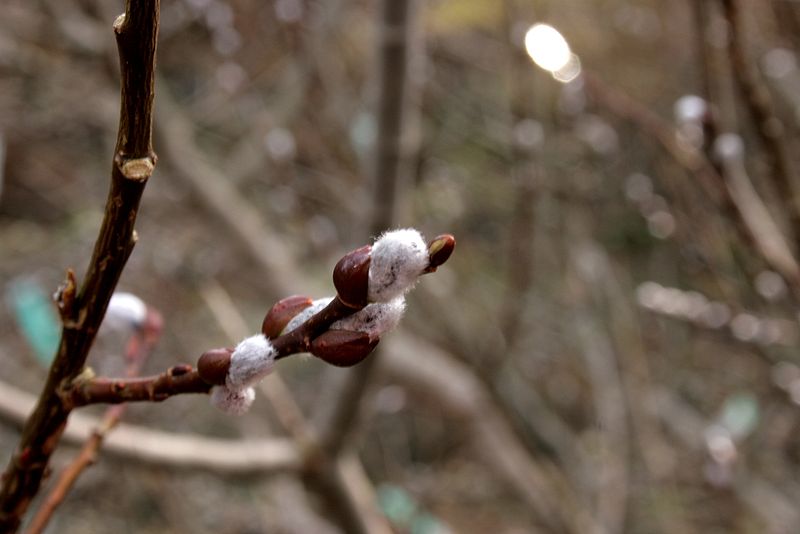
Buds ovate, small, glabrous, reddish. Stipules large, bud-shaped, persistent, finely serrate, bent back like little ears.
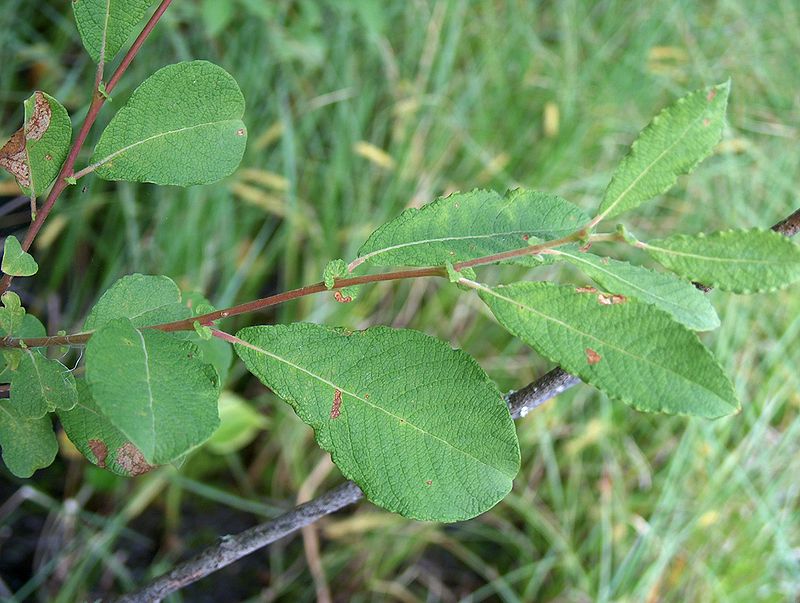
Leaves rounded, obovate or rhombic, 0.8-4 cm long and 0.5-3 cm wide, the greatest width located slightly above the middle of the leaf. The blade apex folded, base cuneate, margins undulate or coarsely finely serrate. Above the leaf is dull green, wrinkled; beneath it is covered with a grayish dense pubescence and a clearly visible network of veins.
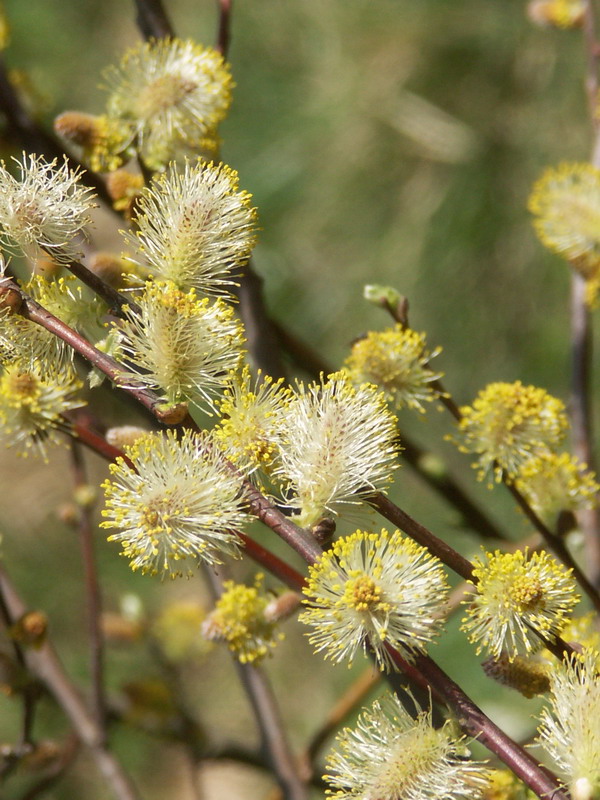 |
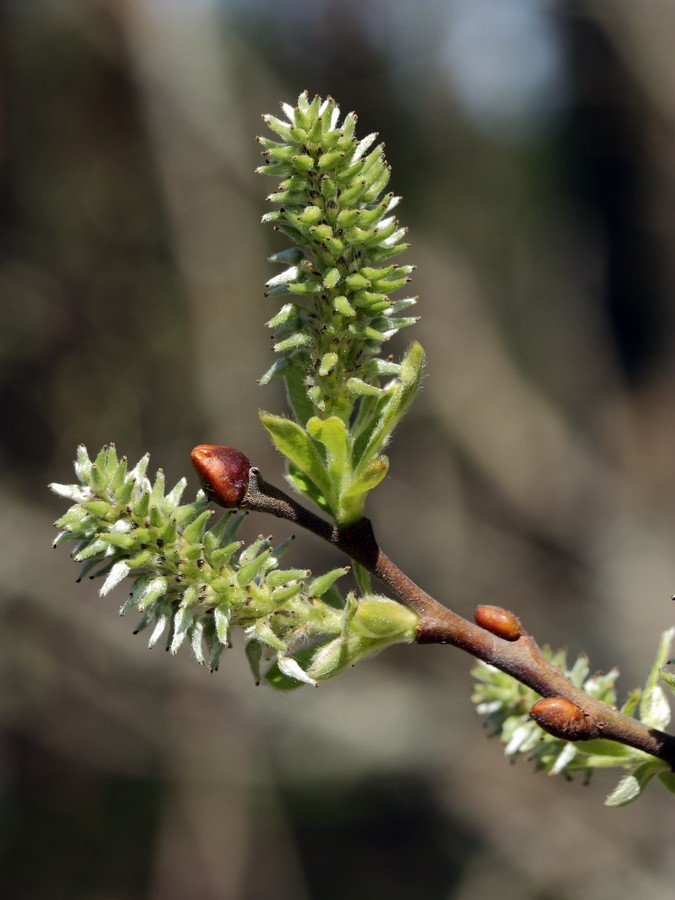 |
| Male catkins | Female catkins |
Catkins open before the leaves or simultaneously with them, in late April-May. Male catkins are shortly ovoid, sessile, 1-2 cm long. Female catkins reach 2.5-3 cm in length, borne on a short stalk with small leaves. Calyces hairy, ligulate, unicolorous, light-brown, with a darker apex. Stamens 2, pubescent at the base, free. Nectar gland 1. Anthers yellow. Ovary ovoid-subulate, bluntish, silky-hairy, borne on a long stalk. Bracts brown or with a black tip, shortly hairy.
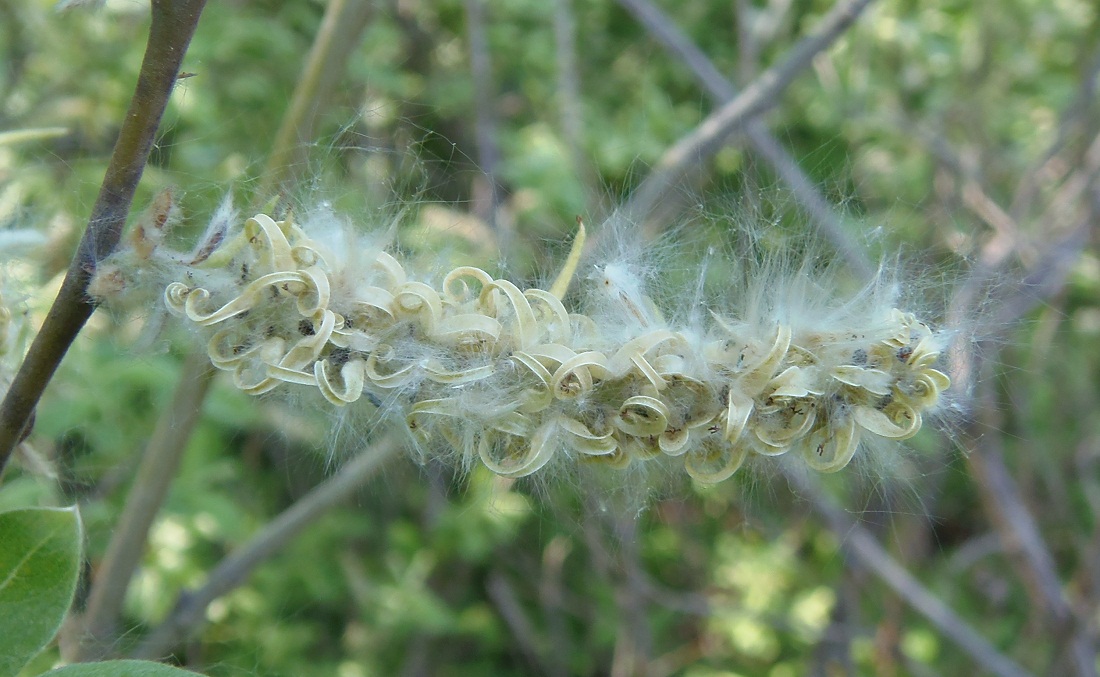
Fruits – dry capsules of a white-brown-green color, on a stalk up to 2 mm long.
Hybrids:
- with Salix caprea L. – Salix × capreola Kern. ex Andersson
- with Salix cinerea L. – Salix × multinervis Doell
- with Salix myrsinifolia Salisb. – Salix × coriacea Schleich. ex J. Forbes
- with Salix phylicifolia L. – Salix × ludificans F.B. White
- with Salix starkeana Willd. – Salix × livescens Döll
- with Salix triandra L. – Salix × krausei Anderss.
Hardiness zone: 4b (-29°C)

Location: light-loving but shade-tolerant, moisture-loving, easily tolerates waterlogging and temporary flooding, can grow on waterlogged soils. Undemanding and very hardy. Does not tolerate urban conditions and river floodplains.
Soil: does not like calcareous soils. Prefers acidic, poor podzolic or sandy soils.
Planting: Planting is best carried out in spring before bud burst. When establishing «willow stands» (stands of willow) it is recommended to cultivate the soil in autumn to a depth of 30-80 cm, depending on its fertility and dryness. The topsoil layer should be turned downwards. The recommended spacing between seedlings should be at least 0.6-2 m, depending on the species. Planting depth – 40-70 cm. Transplanting is recommended up to 3-4 years. On heavy soils, drainage of rubble or sand 20-30 cm thick is recommended.
Pruning: tolerates cutting and pruning well. Regular removal of dead shoots and shaping of the trunk and crown is recommended. For creating hedges, annual coppicing to the stump is necessary.
Care: practically requires no care.
Propagation: by cuttings and seeds. Seeds lose viability after 10 days. Winter cuttings almost do not root; green cuttings treated with Kornevin root at 100%. Can also be propagated by grafting onto other Salix species.
Pests: Cecidomya saliciperda, Cecidomya salicis, Tortrix (Helias) Chlorana, Agrotis vallugera, Bombyx Salicis, Curculio crux, Phratora vulgarissima, Phratora vitellinae, Galer ucacapreae, Galer lincola, Arvicola terrestris.
Diseases: affected by fungal diseases – fungi of the genera Melampsora, Rhytisma, Erysiphe.
Usage: used for plantings around marshy areas. A good honey plant. Provides good material for weaving. Wood is very soft, not used as fuel. Not used in cultivation. The bark contains a large amount of tannins.