
Deciduous shrubs
Black chokeberry
Aronia melanocarpa Michx
Synonyms: black-fruited rowan, Mespilus arbutifolia var. melanocarpa Michx., Adenorachis melanocarpa (Michx.) Nieuwl, Photinia melanocarpa (Michx.) K.R.Robertson & J.B.Phipps, Pyrus arbutifolia var. melanocarpa (Michx.) Hook., Pyrus melanocarpa (Michx.) Willd, Sorbus melanocarpa (Michx.) Heyhn., Adenorachis nigra (Michx.) Nieuwl., Aronia arbutifolia var. melanocarpa (Willd.) Torr., Aronia arbutifolia var. nigra (Willd.) F.Seym., Aronia grandifolia Sweet, Aronia melanocarpa Britton in Britton & Brown, Aronia melanocarpa Spach, Aronia nigra (Willd.) Britton, Aronia nigra (Willd.) Koehne, Aronia nigra var. grandifolia (Sweet) Dippel, Hahnia arbutifolia var. nigra Medik., Pyrus arbutifolia var. nigra Willd, Pyrus nigra (Willd.) Sarg., Pyrus pensylvanica Lindl.
Black chokeberry (Aronia melanocarpa (Michx.) Elliott) – a species of the genus Aronia (Aronia) in the family Rosaceae (Rosaceae). The first scientific description was published in Sketch Bot. S. Carolina 1: 556 in 1821 by the American botanist Stephen Elliott. In cultivation since 1700. The name is translated from Greek as «black fruit» and «benefit».
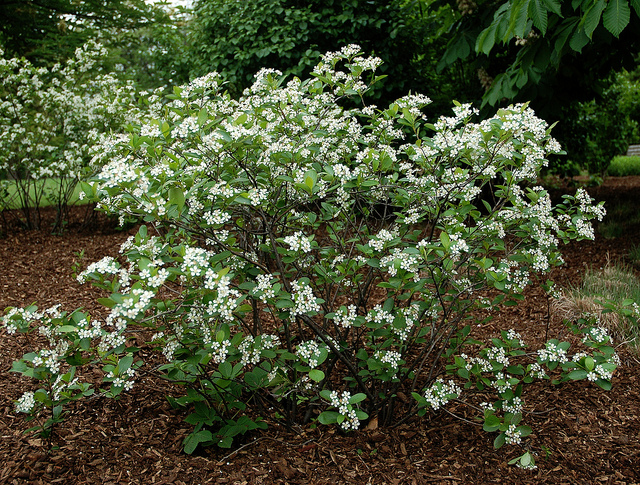
In the wild it is found in the eastern part of North America. It grows in swamps, in wet thickets, on the banks of ponds and lakes, and in moist forests. It rises into mountains up to 0-2000 m above sea level.
Автор В.Куделя
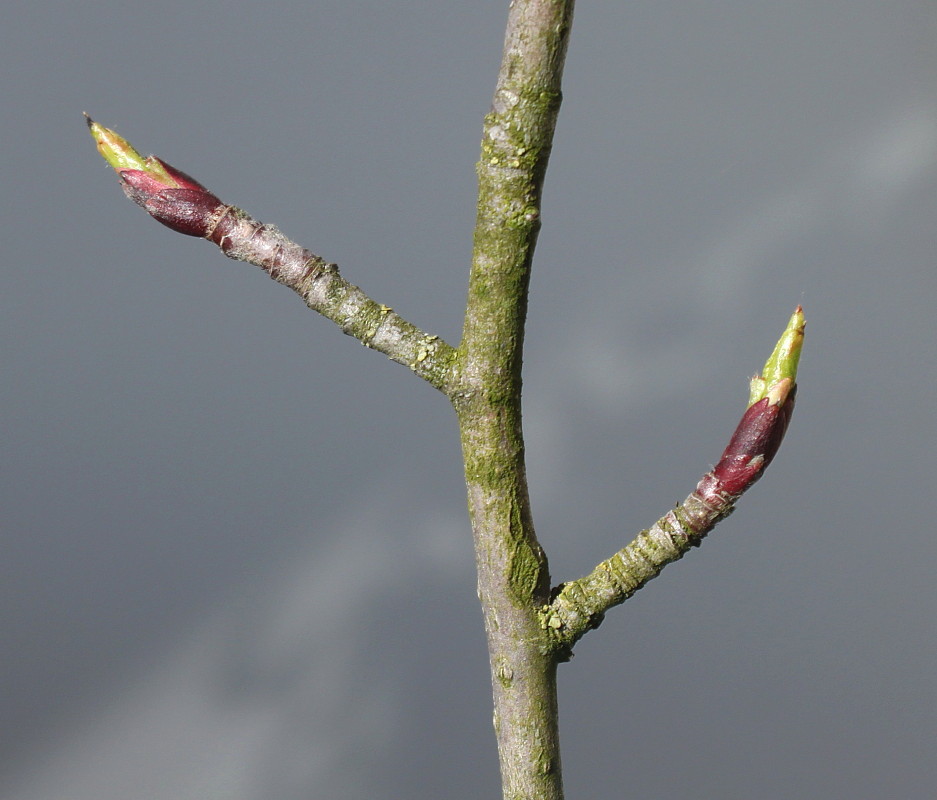
It is a deciduous shrub up to 1 (2.5-3) m in height. The crown is dense, heavily branched, initially compact, later becoming spreading, reaching 1.5-2 m in width. It forms numerous root suckers. Shoots numerous, reddish-brown, almost glabrous, later becoming dark gray.
Автор В.Куделя
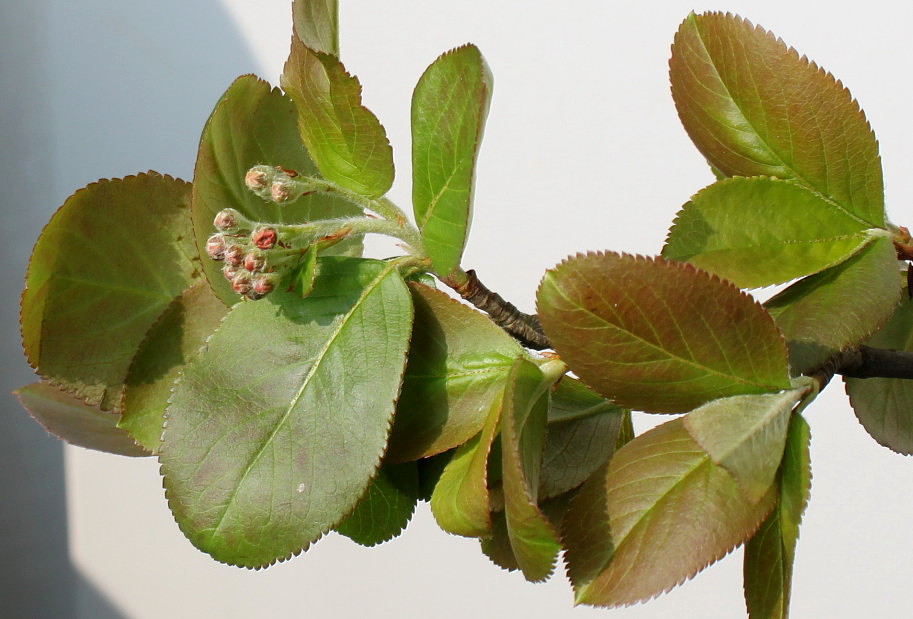
Leaves 3-6 cm long, from elliptical to oblong-lanceolate, acute or shortly acuminate, apex drawn into a short point, with a rounded or cuneate base, margin finely crenate-serrate, coriaceous, when unfolding reddish-brown, above dark green, glossy, glabrous, below slightly pubescent, lighter, in autumn turning brownish-red.
Автор В.Куделя
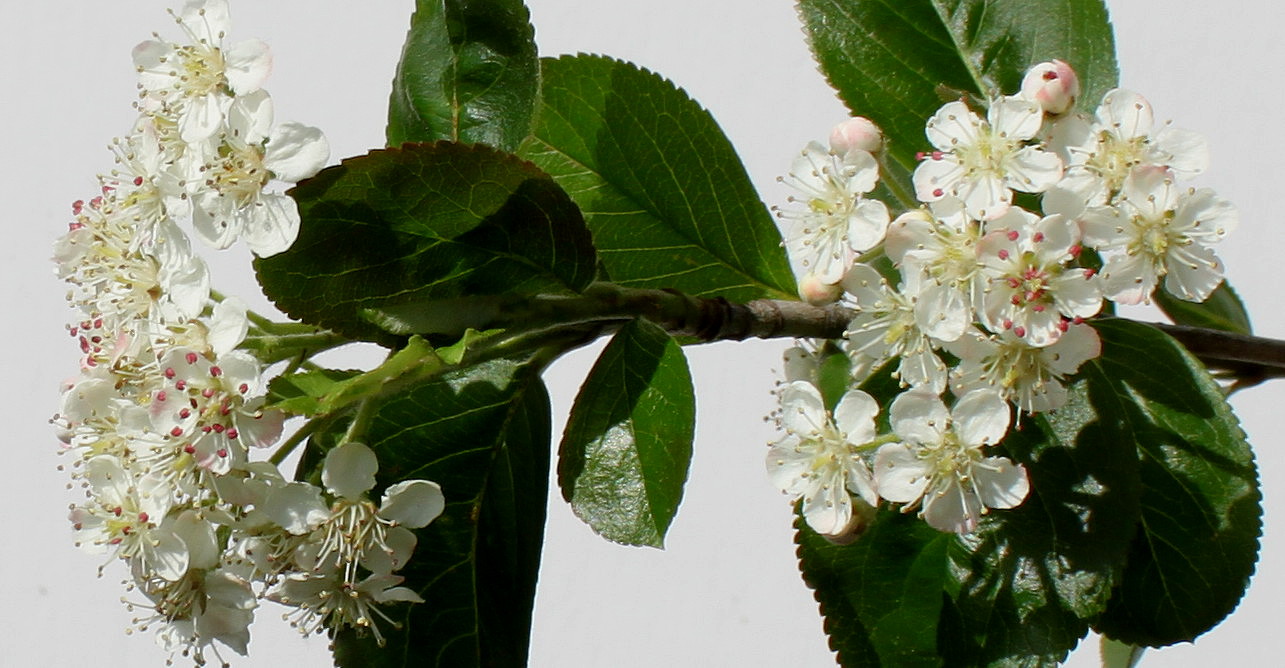
Flowers white or slightly pinkish, bisexual, up to 1.2 cm in diameter, grouped 12-20 per corymbiform glabrous inflorescences up to 5 cm in diameter. Perianth double; petals free, 5 in number; stamens 18-20; anthers purple, rising above the stigmas. Pollen light yellow. Blooms in the second half of May until early June, flowering lasts depending on the weather 12-16 days.
Автор В.Куделя
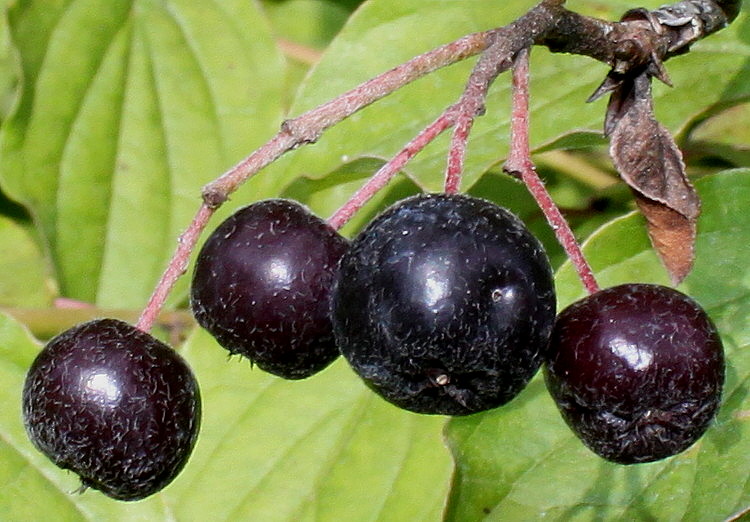
Fruits spherical, less often depressed-globose, glossy, black or black-purple in color, with a glaucous bloom, reaching 6-8 cm in diameter, edible, tart-sweet with an astringent tang. Weight of one fruit 0.6—1.5 grams. Fruits ripen in August – September. Begins bearing fruit in the 3rd-4th year after planting.
Cultivars: Aronia × prunifolia 'Viking' ( Purple chokeberry 'Viking', Aronia melanocarpa 'Viking', Black chokeberry 'Viking')
Varieties:
- var.grandifolia – large-leaved black chokeberry (Aronia Michurina)
- f. subpubescens - semi-pubescent
- f. elata - resilient
Hybrids:
- A. × prunifolia – × Sorbaronia dippelii - × Sorbaronia fallax - × Sorbaronia jackii - × Sorbaronia sorbifolia
Hardiness zone: 3b (-34°C)

Location/exposure: light-loving. Does not like waterlogged, saline or stony soil. Grows well on fertile and moist sandy loams and loams, tolerates strongly acidic soil. On light sandy soils and elevated dry sites fruits become small and dry. Can grow on slopes, except the south-facing; grows well on north-facing slopes.
Planting: tolerates transplanting well. Best planted in autumn.
Care: in dry periods requires additional watering - 1 bucket per 1 sq.m of crown projection. In early spring and summer plants should be fed with a nitrogen-containing fertilizer (per 1 bucket of water: 1 kg cow manure, 10 g urea, 20 g ammonium nitrate/). In autumn fertilize with nitroammophoska (http://www.shop.vashsad.ua/catalog/universal-fertilizer/item/11509/) or Kemira Universal.
Pruning: requires regular pruning. To avoid crown thickening, leave only 10-12 strong shoots. Branches older than 7 years should be removed, as fruits on them are of poorer quality. For rejuvenation prune the bush at ground level, which leads to abundant emergence of young shoots. Rejuvenation pruning is started at 10-11 years, every 4-5 years.
Diseases and pests: practically not affected. Among pests – raspberry beetle, scale insects, May beetle (cockchafer).
Propagation: by seeds, layering, grafting and cuttings. Seeds are sown in late September-early October. Seed sowing depth depending on soil should be 1—1.5 cm. Seedlings appear in May. For spring sowing stratification for 3-4 months at 3-5 °C is required. For cuttings use green cuttings, hardwood cuttings, horizontal and vertical layering, root and stem suckers, division of the bush, grafting onto common rowan, hawthorn, pear. Gardeners most often use propagation by root suckers.
Uses: for hedges, solitary and group plantings. Fruits are consumed as food and used in medicine.