
Conifers
Fir
Abies Mill.
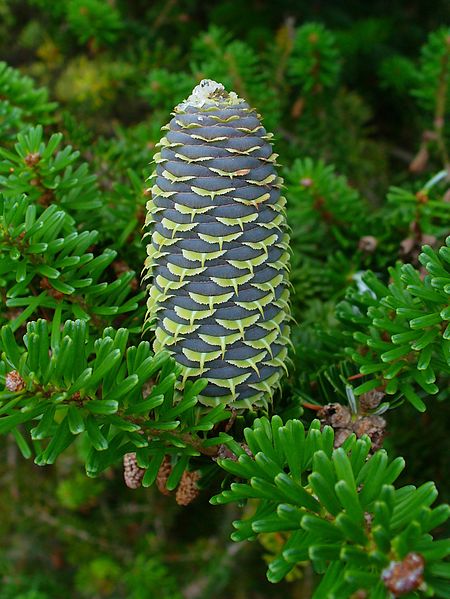
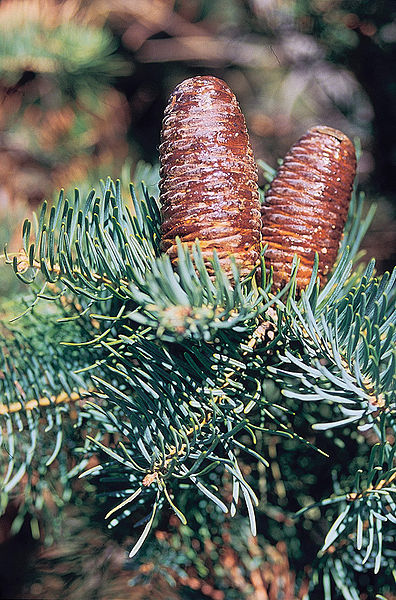
Fir (lat. Ábies) — a genus of gymnosperm plants of the Pine family (Pinaceae). A characteristic feature of firs — their cones, unlike those of other conifers, grow upwards. The genus comprises about 50 species. It is distributed in temperate regions of the Northern Hemisphere. The regions richest in species are western North America (Pacific coast) and East Asia (especially Japan).
Most likely the name derives from the Indo-Germanic 'abh' - to abound, which can be associated both with abundant branching and with the very dense arrangement of foliage. According to Fasmer's etymological dictionary, the Russian name of the genus comes from the German 'Fichte' — "spruce".
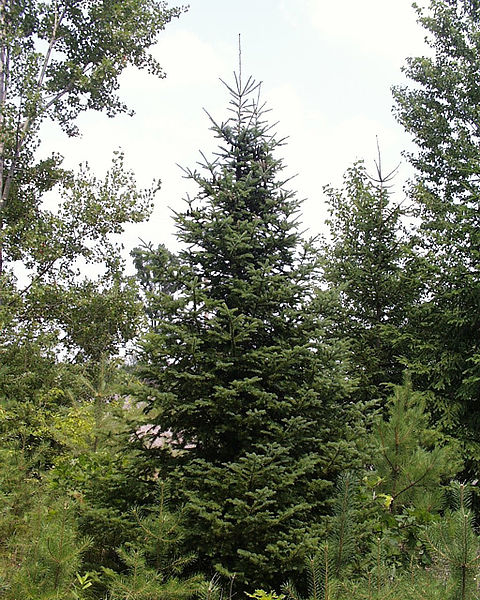
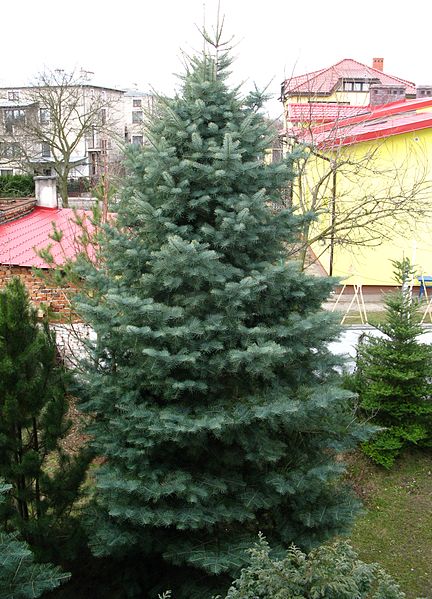
Large monoecious, evergreen trees with a handsome conical crown beginning at the base of the trunk, covered with gray bark, in some species remaining thin and smooth until old age, in others becoming thick and deeply fissured. The root system is powerful, a taproot, penetrating deeply into the soil. Buds are resinous or non-resinous. Needles of two types: on vegetative shoots — with a rounded or slightly notched apex; on reproductive shoots — usually with an acute apex. Needles in most species are solitary, arranged spirally.
Cones are sessile, cylindrical, ovoid or ovoid-cylindrical, maturing in the first year and disintegrating in autumn or winter, releasing the seeds. The cone axes remain on the branches for a long time. Seeds are obovoid-cuneate or triangular-cuneate, with resin cavities, difficult to separate from the wing that cup-like surrounds the seed; the wing is rectangular or fan-shaped.

Location: shade-tolerant, but develop better in full light, requiring partial shade in the first years of life. Wind-resistant. Very demanding of high air humidity. Sensitive to air pollution by smoke and gases.
Soil: prefer fertile, moist and well-drained soils.
Planting: in avenue plantings the distance between plants is 4 - 5 m, in loose groups 3 - 3.5 m, in dense plantings up to 2.5 m. Planting time: spring - April, autumn - late August - September. Seedlings establish better at an age from 5 to ]0 years.
Care: 2-3 years after planting it is desirable to apply "Kemira Universal" 150 g/m2 in spring. Watering of balsam fir, as a moisture-loving species, is 2 - 3 times per season at a rate of 15 - 20 L per tree; in dry summer periods overhead watering (spraying) is recommended once every 2 weeks.
Firs do not tolerate excessive waterlogging of the soil. Loosening and mulching are mandatory in young plantings to a depth of 25 - 30 cm, simultaneously with weed removal. Mulch with sawdust, wood chips or peat in a layer of 5 - 8 cm near the root collars of young plants. Remove dry branches in spring. Crown shaping, only if necessary, is carried out in early spring before sap flow. Cultivars of subalpine fir in youth can be formed by cutting shoots damaged by late spring frosts at the end of May, giving the plant a more compact form. Many firs and their ornamental forms grown in Europe and the temperate zone of Russia are hardy and are not damaged in severe winters. However, young plants in the first year after planting are better covered with spruce boughs to protect them from late spring frosts (the one-colored fir, whose needles turn red). With age, the winter hardiness of firs, as with other conifers, increases and the need to cover root circles with dry leaves or peat disappears.
Propagation: by seeds, which are harvested at the beginning of cone maturation. Sowing is done in autumn, or in spring after 30-40 days of stratification or snow storage. Seeds under ordinary conditions are stored up to one year. One-year cuttings with an apical bud can also be used for propagation. Cuttings form roots only after 8—9 months. The crown forms naturally. During the first decade they grow slowly, then growth accelerates and continues into great old age. When branches come into contact with the ground they root and produce layers.
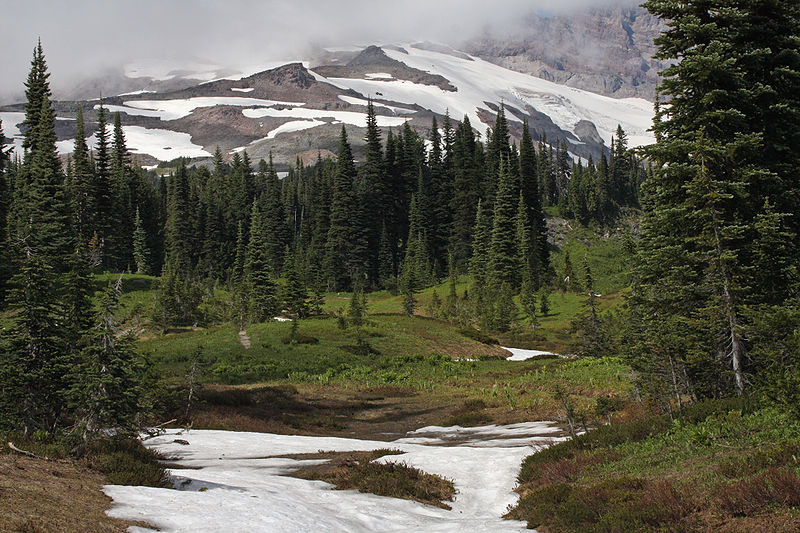
Subalpine fir forest
Uses: the tall, mostly narrow, sharply defined conical crown and the dark, glossy green of the foliage with white bands of stomata on the underside of the needles give firs a stately and lush appearance. These qualities are further emphasized by the ability of firs to retain lower branches for a long time. They have long been used in landscape and park design. However, in the city, except for some species, firs suffer from air pollution. They look splendid in group and avenue plantings in combination with white-barked birches, maples, velvet and various shrubs. Good for creating living walls without pruning. Because their needles persist for a long time, fir branches are widely used in floristry. However, as winter shelter for other plants they are not suitable, because in spring so much foliage remains on the branches that neither light nor air reaches the plants through it.